Tag: reauthorization
The good, the bad, and the ugly: early signals for reauthorization

The debate over the surface transportation reauthorization bill is already underway, and early proposals show just how much is at stake for the future of our transportation system.
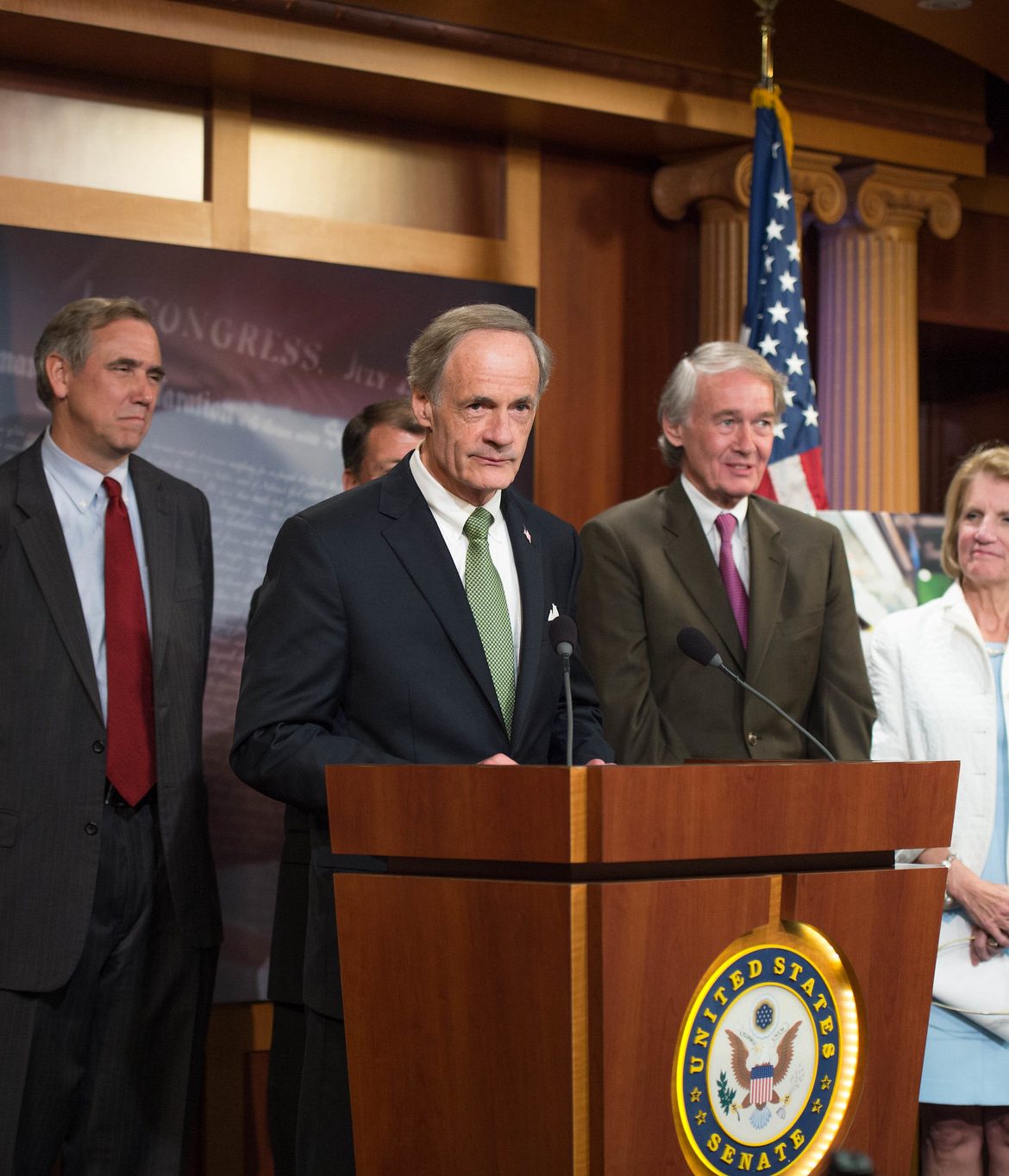
As Congress gears up for surface transportation reauthorization, a slew of marker bills has emerged. These standalone proposals signal priorities, test ideas, and lay the groundwork for the final package. While they rarely pass on their own, these bills play an outsized role in shaping the debate. Taken together, they offer an early look at whether federal transportation policy is moving toward building a more accountable, multimodal system or doubling down on outdated approaches.
So far, the picture is mixed. Here’s a look at three recent proposals that together capture the good, the bad, and the ugly of where things might be headed.
The good: measuring what matters in transportation
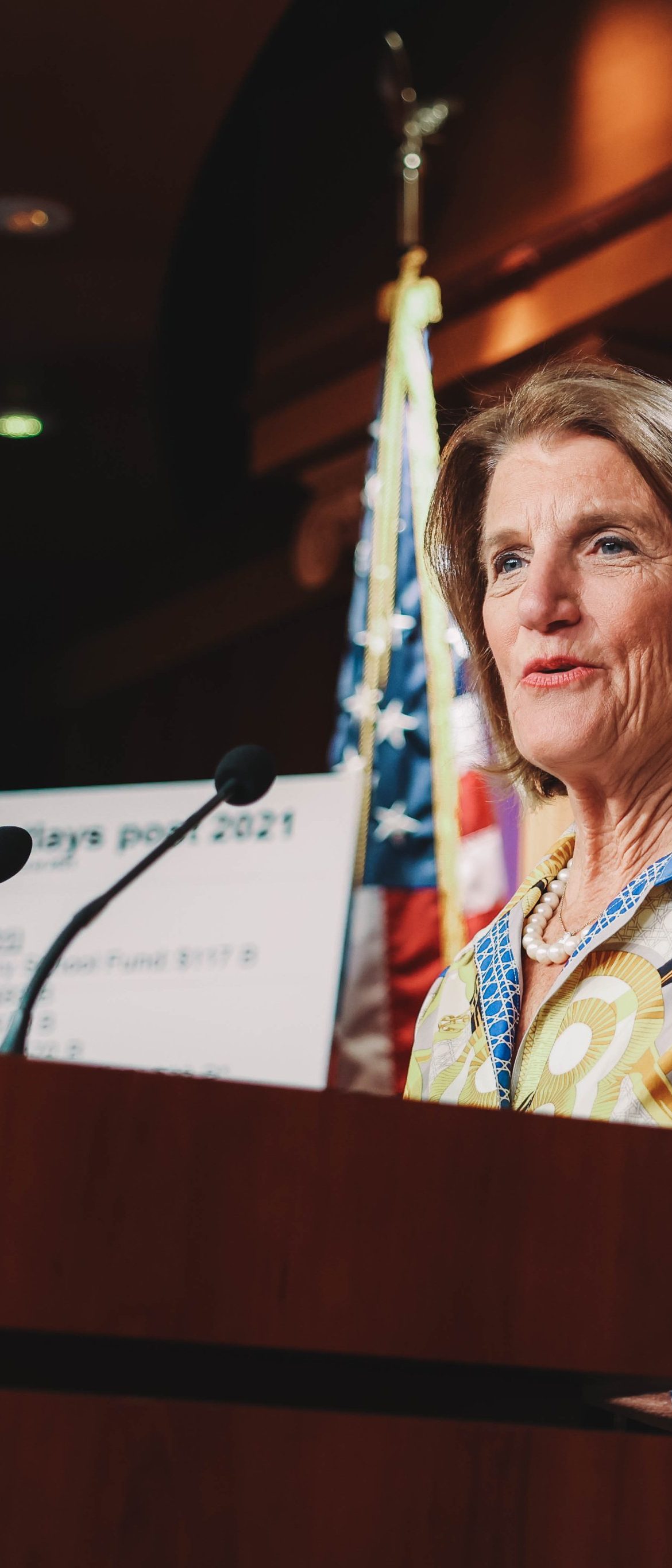
The Generating Resilient, Environmentally Exceptional National (GREEN) Streets Act, introduced by Sen. Ed Markey (D-MA), and its companion legislation introduced by Rep. Jared Huffman (D-CA), would meaningfully shift how we approach transportation and climate policy. The bill would establish clear goals for reducing greenhouse gas emissions across our transportation system at a time when transportation remains the largest source of emissions in the U.S.
For decades, federal transportation policy has prioritized expanding highway networks, based on the assumption that most trips will be made by car. The result is a system that encourages more driving, leading to increased congestion, higher emissions, and greater burdens on communities already facing public health challenges and an affordability crisis.
The GREEN Streets Act would begin to address this by directing the U.S. Department of Transportation to set minimum standards for states to reduce emissions, vehicle miles traveled, and air pollution on public roads. By focusing on outcomes rather than infrastructure expansion, the bill would help reorient transportation policy toward improving access and affordability.
The bad: punitive EV fees that won’t fix the Highway Trust Fund
There’s no question that the Highway Trust Fund faces a real fiscal challenge, but not every proposed solution actually addresses this.
One idea that has been circulating for years and is now gaining renewed traction is putting federal fees on electric vehicles (EVs). House Transportation and Infrastructure Chair Sam Graves (R-MO) has made clear that EV fees are very much in play in the upcoming surface transportation reauthorization. He signaled that if they don’t make it into a Senate package, he will pursue them through other legislative options, including in the House’s draft of the 2025 budget reconciliation bill.
It makes sense that EV drivers should contribute to transportation investments, especially as their share of the vehicle fleet grows, but this proposal misses the mark entirely. For starters, the proposed fees are wildly disproportionate. In 2019, the average gas-powered vehicle paid roughly $95 in federal gas taxes each year. A $250 annual fee on EVs would be more than double that amount, despite EVs currently making up a relatively small share of vehicles on the road. Finally, Chairman Graves’ proposal does not direct those funds into the Mass Transit Account of the Highway Trust Fund. Other marker bills—like one from Sen. Fischer and Rep. Dusty Johnson that would impose a one-time $1,000 fee on all EVs—are even more extreme.
Many states already have their own EV registration fees, often at similarly inflated levels. Piling on a federal fee risks creating a punitive system that discourages EV adoption without improving the Highway Trust Fund’s long-term outlook.
You can’t solve a structural funding problem on the backs of a growing but small minority of drivers. Aggressive EV fees won’t change the underlying math of rising highway construction costs and declining gas tax revenues. A sustainable solution will require a broader rethink of how we fund transportation, not a band-aid solution that’s unfair and ultimately ineffective.
The ugly: more“flexibility” that undermines accountability
The Highway Funding Transferability Improvement Act, introduced by Sens. Kevin Cramer (R-ND) and Angela Alsobrooks (D-MD), and its companion bill introduced by Rep. Harriet Hageman (R-WY) would increase how much flexibility states have to transfer federal highway funds to other highway programs from 50 percent up to 75 percent. Supporters of the bill frame this change as allowing more local control and streamlining transfers between programs, but in reality, it risks weakening one of the few tools Congress has to ensure federal dollars are spent as intended.
States already have significant flexibility under current law, including the ability to transfer unlimited funds to transit programs, as long as the projects are eligible under both funding categories. If states aren’t investing in transit, safety, or emissions-reducing projects today, it’s not because they lack flexibility. It’s because the state isn’t interested in those investments.
This proposal would allow states to shift further funding away from programs that specifically address safety, air quality, and multimodal transportation. In practice, it could shrink already limited investments in these projects to an even smaller fraction than Congress intended.
We’ve seen how this plays out. Flexibility can be valuable, but not when it comes at the expense of accountability. Expanding that authority risks opening the floodgates, particularly in places with poor safety records or ongoing air quality challenges.
What does this mean for surface transportation reauthorization?
Marker bills are initial ideas that can be incorporated into a surface transportation reauthorization package that allocates how hundreds of billions of dollars are spent. It will shape whether we double down on outdated, car-centric policies or move toward a system that prioritizes repair, safety, and multimodal investment.
The good news is that there are thoughtful ideas on the table, but the challenge is that there are just as many that would move us backward. When the draft of the surface transportation reauthorization bill is released, T4America will examine proposals and grade them against our core principles, which have broad support from voters across the political spectrum. Bills that fall short of these very attainable goals will be rated accordingly, while those that meet the mark will earn our ringing endorsement.
Here’s how we will grade the next surface reauthorization bill

With the IIJA expiring in September, a draft version of the next surface transportation reauthorization will eventually be released. As with previous bills, T4America plans to release a public scorecard on how well Congress’s proposal would steer the federal program toward achieving its stated goals. Here’s what we are looking for.
Transportation for America is ready to grade the next surface transportation reauthorization, and our rubric is incredibly simple.
The federal government has spent $1.5 trillion over the past 30 years to achieve its stated goals of improving safety, fixing infrastructure, reducing congestion and emissions, and improving public health. The reality is that despite the massive amount of money poured into the system, we don’t have much to show for it. The success of the next transportation bill should not be measured by how much or how little money we put into the program, but by how well it holds the system accountable for achieving our national goals and being responsible to the American taxpayer.
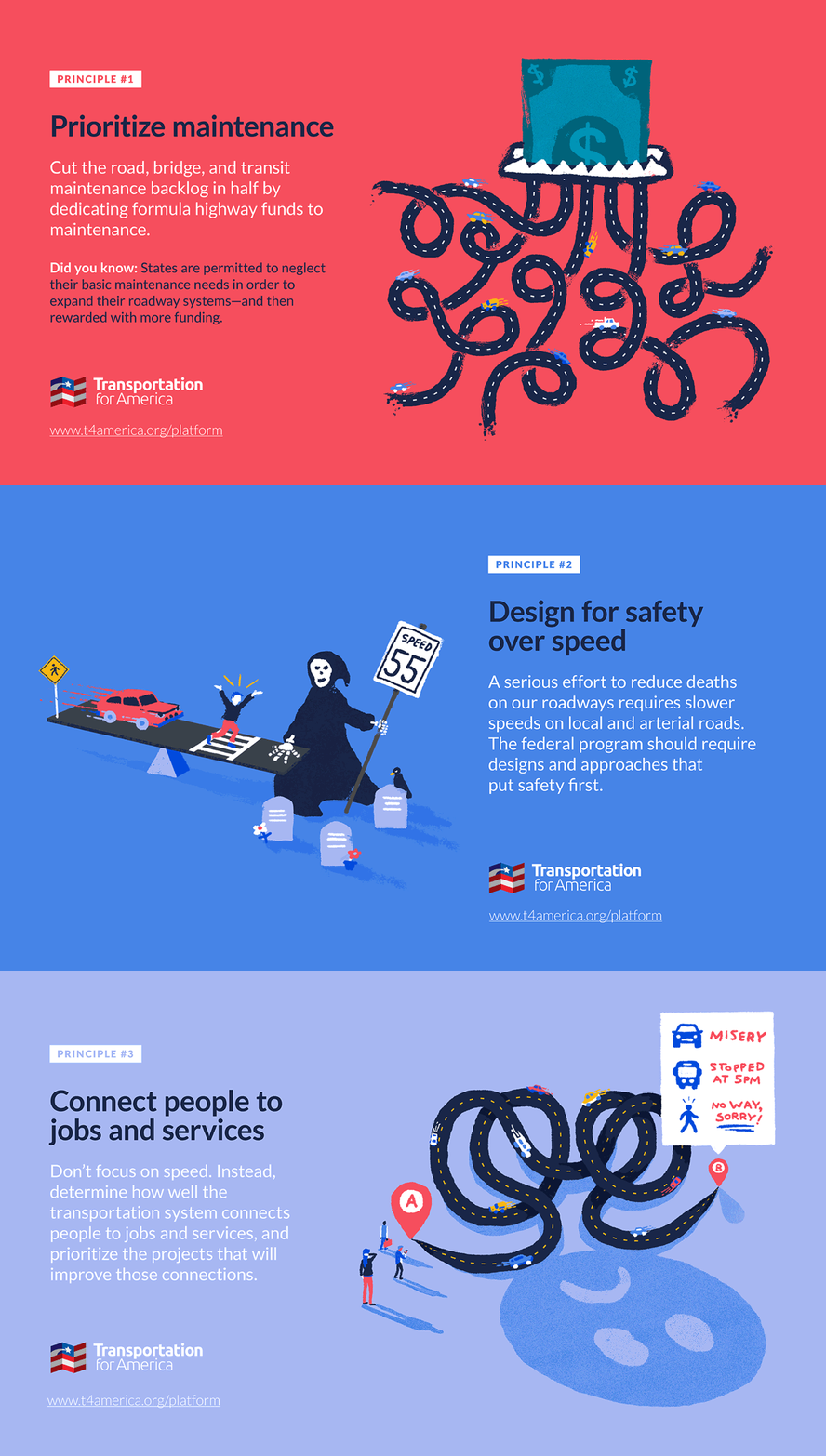
Similar to our past scorecards, T4America will be grading legislative text on a pass/fail basis against our three core principles. In line with these principles, T4America will be looking for how the text prioritizes 1) safer roads over speed, 2) the maintenance of existing infrastructure, and 3) investing in more transportation options.
Safety over speed
The roads in most developed countries are safer than ours and continue to improve, but Congress continues to prioritize vehicle speed above all else, including safety. Safety needs to come first.
What we’ll be looking for: States and MPOs should be required to set concrete targets to improve roadway safety and reduce roadway deaths and to report progress on safety goals. When states fail to meet those safety targets, their flexible funding under the National Highway Performance Program and the Surface Transportation Block Grant Program should be dedicated to projects that are proven to move the needle on safety. Localities also need evidence-based guidance for roadway designs, and the federal government needs to overhaul its own road safety guidance and provide localities the freedom to experiment. Read T4America’s policy recommendations for prioritizing safety over speed in surface transportation reauthorization.
An emerging consideration: As the autonomous vehicle (AV) market continues to expand, it is vital to ensure that the rapid growth of this industry does not come at the expense of safety. The next law must promote transparency, make AV data public, and require reporting of collisions, malfunctions, and other anomalies. Local oversight also needs to be preserved, and localities should be able to determine how autonomous vehicles are deployed and operated on their streets. Finally, left unchecked, empty AVs could clog our roads while waiting for passengers. USDOT should establish a pricing mechanism that disincentivizes AV operators from allowing their vehicles to operate without passengers, preventing roads from being filled with empty cars. Read T4America’s other policy recommendations on ensuring AVs meet their potential.
Fix it first
Prioritizing roadway expansion and leaving maintenance as an afterthought, with no long-term plan for decades of maintenance costs, is nonsensical. We can’t afford to keep expanding the size and scope of the system without a clear plan to maintain what we’ve already built. Our last Repair Priorities report showed that we’d need $231.4 billion per year just to keep our existing road network in acceptable condition. Every new road, lane-mile, or bridge adds a costly new financial obligation for decades to come, pushing that number even higher. We need to be accountable to taxpayers and cannot continue to defer maintenance. Federal funding should prioritize fixing what we have before building anything new.
What we’ll be looking for: Legislative language must center accountability to ensure that maintenance is not on the back burner. If federal funds are given to grantees to increase roadway capacity, recipients should first demonstrate that they can maintain that asset over the course of its entire lifetime. Grants should not be distributed to agencies that cannot maintain the capacity they claim to need. States and MPOs should be required to set clear, measurable targets for improving pavement conditions, and when they fail to meet those targets, USDOT should step in and reorient National Highway Performance Program and Surface Transportation Block Grant funds toward repair. See the rest of T4Americas’s policy recommendations to prioritize existing maintenance needs.
Fixing roads should also include reconnecting communities and addressing the harms of previous infrastructure decisions. Projects built in the 1950s (and continuing through today) destroyed local economies and undermined the health and connectivity of people living near highways. Language that expands programs like the Reconnecting Communities Program (RCP), a competitive grant that funds the redesign and deconstruction of outdated infrastructure, must be included in the text (we’ll be looking out for the REPAIR Infrastructure Act, which continues the Reconnecting Communities Pilot Program). Opportunities like RCP offered communities the chance to improve access to daily needs such as jobs, schools, food, recreation, and healthcare resources by building complete streets, fixing sidewalks, and investing in access to public transit. Additionally, models need to be updated for accuracy so agencies can accurately assess the impacts of highway alternative projects, and agencies must be transparent with the public about which models they use. Read the rest of our policy recommendations for an idea of what we are looking for in the next surface reauthorization bill to fix our past infrastructure history.
Invest in the rest
As the U.S. has built out the highway system, there has been too little support for other modes of transportation. Households need choices for how to get around, and we do not have freedom if there is a monopoly on mobility. The next surface reauthorization bill text must ensure we can build out a world-class transit system, a strong passenger rail network, and take charge of the electric vehicle market (EV).
What we’ll be looking for: One of the biggest challenges localities face is securing reliable funding for transit operations. Fare revenue does not cover the full cost of transit operations, and only smaller systems are allowed to use their federal funds on operations. Larger systems do not have that flexibility, and even if they did, that flexibility comes at the expense of money for capital improvements. In the next surface bill, T4America will be looking for policies that provide robust support for federal transit operations (similar to the Stronger Communities Through Better Transit Act). Rural communities also rely on transit, and we will be looking for language that improves mobility services in rural areas by streamlining funding from the Federal Transit Administration (FTA), Department of Veterans Affairs (VA), and Department of Health and Human Services (HHS). Read T4America’s full policy recommendations on how to build out world-class transit.
Passenger rail needs to be preserved and expanded on in the next surface bill. Amtrak’s national network of long-distance and state-supported routes provides vital transportation connections for communities. We are looking for policies that restructure roles and responsibilities, so that Amtrak’s board includes representation from individuals with demonstrated interest in the system and regular experience using passenger rail. The legislation should also encourage residential, commercial, and mixed-use development near rail stations to support transit-oriented development. Read T4America’s complete policy recommendations on building world-class passenger rail.
Federal transportation policy should position the U.S. to build a competitive advantage in electric vehicle manufacturing. An important part of supporting this market is expanding a reliable charging network by increasing the flexibility within the EV fueling program. The surface bill should include reducing unnecessary restrictions on the National Electric Vehicle (NEVI) program and ensuring that EVs pay into the system just like gas and diesel cars do. Read T4America’s other policy recommendations on investing in the EV market.
Looking ahead
T4America will look closely at any reauthorization proposal and grade it against our three core principles—priorities with broad support from voters across the political spectrum. Bills that fall short of these very attainable goals will be rated accordingly, while proposals that deliver the mark will earn a ringing endorsement. We will publish our scorecards and determine whether the next surface reauthorization law would actually deliver measurable and improved outcomes.
“Why do we do this bill?” Preparing congressional staff for surface transportation reauthorization

Over the past month, T4America organized briefings for Hill staffers (one each for the House and Senate) about the federal surface transportation reauthorization process to help them advance their members’ priorities, but also hopefully to encourage them to take a more skeptical look at a program producing marginal and diminishing returns for taxpayers at enormous expense.

When SGA president and CEO Beth Osborne asked the staffers present to raise their hands if they worked on developing the Infrastructure Investment and Jobs Act (IIJA) back in November 2021, maybe two total hands went up in either briefing. Ninety-five percent or more of the staff who showed up are knee-deep in their very first reauthorization cycle. This isn’t just because the briefings drew interns or newer, younger staffers. These were staffers who, in most cases, had worked on the Hill for years and were specifically responsible for transportation issues.
In T4America’s experience, this is pretty typical for most offices. The fact that reauthorization happens about every five years has one notable effect: There’s little institutional knowledge of the process or the policy within many congressional offices. Most members of Congress (and their staff) don’t think or do much about it during the 4-6 years between reauthorization cycles.1
But this once-every-five-years cycle is one reason why the bipartisan status quo has so much inertia—there’s little reason to interrogate the overarching purpose of this program, to look back at how it has performed, or what everyone is getting for the money.
In both briefings, we wanted to try to get everyone to take a step back and think about the purposes of the federal transportation program. Why do we need this bill? Why does this program exist? We asked everyone in both briefings, and the answers started out largely the same:
- “To provide steady, predictable funding.”
- “To allocate transportation money to states.”
- “To make a better transportation system.”
Look carefully: These answers are not about measurable outcomes but are simply outputs. This underscores many of the structural problems and defines how most lawmakers tend to approach this program: How much money is in the bill overall, and how much is coming to my state? Many are also interested in things like “How much is going toward transit vs. highways, or is the small program I like getting more funding?” But very few members of Congress are asking harder, outcomes-oriented questions like “Are we making measurable progress on outcomes that matter with the hundreds of billions in general funds that we have been using to subsidize this program?”
Eventually, many of the staffers started answering with goals for the program more oriented around outcomes, including the performance measures specifically codified into the program back in 2012’s MAP-21:
- “To make a safer, faster, reliable, more predictable system.”
- “To reduce congestion.”
- “To finally fix our crumbling roads and bridges.
If these are truly core goals for the program (and they are!), how has the program performed? If we’re going to do what the big industry groups think we should do and borrow another $200 billion or more from our grandkids to do more of the same, we should ask some questions about the returns we’re going to get for that money.
Here’s what Beth had to say on safety, the state of repair of our roads and bridges, and congestion:
As we said last year, after spending over $1 trillion on transportation, our roads are still crumbling, unsafe, and congested. So we asked these staffers: Why should any member of Congress be lining up to support continuing this program without significant changes? And for those in the congressional minority, why should they be lining up to provide bipartisan support for a law where their priorities in the last bipartisan bill—the Infrastructure Investment and Jobs Act—have so often been meddled with, frozen, or eliminated outright by the White House? Especially while those with whom they forged the “bipartisan” agreement have largely stood on the sidelines and failed to defend what they collectively passed?
To that last point, as we’ve chronicled here, over the last year, billions of dollars in funding for community-led safety projects, electrification, transit, and passenger rail projects from the bipartisan-passed IIJA have been delayed, frozen, or outright cancelled by the administration’s USDOT. But it’s not just the administration: Congress rescinded and reprogrammed over $2.3 billion in IIJA appropriations in the FY26 spending bill and even more in the partisan reconciliation bill. And this year, the Trump administration canceled another $963 million for clean transportation projects, targeting communities in Minnesota, Colorado, Illinois, and California.
It’s time to focus on opportunities and outcomes
Surface transportation reauthorization is an opportunity to reorient federal policy to address the issues that matter most to Americans. Such as making our streets and roads far safer for everyone who uses them. Or holding every single entity spending federal money accountable for actually repairing what they’ve built first, before building new stuff. Or focusing not on how much money gets spent on 1950s measures like congestion, but instead on making things more affordable by improving accessibility—making it easier and cheaper to get to what we need each day. Or finding ways to get more homes built in the areas that already have great transportation and transit access.
During the rest of the time in these two briefings, we had tables organized around issues like transit, rail, or safety, where staffers could dig into those issues with policy experts from other organizations and learn how those priorities can be advanced in the reauthorization process.
More members of Congress (from both parties) should be more skeptically interrogating this program and asking: What are we getting for the huge price tag? Why should we deficit spend so much just to accomplish so little?
No more blank checks for unproductive infrastructure that makes life more unaffordable, produces terrible results on safety, and fails to actually improve the condition of our infrastructure. That’s the core message that we hope to continue communicating to these vital staffers and congressional offices who will be shaping what comes next after the IIJA.

Our sincere thanks to Senator Lisa Blunt Rochester (DE) for helping us to organize the Senate briefing, to the Congressional Progressive Caucus for helping to organize the House briefing, and to our many partners and advocates who came to help educate staff.
Letter to Congress calls for penalties for failing to improve roadway safety

Nearly 40,000 people are dying on our roads each year, and Congress must take action to address the crisis by requiring changes in policy and practice. Last week, the National Complete Streets Coalition, Transportation for America, and a coalition of 24 other national, state, and local organizations sent a letter to Congress, calling on them to immediately address safety in road design instead of letting thousands more die year after year.
Since the Infrastructure Investment and Jobs Act was passed in 2021, roughly an average of 40,000 people have died per year on U.S. roads. If the trend continues, over 200,000 people will die over the course of the next five-year surface transportation reauthorization bill. The federal government has a fundamental duty to protect those who are getting killed everyday and they cannot wait until this transportation bill expires (or later) to address the roadway safety crisis. That’s why we wrote a letter calling on Congress to hold hearings on improving federal roadway design standards to prioritize safety for all roadway users, change the federal roadway design standards based on the lessons learned from those hearings, and penalize state DOTs and metropolitan planning organizations that fail to improve safety.
Federal roadway design standards favor the speed of cars over the safety of everyone using the roadway, leading to a 40-year high in people killed while walking and biking, and higher roadway deaths per billion vehicle kilometers traveled than any of our peer nations. The federal government provides hundreds of millions of dollars each year to state DOTs and metropolitan planning organizations which they then use to build dangerous roads constructed using roadway design standards that favor car speeds over regularly-placed crosswalks, daylighted intersections, and protected bike infrastructure. When more and more people walking and biking die on these federally funded roads, the government levies zero consequences against the main culprits, state DOTs and MPOs. Congress will try and pass a new “traditional” transportation bill by next year, a supposed “return to basics.” However, our traditional methods of funding transportation have resulted in congestion, crumbling roads, and a record number of lives lost. The U.S. cannot afford to continue with business as usual. Congress needs to hold hearings and learn from experts about road design that protects all road users, alter road design recommendations in response to what they learn, and restrict funding to states and MPOs who exacerbate the roadway safety crisis.
In a letter sent to Congress last week, we proposed three concrete actions for Congress and USDOT to take. You can read them in full in the letter, but they are:
1. Prioritize safety in all road design guidance and within the entire federal transportation program, rather than treating safety as an afterthought.
Federal roadway design guidance is inherently broken. Manuals such as the Policy on Geometric Design of Highways and Streets from AASHTO and the Manual of Uniform Traffic Control Devices value continuous movement of cars over the safety of those both inside and outside vehicles leading to wide, high speed roads. There is no requirement that our federal roadway design standards be proven to improve safety. It is well established that speed increases the deadliness of a roadway and that safety and speed are fundamentally incompatible, yet the design manuals our federal government recommends ignore this basic truth. This creates a dangerous environment for pedestrians, cyclists, people with disabilities, and those inside vehicles. Congress needs to ensure that our roadway design guidance is evidence-based, allows for innovation, and protects those who are walking, biking, and driving.
2. Require measurable improvements on safety from all funding recipients—with penalties for failing to perform.
Congress funneled historic amounts of money to state DOTs and MPOs in the IIJA with big promises to improve roadway safety, however those results have yet to be seen. Congress cannot continue to dole out millions without any enforceable targets, therefore Congress should tie funding to outcomes, including safety. Congress must call on these states to answer for the disappointing outcomes resulting from federal funds. If states and metropolitan planning organizations fail to meaningfully decrease the number of people dying while walking and biking on their roadways, Congress should limit their funds to programs that improve safety and repair rather than allow them to burn millions on dangerous new or expanded roads.
3. Hold hearings in the House and Senate focused specifically on how road design contributes to the roadway safety crisis and holds the key to solving it.
Reauthorization in 2026 represents our best opportunity to orient federal policy and spending toward improving safety. But we need to lay the groundwork for that bill now. Congress must hold additional hearings focused specifically on the ways road design contributes to the roadway safety crisis, why we are failing at all levels to implement safer designs, and how Congress can actively help address this crisis. They need to quickly gain a deeper understanding of the relationship between roadway design and poor safety outcomes, successful interventions to address roadway safety through design best practices, and why states repeatedly fail to implement safe road design. They must call for the best roadway design practices from at home and abroad to be more widely implemented and recognize the roadway safety crisis as a public health emergency. Congress cannot spend the next year writing a transportation bill that fails to address dangerous roadway design and its contribution to the roadway safety crisis. They need to go beyond public support for safety and show their commitment by working with experts to problem solve and address the fundamental issue of flawed roadway design through legislation and appropriations.
Congress cannot ignore the catastrophe they’ve helped create. They need to listen to the local, state, and national voices that are demanding they use their legislative authority, act now, and save lives.
Five reasons why IIJA will expire without a replacement in September 2026

The general consensus starting to emerge around Washington these days amongst all the transportation trade groups, some in the media, and many legislators on Capitol Hill is that Congress will definitely pass a new five-year transportation law when the current one expires next September, and that it will have at least as much money in it as the IIJA did in 2021. This flies in the face of history and reality.
Whether from press releases from trade groups, testimony in early hearings before Congress on reauthorization, or just conversations here and there, it has somehow become the conventional wisdom that we’ll see a new transportation law pass in September 2026 when the Infrastructure Investment and Jobs Act expires. Sure, there might be a short extension while Congress hammers out some details in the fall, but “transportation has always been a bipartisan issue,” and “our country’s infrastructure is too important,” and “they came together last time to pass historic amounts of funding for highways, transit, and rail, so they’ll definitely be able to do that again.”
Anyone who has been around for the last ten years should know better. And there are countless signs on the wall that we are headed not just for a massive delay but for some fundamental changes in whatever ends up passing in 2026. Or 2029. Here are five reasons why nothing is happening by next October 1, starting with the most obvious:
- Reauthorization failing to pass on time is the standard
- Continuing the program at IIJA funding levels would require enormous deficit spending
- The novel spending mechanisms used to paper over the massive deficit last time won’t work this time
- The bipartisan coalition is already fragmenting as the administration unilaterally undermines the law Congress passed in 2021
- If the majority tries to remove all non-highway spending from the program, that coalition dies
1) Reauthorization has never passed on time. Why would it happen now?
Just save this graphic to share anytime you read some rosy optimist prognosticating that Congress will find a way to pass a new law on time, or maybe by the end of 2026 at the latest. 
Since 1991—a time when we were swimming in gas tax surpluses and Congress just had to figure out how to spend all that extra money—the country has operated on a short-term extension of an expired transportation law for a full third of the time. And when we moved past those surpluses of the 1990s and the insolvency of the trust fund became the most pressing issue when SAFETEA-LU expired in 2009, it took Congress 33 months and 10 separate extensions to get to MAP-21 in 2012—which only covered two years because Congress couldn’t find enough money in the couch cushions to pay for anything longer. Financially speaking, which era is our transportation program closer to as it wildly outspends what the gas tax brings in each year?
So, for the first time in modern history, something that has never happened before is definitely going to happen? Ok, if you say so! Especially considering what’s coming next:
2) The budget reconciliation bill, which added $3 trillion to the federal deficit, likely killed the appetite for further deficit spending
The budget reconciliation law passed on July 4 blew up the federal deficit, adding over $3 trillion to the deficit while making painful cuts to popular programs that ordinary taxpayers understand, like Medicaid. The appetite for further deficit spending by this Congress will be non-existent, especially when it comes to doing it for transportation, which we like to say is right at the top…of everyone’s second page of important issues. There are already conversations about finding ways to restore some of the most unpopular cuts in the reconciliation bill, but doing so would require more deficit spending. Does anyone think that transportation is going to rank anywhere near the top when we’re talking about restoring health care for millions of people who are losing this basic, essential benefit?
3) Congress will not be able to rely on the creative spending mechanisms it used last time to cover the gap
The 2021 Infrastructure Investment and Jobs Act—which is the current transportation law—provided the highest levels of funding ever for transportation. There were massive, historic increases across the board, for roads, rail, and transit, as well as $200 billion plowed into existing grant programs and so many new competitive grant programs that you couldn’t count them with several hands full of fingers. How in the world did Congress manage to find so much money for infrastructure when the gas tax brings in less and less money each year, roads are getting pricier, and it doesn’t come anywhere near close enough to cover the IIJA’s price tag?
Step right up, ladies and gentlemen, and behold the magic of “advance appropriations” and deficit spending! Even back in 2021, we were highly skeptical about how this novel funding mechanism was going to work:
In a notable change from historic practice, these supplemental [i.e, deficit spending] funds will be appropriated in advance of other priorities in the annual budget process. … As far as how these “advance” appropriations are going to work out in practice, no one is really sure what to expect in reality over the next five years as Congress could change several times over during the 2021 infrastructure law’s lifespan. In theory, these programs provided with appropriations in advance (like transit and passenger rail) should be safer than other programs that are wholly discretionary and left up to future appropriators to decide funding each year, but it’s a real possibility that a new Congress could certainly find a way to undo some of the advance funding for programs that they deem unworthy. This will be an issue that we will be keeping a close eye on in the years ahead.
We have indeed been watching closely, and this Congress is right now 100% “finding a way to undo some of that advance funding for programs they deem unworthy” during the ongoing appropriations process for FY26. While the budget reconciliation law already took back more than $2.4 billion in funds for reconnecting communities through the Neighborhood Access and Equity grant program, House appropriators are now proposing to take away more than $100 million in Reconnecting Communities funds that were “advance appropriated,” and they are redirecting supposedly “advance appropriated” funds for the National Electrical Vehicle Infrastructure (NEVI) program into airport spending. This is a great segue to…
4) The traditional left-right bipartisan coalition that produces these massive bills is already fragmenting
Members of Congress who were around back in 2021 and signed IIJA are now watching as their bipartisan, five-year agreement they thought they set in stone is being undermined by the Trump administration at USDOT and undone by the majority controlling the country’s purse strings. Sen. Sheldon Whitehouse (D-RI) was around for IIJA, and during a confirmation hearing for USDOT Assistant Secretary Sean McMaster, the Senator gave a foretaste of the kind of break in the traditional right-left coalition on transportation that we could see during the debate over IIJA’s replacement. From Philip Plotch at Eno:
Senator Whitehouse told McMaster, “The chair and I both intend to deliver to you a robust bipartisan surface transportation.” But, he warned, “The gateway to success, to ultimately passing those bills, is confidence that this administration will faithfully execute the laws we pass and clear the projects we have already approved, appropriated, and obligated.” He said, “This administration has repeatedly unlawfully disrespected congressionally authorized and appropriated spending.” Looking directly at McMaster, Whitehouse rhetorically asked, “Do you understand how it would be hard for the minority to agree to a bipartisan bill if the upshot of that agreement was that only the majority’s parts of the bill were actually implemented and everything that we wanted got binned by the executive branch?”
Fool me once, shame on you. Fool me twice, shame on me.
That should be the lesson for smart members of Congress who are paying attention. Why spend your political capital on a bill where your priorities get shelved 3 years later? Any member of Congress—especially those in the minority—willing to cut a deal on a long-term transportation law without first exacting a promise from the administration and their colleagues to restore all of these cuts has failed to learn this lesson. Shame on them.
These actions have both undermined the use of a trust fund and the concept of a five-year authorization, where these decisions are made at once and then everyone abides by them for the law’s duration. It is yet more proof that the trust fund is dead, and the coalition that has made these past reauthorizations possible is on life support.
5) The only possible way to pass a law without deficit spending or advance appropriations is to eliminate the coalition that has made each law possible
Let’s do some math. The gas tax, which funds (a shrinking) portion of the federal transportation program, is projected to bring in about $44 billion in 2028. If the federal transportation program continues at IIJA spending levels, more than $102 billion would be going out the door, leaving a deficit of $58 billion per year.
One idea that will almost certainly be suggested at some point—especially as USDOT signals their preference for “refocusing” the federal program on core priorities—is removing a bunch of stuff from the federal transportation program, like transit, passenger rail, and other competitive grants that fund things they don’t like. This will present two problems for those who do this:
- The highway formula program alone costs more than $20 billion over what the gas tax brings in, so removing everything else doesn’t solve all of the problems.
- Kicking all of those other programs out of the trust fund would be the nail in the coffin of the coalition that has made it possible to pass these expensive bills.
Does the majority feel confident that they could pass a transportation authorization on a party-line vote? If so, the Republicans will get to choose between a balanced bill that also cuts $20 billion per year from the highway program, or $20 billion in further deficit spending to finance a bill that they will need to pass entirely on their own.

The politics that have defined the passage of these laws since 1991 have been best described as “everyone gets what they want.” (And they all collectively undermine all of their priorities to do it! But that’s a conversation for another day!) Without this coalition where everyone gets what they want, it becomes infinitely more difficult to pass a law like this—especially one where Congress is deficit spending or making major structural changes.
A long-term law is not passing in 2026, so go ahead and get ready for extensions and uncertainty. It’s virtually guaranteed.
Three principles to guide federal transportation spending

It’s time for transportation investments that achieve results for all Americans. For future investments in U.S. infrastructure, Congress should follow three key principles: prioritize safety over speed, fix it first, and invest in the rest.

Federal transportation policy has very serious problems to solve. Our roads, bridges, transit, sidewalks, bikeways, and rail systems are in disrepair; congestion has increased; pedestrian fatalities and emissions are the highest in decades, and rising; and too many people lack safe, affordable, and convenient access to jobs and essential services.
For too long, Congress has thrown more funding at the problem, hoping that spending more dollars on the same thing will lead to different results. However, all this money has only continued to make our problems worse. As Congress makes decisions about limited taxpayer funds, it’s time that they invest smarter, prioritizing our dollars to create a transportation system that works for the average American.
With the Infrastructure Investment and Jobs Act expiring in 2026, the next surface transportation reauthorization, a significant federal investment in our nation’s infrastructure, will be top of mind for the next Congress. Based on the results of the last reauthorization (and the one before that, and the one before that), it is clear that we need a fundamental change in approach. That’s why we’re calling on Congress to update the decades-old federal transportation program to design for safety over speed, prioritize maintenance, and invest in the full transportation system, including opportunities to walk, bike, and take public transit.
Invest in the rest
For more than half a century, we’ve invested hundreds of billions of dollars into building a sophisticated highway system that attempts to connect everyone to everything everywhere—by car. We’ve completed a highway system that was once the envy of the world, but now that same system is failing to meet today’s needs. Imagine what we could achieve if we applied the same level of funding and energy into investing in more options to get people where they need to go.
Past road projects destroyed walkable communities or eliminated walking as an option. Investments in highways have drastically outpaced transit investments, with roughly 80 percent of federal transportation money going to highways since the 1980s while only 20 percent has gone to public transportation. As a result, most Americans have to travel by car to get where they need to go—whether or not they want to or can afford to—which leads to more traffic, more lanes, and more harmful climate emissions.
It’s time for Congress to invest in the rest of our transportation system, which has been neglected for far too long, and bring the freedom of choice back to everyday Americans trying to get where they need to go as conveniently, safely, and affordably as possible.
It’s Invest in the Rest Week! In our next three posts, we’ll be diving into this principle and why it should be a top priority in federal transportation spending. Check out the first post here for more on this new T4A principle.
Safety over speed
Ask any member of Congress, and they’ll tell you that they believe our roads should be safe for all travelers. Yet federal investments in transportation have made our roads deadlier. In 2022, the number of people hit and killed while walking reached a 40-year high.
This is because our transportation models and policies prioritize the speed of vehicles over the safety of all road users. High-speed car travel makes sense in some environments, like on interstates or limited access highways. However, when fast-moving cars encounter people walking and biking on our local roadways, crashes, injuries, and deaths become far more likely. When it comes to roads like these, we have to choose between vehicle speed and the safety of all road users—we can’t have both.
Fix it first
There is an $830 billion backlog for repairing existing U.S. highways alone. The entire federal program spends about $50 billion per year, so even if we devoted 100 percent of all federal money to maintenance for ten straight years, we’d still be unable to fully address this backlog. This does not even account for the costs of maintaining and preserving the additional roads and bridges that we continue to build.
Our congressional leaders are well aware of this deficit. In fact, when they are determining how many taxpayer dollars to devote to our nation’s infrastructure, the need for maintenance is always top-of-mind. However, when states go to spend those dollars, they almost always prioritize costly highway expansion projects over needed repairs. And despite the clear public desire to see maintenance needs addressed, there is no federal requirement that they spend these funds any other way.
We can’t continue to build more roads and bridges if we can’t take care of the ones that already exist. Our federal funding needs to be focused on achieving a state of good repair.
For decades, Congress has poured money into the same flawed system. We’ve seen the results of that strategy. It’s time to make smarter investments in our transportation system. Starting now, we will continue to engage our congressional leaders to advance these three principles—and in the year ahead, we’ll be calling on you for help.
Setting priorities at Future of Transportation Caucus Roundtable
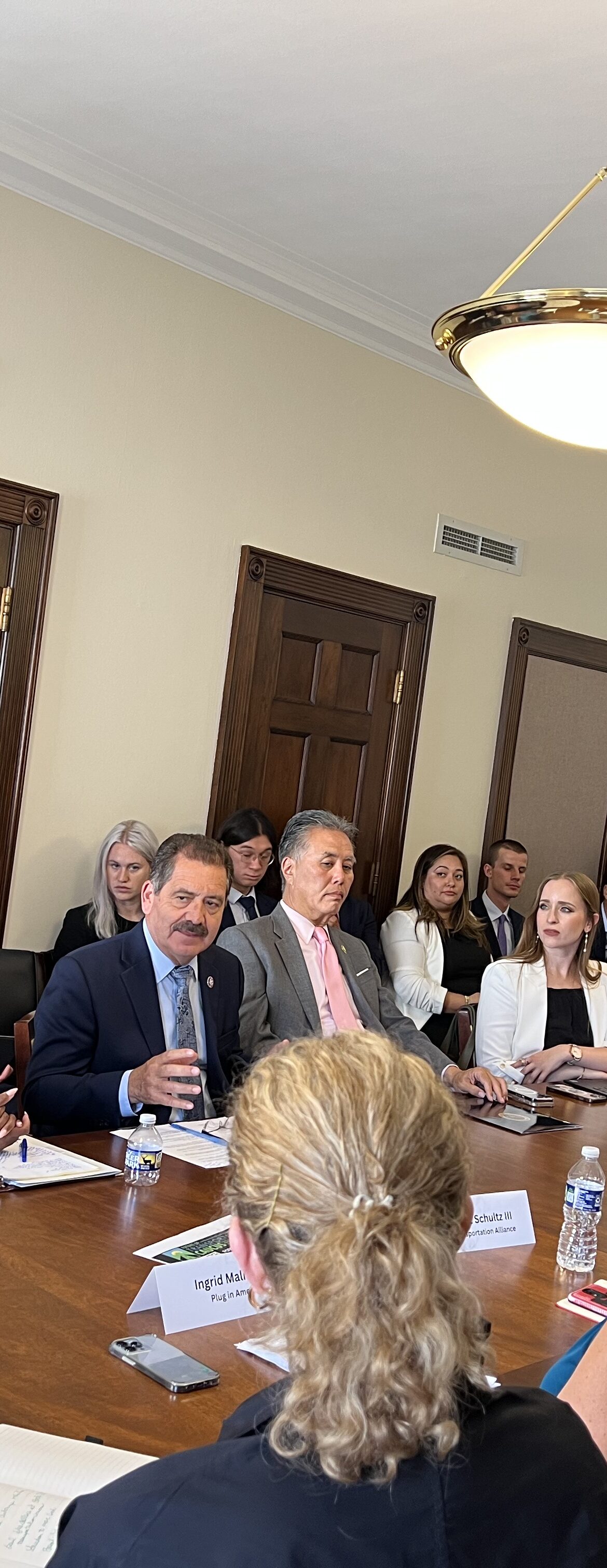
With federal transportation funding set to be reauthorized in three years, the congressional Future of Transportation Caucus met with advocates to discuss the country’s most pressing funding priorities.

A crucial conversation about our transportation priorities
With every passing day, reauthorization for federal surface transportation funding grows closer and closer. Our current framework, the Infrastructure Investment and Jobs Act (IIJA), expires in 2026, and it’s critical that the country gets its funding priorities right by then. If our dollars don’t go towards the right initiatives and objectives, spending more money on transportation and infrastructure will only result in the same poor outcomes. With many competing priorities, discussion between policymakers and advocates about the current state—and future of—our national transportation system remains essential.
Last Wednesday, July 12th, the Future of Transportation Caucus, led by Representatives Ayanna Pressley (MA-07), Jesús “Chuy” García (IL-04), and Mark Takano (CA-39), led a roundtable discussion with advocates on transportation electrification, public transit, active transportation, public health, and road safety. These leaders met to talk through transportation priorities and find common ground.
What does our transportation funding need to focus on?
Advocates covered a wide range of issues, including transportation electrification, operations funding for public transit, and road safety. Advocates discussed the need to electrify public transit and medium/heavy-duty vehicles as well as affordable, safe, and equitable charging for electric vehicles (EVs). Regarding operations funding, advocates spoke about expanding and supporting operations in the face of transit fiscal cliffs, increasing service frequency, and exploring solutions to reduce barriers and increase transit ridership. Finally, road safety advocates discussed improvements for bicyclist and pedestrian safety as well as the dangers of poorly thought-out autonomous vehicle (AV) rollouts in cities.
One point in particular proved to be an underlying thread throughout the conversation: a need for the basics—the baseline infrastructure essential for cities—to be focused on people, at the very minimum. Advocates emphasized the importance of good bus systems and facilities, functional sidewalks, and more, recounting how much of a difference that investing in these essentials made in their communities and socioeconomic outcomes.
Looking ahead to the 2026 reauthorization
It’s essential that Congress gets the right transportation funding priorities in line before the next reauthorization cycle rolls around in 2026. With a massive rise in pedestrian fatalities, a focus on expansion that leaves , and a climate crisis that has only begun, America can’t afford to continue with more of the same. Instead, we need to rethink what our current funding dollars are going towards. T4A’s three key principles for transportation infrastructure investment—prioritize maintenance, design for safety over speed, and connect people to jobs and services—can serve as a guiding framework for a plan that brings the country towards safe, convenient, affordable transportation for all.
We need to move past the outdated “80/20” highway/transit funding split and resist getting distracted by fantasies that promote car dependence like smart cities dominated by AVs. Rather, our federal funding needs to prioritize the maintenance and repair of existing infrastructure, advance safer streetscapes centered on people first, and prioritize access to goods and services, including increasing operations funding for public transit so agencies can expand the crucial services that people rely on.
At the end of the day, we need to commit to investing in our vision of an accessible and equitable transportation system that strengthens communities—one that focuses on moving people, not just vehicles.
Lemonade from lemons: Improvements worth celebrating within flawed infrastructure bill

Money from the finalized $1.2 trillion infrastructure deal is already flowing out to states and metro areas who are plugging it right into projects both already underway and on the horizon. After covering six things the administration should do immediately to maximize this mammoth infusion of unexpected cash, here’s a longer look at some of the law’s incremental or notable successes, with the aim of equipping the administration and advocates alike to steer this money toward the best possible outcomes.
This post is part of T4America’s suite of materials explaining the 2021 $1.2 trillion Infrastructure Investment and Jobs Act (IIJA), which governs all federal transportation policy and funding through 2026. What do you need to know about the new infrastructure law? We know that federal transportation policy can be intimidating and confusing. Our hub for the new law will walk you through it, from the basics all the way to more complex details.
Passenger rail

If you’re looking for good news in the infrastructure bill, passenger rail probably represents the most encouraging and exciting inclusion in the bill. After being woefully neglected over the past 40 years, passenger rail is one of the biggest winners, receiving a historic investment that totals just north of $100 billion over five years. (All of which is thanks to impressive bipartisan work by the Senate Commerce Committee earlier this summer—read our much more detailed take on all the passenger rail provisions here.)
This will provide significant opportunities to reshape American passenger rail in a transformative way. With the record investment, there is ample opportunity to improve safety and state of repair for existing rail infrastructure, make existing service more reliable, and support new, expanded passenger rail service. Communities near rail and lacking in intercity mobility options could connect their community with affordable intercity mobility and integrate passenger rail service with first- and last-mile community connections.
But these improvements are not going to happen automatically nor will they happen easily. The Biden administration, the Federal Railroad Administration, Amtrak and others will have to be very aggressive in ushering this money out the door and supporting state and local plans for those improvements to see the projects that have been promised or mentioned in breathless news coverage come to pass. If the administration fails on this count, this could turn out just like the 2009 Recovery Act, where money sat idle or was even declined by governors. On top of that, freight railroads will be opposed to the improvements in some places, just like they’ve fought or negotiated in bad faith against the publicly and politically popular plan to restore passenger rail along the Gulf Coast.
Additionally, Amtrak’s mission and governing structure have been adjusted to bring a greater focus on expanding and improving the national network. For the majority of Amtrak’s existence, the mission of passenger rail service was to justify investments with performance and operate to make a profit, no matter the cost to user experience, and no matter that nearly every other transportation mode fails to turn a profit. This hampered innovation and opportunity to build and retain rail ridership. Small but significant changes in the infrastructure bill reorient Amtrak’s mission towards the value of the customer and the importance of connecting those customers across urban and rural communities.
While the bill lays out goals for an Amtrak Board of Directors that better represents a diversity of perspectives and communities across the Amtrak system, as we noted last week, those slots need to be filled immediately if the administration is serious about improving passenger rail service and taking advantage of the funding and this historic opportunity.
By reinvigorating passenger rail infrastructure and user experience, this bill could lay the groundwork for other future advancements, including high-speed rail.
Connecting people to jobs and destinations

As we’ve noted, the bill pours the lion’s share of the funds into the same old highway programs with few substantial changes. And states are already responding to their hard-won flexibility and historic amounts of cash by supercharging previously planned or ill-conceived projects. But there are some notable ways the bill recalibrates the highway program for the long run.
First, a portion of every state’s funding will go to new programs aimed at reducing carbon emissions, improving transportation system resiliency, and congestion relief, in addition to existing money devoted to Congestion Mitigation and Air Quality (CMAQ) dollars. States and metro areas must also now dedicate a portion of their planning money towards Complete Streets planning and implementation. (2.5 percent of each state’s State Planning Research dollars and 2.5 percent of their metropolitan planning dollars.) This money will be dwarfed by the hundreds of billions going into streets and roads being designed the same old way, but this is an incremental step toward elevating active transportation and livable streets within the transportation program.
Within the largest pot of funding that states and metro areas control (the Surface Transportation Block Grant program), the amount set aside for smaller but vital transportation projects like bikeways, new sidewalks, safe routes to school, and micromobility was increased from 1.5 percent up to 10 percent. This bill also lets local municipalities control more of this funding directly by increasing the share of that 10 percent that they directly control from 50 up to 59 percent
Lastly, while the $1 billion Reconnecting Communities program will be overpowered by hundreds of billions in highway funds perpetuating the very problem this program aims to solve, its inclusion is an important step toward repairing the damage of past highway projects and is worth celebrating. For the first time, Congress is acknowledging the racist and damaging history of highway building, laying the groundwork for future efforts and also providing a way for advocates to spotlight how some of the worst excesses of the past are still going on today in many urban areas. But devoting any federal dollars to tearing down divisive infrastructure plus the means to stitch communities together again is a vital step on the path toward reorienting the highway program to serving people and communities with the transportation system.
Transit

Most of the headlines and coverage about transit focused on the fact that it will receive historic levels of investment over the next five years from the infrastructure deal. That’s certainly good news, but that also glosses over some important shortcomings.
First off, unlike the Senate Commerce Committee did with passenger rail, the Senate Banking Committee never actually drafted a transit title to incorporate into the infrastructure bill. This preserved the transit policy status quo in amber for the next five years. Secondly, while the House’s superior INVEST Act proposal focused on trying to maximize transit service, frequency, and access, this bill failed to fix the current priority of keeping costs down no matter the effects on people when it comes to service, ridership, and access to transit. T4America is still looking to Congress to redress that wrong within the still-in-progress budget reconciliation bill (the Build Back Better Act), ensuring that public transportation, a fundamental backbone in our communities and a lifeline towards affordable housing opportunities, is properly funded.
Thirdly, while the $39 billion is a historic amount for transit and many excellent projects will be built because of it, this amount should have been higher. $10 billion was cut from the original infrastructure deal’s framework agreement with the White House back in June.
While we weren’t anticipating the Senate increasing the share for transit, the infrastructure bill did maintain the historic practice of devoting at least 20 percent towards public transportation and did not decrease it. On a positive note, the bill emphasized improving the nation’s transit state of good repair, plus improving transit accessibility via a grant program to retrofit transit stations for mobility and accessibility.
Environmental stewardship and climate adaptation

Although the infrastructure bill continues to heavily fund conventional highway and road expansions, digging us into an ever deeper hole of traffic congestion and greenhouse gas emissions, it is also the federal government’s biggest investment yet in climate adaptation and protection and recognizes the severity of the impacts of climate change which are already being experienced across America.
The new PROTECT program dedicates $7.3 billion (~2.9 percent of each state’s share of all highway funds) and $1.4 billion in competitive grants to shore up and improve the resilience of the transportation network, including highways, public transportation, rail, ports, and natural barrier infrastructure. Knowing where climate- and weather-related events are likely to be worse is a vital first step, and the National Oceanographic and Atmospheric Administration (NOAA) will invest $492 million in flood mapping and water modeling which could inform future infrastructure planning and investment.
The existing Alternative Fuels program is expanded and recalibrated to focus more, though not exclusively, on zero-emission vehicles and related infrastructure. A new Carbon Reduction program will dedicate ~2.5 percent of each state’s share of highway funds (~$6.4 billion total) to support active transportation, public transit, congestion pricing, and other strategies to reduce carbon emissions. (Although the core highway program will continue making emissions worse.)
All of this represents a positive first step in federal recognition of the severity of the impacts of climate change, but it is still not scaled to the level of risk that we face, though we applaud Congress for taking a bipartisan step on climate change and we hope to see more.
Safety

When it comes to safety, a new federal safety program, even a large one, is not what we need. The entire $300+ billion transportation program should be a safety program, with safety for all users as the highest and ultimate consideration in every single case on every single project. A transportation system that cannot safely move people from A to B should be viewed as a failure, regardless of whatever other benefits it brings.
With that backdrop in mind, there are key safety provisions that ensure a fairer shake for vulnerable road users. If injuries to and deaths of people walking, biking or using assistive devices exceed 15 percent of a state’s total traffic injuries and fatalities, then that state must dedicate at least 15 percent of their Highway Safety Improvement Program dollars towards proven strategies to make those people safer and lower that share. This helps put some teeth into highway safety dollars to target investments where they are critically needed, versus typical lip-service and disingenuous investments sold as safety projects that are really about increasing capacity, speed, or other goals.
The new Safe Streets and Roads for All program is a competitive grant program allowing applicants to seek funding to better plan and implement Vision Zero strategies in their communities and regions. Once deemed a niche concept, the Vision Zero safety framework has gained some prominence. For it to go mainstream, it will need to be fundamental to all highway spending.
Looking ahead
Though this bill leaves much to be desired, there are still some notable changes that will start to shape the direction of state, regional, and local transportation programs. The key will be how they are used. In the coming weeks, T4America will highlight key opportunities to better administer, deliver, and shape the US transportation program for generations to come.
From policy to action: Six things USDOT should do yesterday to maximize the potential of the infrastructure deal
Because of the shortcomings in the Infrastructure Investment and Jobs Act (IIJA)’s actual policy, an enormous amount of pressure now rests on USDOT and Secretary Buttigieg to deliver on the administration’s promises. But the good news is that there are scores of actions that USDOT can take to deliver positive outcomes for equity, climate, safety, state of repair, and enhancing community connections.

This post is part of T4America’s suite of materials explaining the 2021 $1.2 trillion Infrastructure Investment and Jobs Act (IIJA), which governs all federal transportation policy and funding through 2026. What do you need to know about the new infrastructure law? We know that federal transportation policy can be intimidating and confusing. Our hub for the new law will walk you through it, from the basics all the way to more complex details.
After 200+ weeks of #InfrastructureWeek, Congress was sorely overdue to take action on surface transportation reauthorization since the FAST Act was fast expiring in 2021. The House took up the challenge by crafting and passing the bold five-year INVEST Act in July, which would have moved the needle in major ways. But the Senate failed to produce the same kind of transformative bill, instead playing the politics of “compromise” and “bipartisanship” in what would become the infrastructure deal as we know it (the IIJA).
With the conclusion of #InfrastructureWeek on Capitol Hill and Congress pivoting to other issues of national interest, the media spotlight on the US transportation program will quickly dim.
This is unfortunate, because in many ways, the real work on infrastructure is just beginning—especially for USDOT and the administration. Advocates and the media are failing to grasp that the first year of transportation funding from the IIJA is already flowing out to states and metro areas, supercharging project lists that were decided upon years ago in some cases. And states have made it clear that they plan to maximize the use of the flexibility that they have won from Congress to spend this money how they deem it in their interest.
Using this historic infusion of infrastructure funding to make meaningful progress towards equity, climate change, and fostering community economic opportunities is going to be an uphill battle, but that is what the Biden administration has promised. They certainly have the talent and the expertise to make it happen, but Secretary Buttigieg will need to exercise his authority and the flexibility of US transportation policy to realize these outcomes.
Over the next few weeks, we will unpack the details on a range of actions that could be taken administratively to further our three principles and national priorities of economic development, equity, and climate change mitigation. For now, here are six immediate and important actions that would make a big difference:
1. A new commitment to passenger rail needs equally committed leaders.
As the country begins a heavy investment in intercity passenger rail and Amtrak, its Board of Directors is made up of members whose terms have expired (other than Transportation Secretary Buttigieg and Amtrak CEO Flynn). It is time for the President to nominate a new and current Board to lead Amtrak through this unprecedented opportunity to create a world class passenger rail system and push Amtrak to deliver on a new customer driven service delivery mission.
2. Find other ways to prioritize safety.
In late October, Secretary Buttigieg cited the country’s unacceptable traffic death “crisis”:
We cannot and should not accept these fatalities as simply a part of everyday life in America. No one will accomplish this alone. It will take all levels of government, industries, advocates, engineers and communities across the country working together toward the day when family members no longer have to say good-bye to loved ones because of a traffic crash.
—Secretary Buttigieg
With a call to action on safety, the USDOT should bring more attention to the impact of roadway design on safety, including the removal of references to the disproven 40-year old study that claimed 94 percent of crashes are caused by human error and discouraging grantees and the press from using the term ‘accident’ as opposed to ‘crash.’ Furthermore, the USDOT can look to prioritize safety investments across all funding streams (more on that next).
3. Bake important priorities into the many competitive grant programs.
Use competitive grant programs to reward project sponsors that have made a dedicated commitment to safety, state of repair, climate, and equity and to focus the sponsors that have not on addressing those issues. For example, those states who set regressive safety targets could be restricted from getting funding for safety-oriented projects.
4. Require clearer data for the public on transportation emissions.
Track climate emissions per capita from transportation by state and publish results and trends online.
5. Consider the poor track record of transportation models.
Require major NEPA (environmental review) documents to include a report on the past accuracy of any transportation demand modeling used, as well as documenting the expected induced demand from projects.
6. Streamline the arduous process of applying for competitive grants.
The IIJA also establishes several new competitive grant programs. To ensure they are accessible to communities of all sizes and capacity, USDOT should create an easier, more automated process for receiving applications and benefit-cost analyses for all competitive grant programs.
How this historic bill gets implemented and how the hundreds of billions in new transportation spending is spent will determine how far we are able to move the needle on key goals. We will continue to unpack more ways that the administration, states, metros, and advocates can engage in the implementation of the IIJA to produce a transportation system that is safer, cleaner, and more effective at connecting people to jobs and opportunity.
The infrastructure bill is finished—what you need to know

The $1.2 trillion infrastructure bill is notable both for including Congress’ most significant effort to address climate change, and its general failure to make fundamental changes to a transportation program that’s responsible for massive increases in transportation emissions, worsening state of repair, unequal access to jobs, and increasing numbers of people killed on our roadways.
This post is part of T4America’s suite of materials explaining the 2021 $1.2 trillion Infrastructure Investment and Jobs Act (IIJA), which governs all federal transportation policy and funding through 2026. What do you need to know about the new infrastructure law? We know that federal transportation policy can be intimidating and confusing. Our hub for the new law will walk you through it, from the basics all the way to more complex details.
First, you can read our short statement about the deal’s passage (signed by President Biden on Monday, November 15!) In a sea of media coverage and complicated explainers, we wanted to drill into just a few basic things you should know and remember about this new bill:
1) Transportation policy and funding is now wrapped up until 2026
Did you catch this one?
The way this deal was repeatedly referred to in the media as a standalone infrastructure bill created a lot of confusion, so it’s worth being clear on this count: Congress just wrapped up the every-five-years process of transportation reauthorization because the Senate’s five-year transportation policy proposals passed earlier this summer were the foundation of this larger infrastructure deal. There’s a lot of additional money that will go into various forms of infrastructure, but of the $645 billion total for transportation, about $300 billion is for a new five-year reauthorization to replace the expiring FAST Act. The additional ~$345 billion consists of annual appropriations of various kinds which are not guaranteed or sourced from gas taxes via the highway trust fund (see #4 below for more on that.)
So other than the annual appropriations process where Congress decides funding levels for some discretionary programs like the transit capital construction program or BUILD grants, funding and policy decisions are now finished for five years, and the focus now moves to implementation, i.e., how this money gets spent and where.
2) So what was in the five-year reauthorization included in the deal?
We took a long look at the good, the bad, and the ugly when the deal passed the full Senate back in August, and almost nothing has changed since:
[It] includes a lot of new spending, but that spending isn’t directed toward outcomes, much less the priorities that the President articulated in The American Jobs Plan. Though this bill mentions safety, climate, and equity often, as it stands, it will fail to produce meaningful shifts. “The White House will soon discover that they’ve dealt themselves a challenging hand in their long-term effort to address climate change and persistent inequities, while kicking the can down a crumbling road that’s likely to stay that way,” T4America director Beth Osborne said in our full statement after Tuesday’s final vote.
There is some good news, though. When it comes to the next five years of policy and spending, passenger rail was the biggest winner, making the expansion of reliable, frequent rail service to more Americans a cornerstone of the deal’s approach. The rail portion will “1) expand, increase, and improve service, 2) focus on the entire national network (rather than just the northeast corridor), 3) encourage more local, ground-up coalitions of local-state partnerships for improving or adding new service, and 4) make it easier to finance projects and expand that authority to transit-oriented development projects.” We explained these provisions in-depth in this post.
3) More money for transit but with policy crafted in 2015 (and before!)
The transit portion of reauthorization was never produced by the Senate Banking Committee, which means that this deal basically carried forward the status quo approach to transit policy from the now-replaced FAST Act, but with a historic amount of transit funding (along with a historic amount of highway funding.) The House’s discarded five-year INVEST Act proposal contained some vital improvements to transit policy, but it was ignored by the Senate when assembling the larger infrastructure deal.
We’ll have much more about the modest changes to the transit program in a later post—including what’s next.
4) What else was included in the non-reauthorization portions of the bill’s $1.2 trillion price tag?
This great chart from the National Association of Counties shows where the additional transportation money— outside of the ~$300 billion, five-year authorization—is going:
For more on the non-transportation inclusions in the bill, you can read this post from Smart Growth America with a broader look at the package and what was included on climate resilience, broadband, and other areas.
5) Time to hold the administration and Congress accountable for accomplishing their ambitious promises
The Biden administration has made significant promises to taxpayers about what they are going to accomplish with this historic investment when it comes to repair, climate change, safety, equity, and an equitable economic recovery from the past year and a half. They’ve assembled a tremendous team of superstar smart people at USDOT to make it happen. They’ve shown their willingness to use their administrative authority to at least temporarily halt damaging highway projects. They’ve created a litany of helpful new competitive grant programs they now need to write the rules for awarding.
But watching the president sign the bill isn’t just a celebration, it’s a cue for them to get to work with some major urgency: the first year of this money is flowing out the door already, so states are already pouring this money into projects already underway.
It will require a herculean effort from them to make sure this bill accomplishes what they believe it will. As we said when the deal was first approved by Congress on November 5, “The administration is confident they can make substantial progress on all of these goals despite those deficiencies. Most states are promising to use the flexibility they fought for to make marked improvements across these priorities. To make that happen, both the administration and the states will need to make major changes to how they approach transportation, but we know they can do it.”
Because they missed the chance to codify a wholly different approach to transportation into law, they only have the option of making changes that are administrative or imposed by the executive branch—changes which can all be undone by a future administration.
Now is the time for us, the media, advocates and local leaders of all stripes to hold them accountable for what they have promised to accomplish with this historically massive infrastructure bill.
Step one for repairing a problem: Stop making it worse
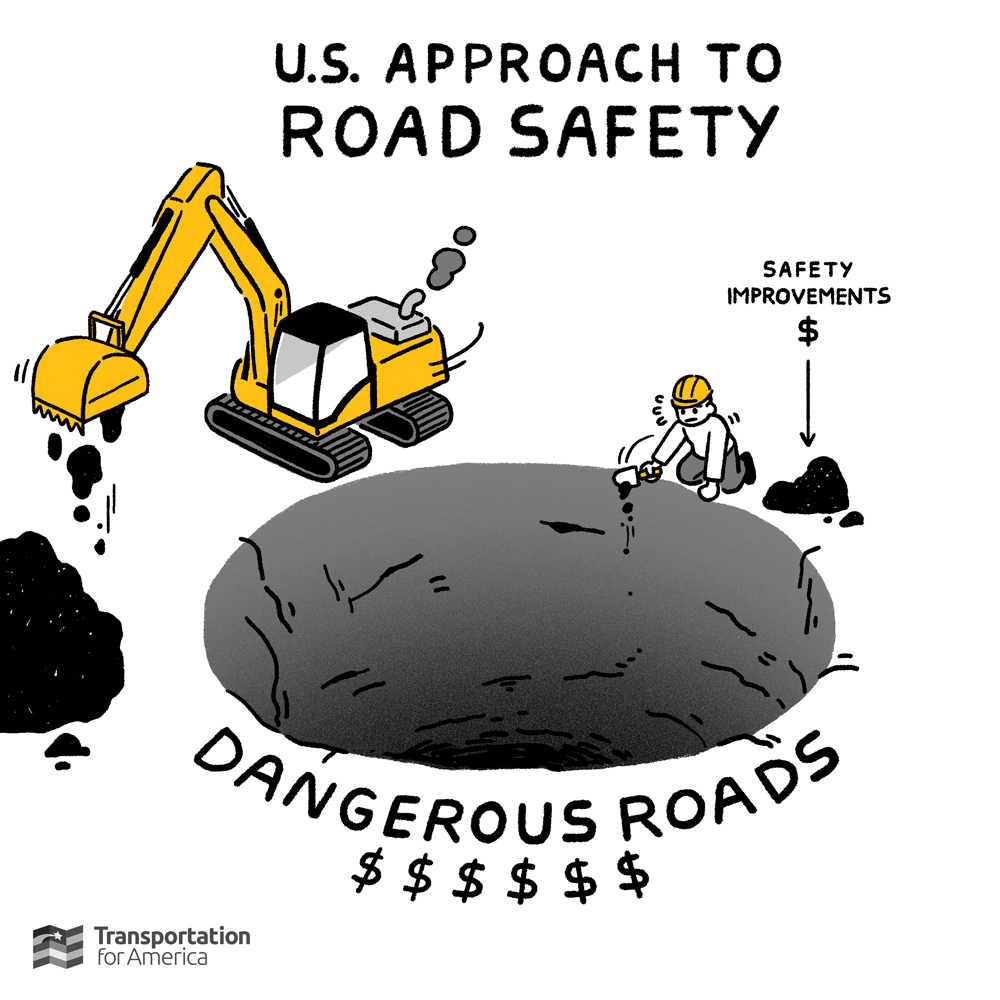
Swap in any pressing issue—climate change, repair, safety—and this new illustration by Jean Wei describes the approach to solving it within the much-debated infrastructure bill, which passed on its own late last Friday. You’ll be hearing a lot of unfettered praise for it today, but we’re far more circumspect.

As T4America director Beth Osborne said today,
“[The deal] spends a lot of money but fails to target it to the needs of the day: building strong economic centers, providing equitable access to opportunity, addressing catastrophic climate change, improving safety, or repairing infrastructure in poor condition.”
The bill has a lot of exciting wheelbarrows of new money, but unfortunately it also includes a lot of excavators for the status quo:
- More money for safety? Far more $$ for the status quo approach of more unsafe roads.
- First-ever money for climate in a transportation bill? Historic amounts for new highways that produce more driving & emissions.
- $1 billion to tear down divisive highways? Offset by $300+ billion to build new ones—like Louisiana’s current $750 million plan to bulldoze a Black neighborhood in Shreveport.
- Historic amounts for public transit? Offset by equally historic levels of highway funding that will undermine the transit investments.
This Politico story from Tanya Snyder captures how the bill will fail to move the needle on reducing emissions and addressing climate change, among other issues:
“Congress has cleared a multibillion-dollar infrastructure package that could improve Americans’ commutes and quality of life, but which fails to meet President Joe Biden’s ambitious pledge to cut emissions off at their root: the transportation sector. …Beth Osborne [and T4America]… accused Congress of ‘doubling down on a dinosaur of a federal transportation program’ that she said has produced a dangerous, inequitable and unsustainable transportation network.”
We had a good chance to do something better with the House’s five-year INVEST Act proposal, but the Senate tossed that one aside in favor of making their own inferior five-year proposal the foundation of the larger infrastructure deal.
As Politico notes, this infrastructure bill is completely missing “any requirement that would prioritize repairing things before building new,” which would ensure we actually make progress on repair instead of just spending billions to build new things we can’t afford to maintain. The discarded House bill also would have taken the modest but vital step of requiring states to “measure and reduce their greenhouse gas emissions.”
What’s next?
With the infrastructure deal completed, the Build Back Better budget reconciliation act is still awaiting action. That package does include some important provisions for improving access to transit, grants for reducing emissions, and more. But it’s tough to swallow knowing that the infrastructure deal is likely to make many of these same issues worse, something we wrote about last week:
“We are encouraged to know that Congress is taking seriously the need to address climate change, equity, and economic recovery. But the $40 billion included here unfortunately won’t be enough to redeem the $645 billion-plus infrastructure bill that will continue to make many of those same problems worse. As we’ve said throughout the second half of this year, the administration has a difficult task ahead to advance their stated goals of repair, safety, climate, equity, and access to jobs and services through these small improvements, while spending historic amounts on unchanged programs that have historically made those issues worse.”
Read that post here (updated with info about the approved infrastructure deal) and share our new cartoon above on social media.
We’ve got a lot to say about this new legislation. We’ll be back soon with a detailed rundown of what’s in the infrastructure deal, a look at the highlights, and how we can make the best things possible happen with funding that will soon touch every city and community.
T4America statement on the passage of the 2021 infrastructure deal

After Congress’ final passage of the $1.2 trillion Infrastructure Investment and Jobs Act, aka “the infrastructure deal” on Friday, November 5, Transportation for America Director Beth Osborne offered this statement:
“As we have stated before, the transportation portion of the infrastructure bill spends a lot of money but fails to target it to the needs of the day: building strong economic centers, providing equitable access to opportunity, addressing catastrophic climate change, improving safety, or repairing infrastructure in poor condition.
“The administration is confident they can make substantial progress on all of these goals despite those deficiencies. Most states are promising to use the flexibility they fought for to make marked improvements across these priorities. To make that happen, both the administration and the states will need to make major changes to how they approach transportation, but we know they can do it.
“We stand ready to support this important and challenging work. We also encourage everyone— elected leaders, businesses, taxpayers, advocates and the press—to follow their results and hold them to their promises.”
Transit funds could crack under the pressure of the budget deadline

The upcoming continuing resolution to fund the government and avert a shutdown won’t include transportation spending, piling on the pressure to pass the infrastructure deal and budget reconciliation. Congress could end up gutting the reconciliation package to make a deal.

Congress is currently negotiating a continuing resolution (CR) to fund the government at current levels and keep things open and functioning through December 3, but, unlike most other CRs, transportation is not in the current CR. So the race is on to pass both the surface transportation reauthorization (the Infrastructure Investment and Jobs Act, also known as the Senate’s infrastructure deal), and the budget reconciliation by the current September 27 deadline set by Congressional Democrats.
If passed, the current CR will fund only the FAA and the FHWA’s emergency fund, no other transportation programs. This means that without reauthorization, normal authorized funding provided to highways, transit, rail and other programs will come to a halt after September 30, even under this CR. Of course, these things will be funded by reauthorization and reconciliation if they pass, but that is not a given. So without the safety net of a CR, Congress must pass reauthorization by September 30 or risk a shutdown of much of US DOT. That date is coming fast, and the United States government has already begun shutdown planning procedures.
Speaker Pelosi’s dual-track approach has tied the fate of reauthorization to that of budget reconciliation. If Congress can pass reconciliation, they will most likely be able to pass reauthorization. But key Senators are debating the budget’s $3.5 trillion funding level, which may mean that in order to get both bills to pass, Congress could cut reconciliation funding for the transit programs we applauded last week.
For those who wish to improve the nation’s infrastructure, reconciliation is just as important as reauthorization.
If Congress passes reauthorization without the transportation funding in the budget reconciliation package, they will cut $10 billion in transit funding and remove all operations funding for transit agencies. They will fail to provide direct funding to localities, fail to connect affordable housing to services and amenities, and fail to address the impacts of U.S. transportation policy on communities of color.
As we said when the reauthorization text was released, the bill does not represent any sort of policy shift toward safety or connectivity that our communities so desperately need. In fact, it cements irresponsible highway expansion. The transportation programs included in the budget reconciliation package move this reauthorization in the right direction.
To avoid a shutdown that could cripple transportation projects and to improve the infrastructure deal, reconciliation is just as vital to pass as the deal itself.
Senate makes historic investment in yesterday’s transportation priorities

Deal worsens long-term prospects for addressing climate and equity woes
“The Senate’s final infrastructure deal is certainly big, but it’s anything but bold,” said T4America Director Beth Osborne after the Senate’s 69-30 approval of the package on Tuesday.
“There are certainly welcome new additions, including a major recalibration of the nation’s approach to investing in and running passenger rail and a small program to tear down divisive old highways. But with this deal, the Senate is largely doubling down on a dinosaur of a federal transportation program that’s produced a massive repair backlog we are no closer to addressing, roads that are killing a historic number of vulnerable travelers each year, little opportunity to reach work or essential services if a family doesn’t have multiple cars, and the continued inability for local governments to have a say over what projects are built in their communities.
“The White House will soon discover that they’ve dealt themselves a challenging hand in their long-term effort to address climate change and persistent inequities, while kicking the can down a crumbling road that’s likely to stay that way. And they’ve done so while sidelining the House’s visionary INVEST Act, which would have started to finally bring a long overdue 21st century paradigm to transportation.
“While we are excited to see a historic amount of funding for transit, the Senate also supercharged the highway program with a historic amount while failing to provide any new accountability for making progress on repair, safety, equity, climate, or jobs access outcomes. And in fact, when comparing this deal to the original bipartisan infrastructure framework announced in June 2021, transit is one of the few things cut at all (by $10 billion). Coming just a day after a dire new IPCC climate report calling for transformational change, the Senate is providing hundreds of billions for status quo programs that will be used to build new roads and produce ever-increasing emissions for decades to come.
“There were hundreds of amendments proposed to address these core shortcomings, but not only did the Senate fail to include any of them, the majority were not considered at all. This includes vital proposals requiring states to make progress on repairing their infrastructure before building expensive new things (in fact, this provision was applied to transit only), requiring measurable improvements in the number of people killed on our roads, measuring greenhouse gas emissions from the transportation system, and providing more money for removing or bridging over highways that were rammed through Black and Brown neighborhoods.
“We now turn to the House to see if they can bring more of a results-oriented approach to the transportation program. And we stand ready to work with the administration to change their internal procedures to get the best out of a very flawed piece of legislation.”
###
Nine ways the House’s transportation proposal starts to make a “paradigm shift”
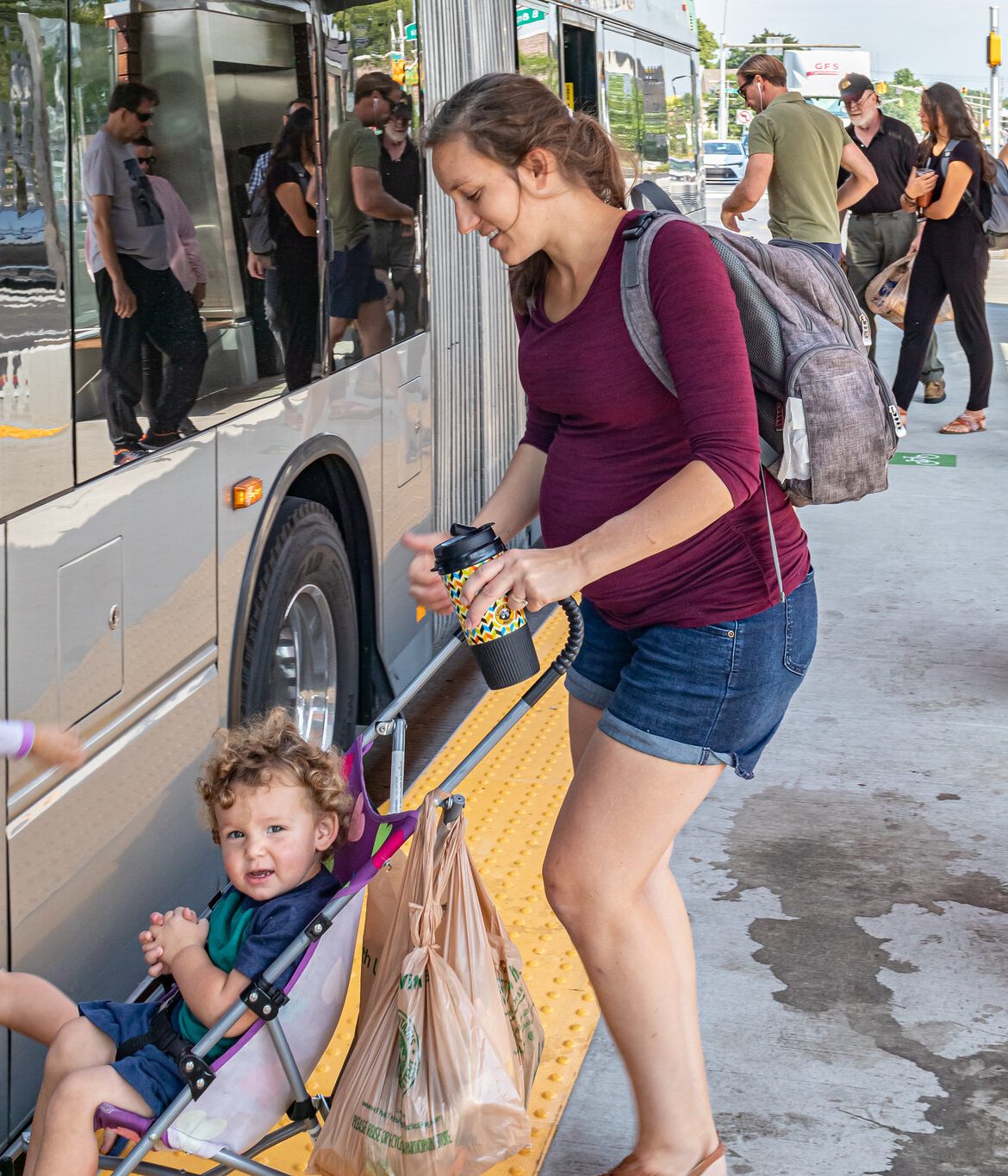
With the House’s INVEST in America Act being considered in committee on Wednesday, it’s a good time to look at what else beyond our core three principles in the bill are worth praising and potentially even improving.

Most of the time, when we evaluate long-term transportation policy proposals or infrastructure bills from Congress, we start with a “good, bad, and ugly” post, but this House bill doesn’t fit well into that rubric. There’s a lot of great, some good, a few things that could use further refinement, and a couple of missed opportunities; but nothing that falls into the category of “bad,” much less “ugly.” It also has a lot of the same language in the INVEST Act introduced in the last Congress which stalled before a Senate vote, which also went 3 for 3 (after some modifications) on our scorecard.
With that in mind, here are nine specific things in the House bill (INVEST 2.0 for shorthand) that we wanted to highlight. Bear with us, this is a longer post!
1) Avoids the Senate’s cardinal sin of creating small, new programs to fix mistakes actively being perpetuated by the larger, unchanged, status quo transportation program
The overall approach of the last 30 years has been to create small, exciting new programs to fix established problems (safety, pollution, etc) while allowing the much larger core program to exacerbate and further those same problems. This was our biggest complaint about the Senate’s bill from a few weeks ago.
If you want to create a program to fix the issues created by running interstates through neighborhoods, you should also stop actively running interstates through neighborhoods. Or consider the issues of repair and maintenance. As we noted in our scorecard post, this bill doesn’t just create some new repair programs, it requires states to produce a plan to maintain any proposed new capacity while making progress toward their state of repair goals anytime they spend money from the biggest pot of highway funding. That’s the kind of new approach that the Senate completely missed, but the House is proposing to implement for key issues like repair, climate change, and others.
2) It recognizes that transportation is primarily about people and connecting them to what they need
The current federal transportation program does not require that states actively improve access to jobs and services for the real people who use the system every day. Say what? This is why the bulk of current transportation funding goes toward increasing vehicle speed, a “goal” that focuses on concrete and steel instead of the needs of actual people and where they need to go. This House bill kickstarts a huge shift toward focusing on people instead of vehicles by instituting a new performance measure that requires project sponsors to improve access to jobs and services by all modes.
Under the House bill, state departments of transportation and regional planning organizations would have to measure whether all people traveling (not just driving) can reach jobs, schools, groceries, medical care, and other necessities. Further, states and MPOs would have to project the impact their projects would have on access and USDOT will review and publicly report their targets and progress. USDOT also has to collect that data and make it available to help with the measurement of multimodal access, and there are requirements to analyze the accuracy of the models and update direction to states and MPOs on how to improve access.
While seemingly minor and perhaps a little wonky, this would mark a big shift in how transportation projects are evaluated. Measuring access—not vehicle speed—is a people-first way to consider the impact of the billions we spend on transportation each year. With this, we can create more equitable access to economic opportunity, lower transportation costs, and reduce emissions and the damaging climate and health impacts of them.
3) Nails all three of T4America’s core principles
As we’ve done with every infrastructure proposal or long-term policy proposal for the last few years, we’ve produced a scorecard to evaluate how it starts to redirect transportation policy toward T4America’s three core principles of 1) maintaining the current system, 2) protecting the safety of people on the roads, and 3) getting people to jobs, schools, groceries and health care. This bill nails all three of these principles Read more about how the House bill advances these three simple priorities in this post with the scorecard.
4) Advances our proposal to start tearing down divisive infrastructure and repairing the damage
Since 2020, with help from Third Way, T4America has been advancing a policy to undo the damage of “urban renewal” projects that have displaced more than a million Americans since construction of the Interstate Highway System and that continue to harm communities of color today. Our plan focuses heavily on creating a competitive grant program to redesign or deconstruct things like divisive highways, and creating strategies to prevent displacement so that this work generates wealth for the communities that suffered most, in addition to a few other strategies.

The House runs with our proposal through a $3 billion ($600 million a year) Reconnecting Neighborhoods program, which is six times larger than a similar proposal in the Senate bill. This program will analyze neighborhood barriers (like interstates) and identify candidates for remediation, repurposing, or removal. In addition, part of that money can also be used to establish a community advisory board or a land trust to preserve the new wealth for those most affected by the divisive infrastructure. There are some details we’d like to enhance, but this idea has gained incredible traction over the last year and we are excited about the possibilities for the future.
5) Recognizes that you must address climate change within the entire transportation program

Transportation is the largest source of carbon emissions in the United States, and the majority of them come from driving. The bill addresses the entirety of the transportation program by establishing a new greenhouse gas performance measure and requiring states to set positive targets to reduce emissions. It gives states the latitude to figure out their own preferred path to hitting those targets, but we know that infrastructure investments that give people more options than hopping in the car are key to reducing these emissions. INVEST 2.0 creates programs to fund these projects at both the state and city levels.
While making it easier to drive less overall should be central to our short-term climate and transportation strategy, we do need to accelerate the transition to electric vehicles as well. This is why we’re part of a unique coalition called CHARGE—the only “electric vehicle” coalition where improving and expanding public transit is the first priority. This bill creates a new program to build electric vehicle charging stations along corridors and sets standards to require them to be open to the public and work with all kinds of electric vehicles.
There are also some good provisions targeted at making the transportation system more resilient to climate change and making resilience an eligible use in the largest highway programs. One place where the bill could be improved is to require resilience to be built into the design of all projects.
6) Measuring access to jobs and services is one of the best ways to address equity, but this bill includes others
As noted above, requiring agencies to measure and improve access to jobs and services for all people is perhaps the single greatest change to remake transportation policy in a more equitable way. But INVEST 2.0 would also improve equity in other ways—something we wrote about at length last summer in the context of the House’s very similar 2020 proposal. Prioritizing access, investing in more and better transit, building safer streets for people, and investing in what we have would all have an impact on equity. Considering the similarities between that bill and this year’s INVEST in America Act, that evaluation still stands.
7) Support for expanded national passenger rail

Expanding and improving our nation’s passenger rail network to bring better, more reliable passenger rail service to more people is one of the best ways to improve access for millions of Americans in big urban areas and small rural ones alike. This bill creates a new $5 billion a year program for high speed and intercity rail investments, triples the funding for the existing program for improved safety and efficiency in passenger and freight rail service, and funds Amtrak at $32 billion over the life of the bill.
The House incorporated several of our other recommendations, including updating the Amtrak Board to have better representation from riders and the national network as well as the Northeast Corridor. More importantly, it allows for the formation of more multi-state rail commissions like our partners the Southern Rail Commission, which has been the key to (almost!) restoring passenger service along the Gulf Coast, and provides funding for them to operate.
There is some opportunity to strengthen the authorities for the Federal Railroad Administration and the Surface Transportation Board to prevent the freight railroads from obstructing or interfering with that service.
8) A strong commitment to transit…
INVEST 2.0 provides over $21 billion for transit, a sizable increase over the current $13 billion program, and it also includes some funding for operations—a major win, as operations funding has typically been a no-go with federal funds. Funds from the Congestion Mitigation and Air Quality program and even the core Surface Transportation program can be used for transit operations. There’s also a new one-time competitive grant program to support capital and operations costs associated with addressing transit deserts through better, more frequent transit service.
Improving service frequency is a big focus of the bill. There is a new $100 million competitive grant program for transit agencies collaborating with state or local governments to increase bus frequency and ridership by redesigning urban streets to better move transit (and more people) in congested areas. There is also a change to the funding formula that prioritizes frequency.
9) But with opportunities for greater improvements on transit
While the bill makes some important changes and does slightly increase its share compared to highways, the bill does not hit T4America’s priorities of equalizing transit funding with highway funding, nor does it create long term support for keeping transit running. We will be once again turning to leaders on Capitol Hill to move these efforts forward. Rep. Jesus “Chuy” Garcia of Illinois has led the effort to invest in transit as strongly as we do highways, and we hope he uses this bill as an opportunity to push that effort forward.
On the operations side, Rep. Hank Johnson of Georgia is leading an effort to create a federal program for transit operating support. The Stronger Communities through Better Transit Act would create a new grant program available to all transit agencies, rural and urban, to increase service frequency so that people don’t have to wait so long for the bus; to provide additional hours of service so that those who don’t work regular hours can still get to their jobs; and to add new, frequent service in the region. We are proud supporters of that bill and we encourage you to tell your House rep to join Rep. Johnson as a sponsor.
New House transportation bill goes 3 for 3 on T4America’s core principles
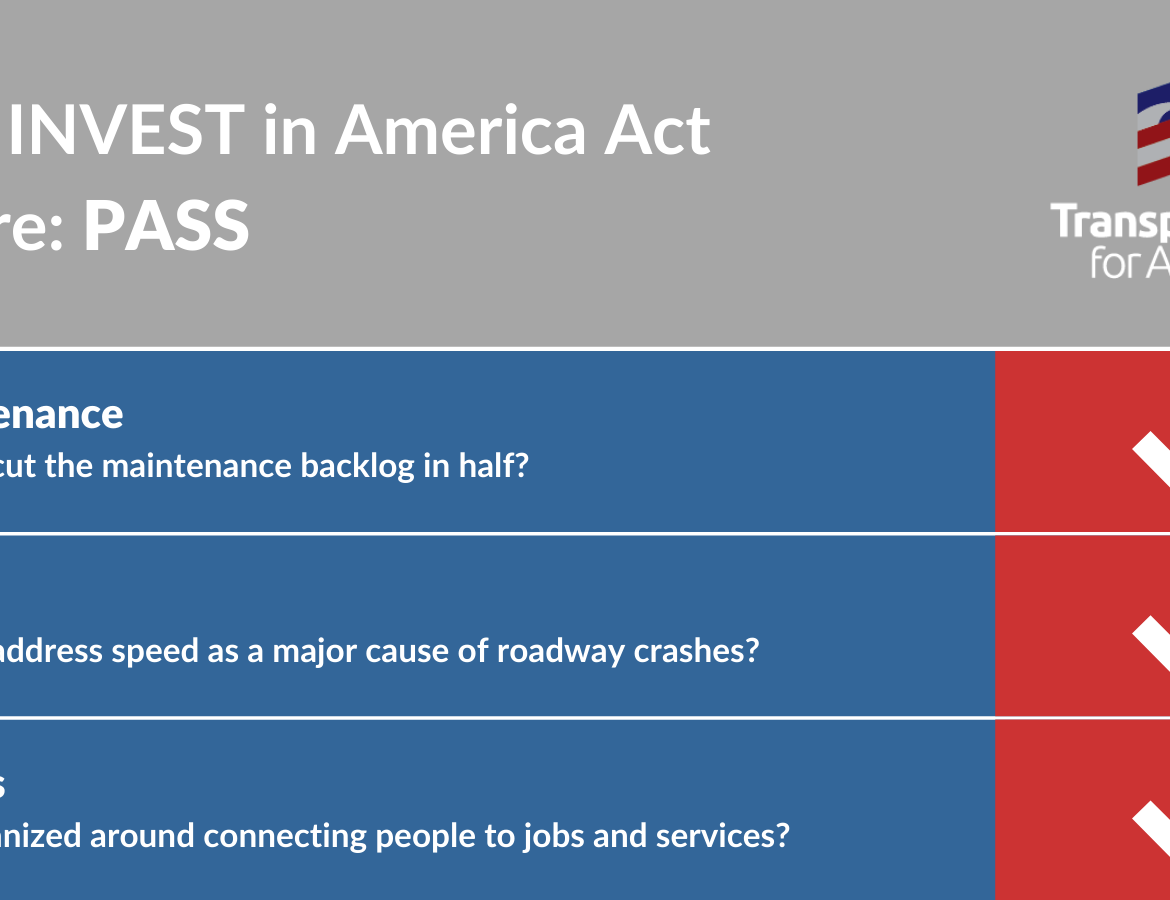
Late last week the House released their new five-year proposal for transportation policy and spending, known as the INVEST in America Act. By focusing on making tangible progress on outcomes like repair, safety, climate change, and access to jobs and services—rather than just asking for more money for more of the status quo—House leaders have again proposed a paradigm shift in how we spend transportation dollars and measure what they accomplish.
The first, most important thing to know about the new Invest in America Act is that it’s quite similar to the INVEST Act, which was approved by the House in the last Congress but which failed to advance to the Senate. This new bill picks up where the INVEST Act left off, repeating almost all of the good provisions and making improvements. As we said in our statement last Friday about the bill, “this is a paradigm shift from the approach of the last 30 years of proposing small, exciting new programs to fix recognized problems while allowing the much larger core program to exacerbate and further those same problems.”
It’s the kind of fundamentally new approach we need.
As we’ve done with every infrastructure proposal or long-term policy proposal for the last few years, we’ve produced a scorecard for the bill to measure how the Invest in America Act starts to redirect transportation policy toward T4America’s three core principles of 1) maintaining the current system, 2) protecting the safety of people on the roads, and 3) getting people to jobs, schools, groceries and health care.

1) Prioritizes maintenance first in nearly every program
We can’t keep choosing to expand with no plan to maintain. We’ll never make progress on our infrastructure if we don’t start prioritizing the care of the valuable assets we’ve spent decades and billions of dollars building.
As we wrote last summer, we’re “expending money we don’t have to build roads we can’t afford to maintain which fail to bring the promised economic returns—all while neglecting repair needs.” While our preference would be to cut maintenance backlogs in half by dedicating formula dollars to maintenance, this bill finally brings the kind of focus on repair that we need, pushing transportation agencies to prioritize maintenance across the board in core programs—the most important way to make repair a priority—while also creating some new repair programs. This stands in sharp conflict to the Senate approach which favors providing state DOTs the flexibility to ignore their repair needs in order to build new things they can’t afford to maintain.
As an example of that approach, for one of the two largest programs typically used on highways (the National Highway Performance Program), this bill requires project sponsors to have a plan to maintain any proposed new capacity while making progress toward their state of repair goals. Overall, this bill maintains the INVEST Act’s language requiring a long-term maintenance plan for any proposed new capacity project and a record of improving their state of repair, includes a provision requiring states to spend no less than 20 percent of their main highway programs on bridge repair, creates a new programs to fix bridges and a $1 billion program for repairing rural bridges, adds a unique program to prioritize replacing the oldest buses, and creates other new programs focused on the maintenance of rail crossings, bridges, and tunnels.
2) Institutes a comprehensive approach to safety
Designing for safety over speed is our second principle, with a call to save lives with road designs that support and encourage safer, slower driving.
The conventional approach to designing highways—wide lanes and wide roads to allow for high speeds—has resulted in the highest number of people being struck and killed while walking and biking in three decades, in addition to a record rate of in-vehicle fatalities in 2020 as traffic evaporated and speeds increased. Our roads are deadly by design, and safety needs to supersede moving cars fast at all costs.
Last summer’s INVEST Act was strong on this count, and this bill maintains almost all of that positive language, which might be easiest to digest in a list of bullets:
- It removes states’ current ability to set negative targets for safety, i.e, planning for more people to die on their roads next year with the money they spend. This stands in stark contrast to the Senate bill which continues to provide states with the “flexibility” to continue with this practice, with no penalties and certainly no concrete, accountable goals for saving lives and reducing deaths.
- It will no longer require states to use the unreliable sorcery of traffic modeling that so often results in prioritizing speed and vehicle throughput over peoples’ lives.
- The Transportation Alternatives Program, which is used to make walking and biking safer and more convenient, is popular and oversubscribed in almost every state, where localities have to apply to the state for funds. Yet some states either sit on this money or transfer it into conventional road-building projects, a practice which will be curtailed by this bill.
- The Highway Safety Improvement Program (HSIP) gets a new focus on vulnerable users and a push toward what’s known as a safe systems approach.
- To create plans for Complete Streets and Vision Zero plans—an effort to completely eliminate traffic fatalities, in part through street design—states would be able to use a variety of federal funds for those efforts, including the HSIP program above.
- Lastly, the 85th percentile rule for setting speed limits gets tossed, and states would instead be required to set speed limits with a consideration of the community surrounding the corridor, the number of bicyclists and pedestrians, and crash statistics (as opposed to just traffic conditions). Right now (with the 85th percentile rule), speed limits are set by how people behave; so if you build a wide street and people drive too fast, the speed limit is often raised to accommodate the rule breakers, showing just how pernicious the focus on speed over safety is with the current program.
This bill will most certainly create a safer transportation system and save lives. We may dive into the safety provisions in more detail in a longer post, so stay tuned.
3) States and metro area planners must determine how well their system connects people to jobs—drivers and non-drivers alike
If the goal of transportation spending is to connect people to jobs and services, then that must be measured and considered when funding decisions are made. Our third principle is measuring transportation success by how many jobs and services people can access, rather than the blunt and outdated assumption that cars being able to drive fast on specific segments of road equals success.
As with the INVEST Act last summer and for the first time at the national level, recipients of federal transportation funding will be required to measure how well their system connects people to the things they need, whether they drive, take transit, walk or bike. State DOTs and MPOs must consider whether people traveling (not just driving) can reach jobs, schools, groceries, medical care and other necessities, collect that data, and also make it available. And they will be penalized if they fail to use federal funding to improve that access.
This is truly groundbreaking stuff, and while there’s far more under this umbrella to highlight in a longer post, this represents a massive shift to how we currently spend money on transportation, which is largely unhinged from producing any sort of measurable improvement in access for everyone who uses the system.
—
We will be taking some longer looks in a follow-up post at how the bill will impact other important areas beyond our three principles, like climate, equity, transit, passenger rail, and others, so stay tuned.
House transportation proposal focuses on updating nation’s outdated transportation policy to get better results

The House Transportation & Infrastructure Committee’s proposal for long-term transportation policy makes repair, safety, climate change, and access to jobs and services core goals for the bill’s spending, rather than just nice add-ons— taking a dramatically different approach than the Senate’s long-term proposal.
WASHINGTON, DC — “Federal transportation policy has been on autopilot for two decades, blindly pouring money into the same old programs and hoping for miracles when it comes to producing a transportation system that works for all Americans, keeps them safe, is well maintained, and helps meet our goals for reducing emissions and addressing climate change,” said Beth Osborne, director of Transportation for America. “As with the House’s proposal in the last Congress, Chairman DeFazio once again lays the groundwork for finally updating our country’s 1950’s approach to transportation to meet 21st Century needs.
“The proposal that Chairman DeFazio released today takes last summer’s fairly groundbreaking INVEST Act and improves on it. We are particularly happy to see the inclusion of a program to address transit deserts and another program to reconnect communities divided by transportation infrastructure, like highways.
“Like last summer’s bill, this proposal includes reforms to the core, fundamental programs to ensure that states prioritize repair, make safety a primary goal, and make access to jobs and opportunities a priority for the billions we invest each year. This is a paradigm shift from the approach of the last 30 years of proposing small, exciting new programs to fix recognized problems while allowing the much larger core program to exacerbate and further those same problems.
“That’s the kind of fundamentally new approach we need, and we are excited to work with the Committee to make it even better. We hope the Senate takes some cues and that both Democrats and Republicans focus their efforts on a proposal that generates better outcomes, rather than agreeing to prop up a stale and destructive status quo,” Osborne said.
###