Posts Tagged "health"
Federal program that helps tackle health disparities threatened in ’18 budget

Congress is threatening to eliminate a small yet significant federal program housed within the Centers for Disease Control and Prevention (CDC) that helps local communities take concrete steps to prevent someone’s zip code from being the most powerful determinant in their long-term health.
How are metro areas prioritizing health and building more biking and walking projects?
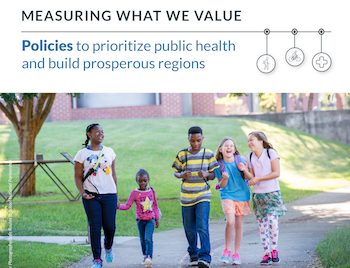
Though there’s booming demand all across the country to build more projects that can help residents get out and bike or walk — whether for exercise or just for getting around safely from A to B — it can be an uphill battle to do so. How are metro areas upending the conventional wisdom and building more projects that help improve their residents’ health?
New national survey examines how metro areas use performance measures to evaluate their spending
Thanks to action taken by Congress, metro areas will be required to use a data-driven process to measure the performance of their transportation spending. But some metro areas already go far beyond the modest new federal requirements. T4America’s new national survey of over 100 metro planning agencies examines the current state of the practice — and where it’s headed.
Measuring what we value: Prioritizing public health to build prosperous regions
A new package of case studies released today by T4America, in partnership with the American Public Health Association, showcases a range of strategies that metro area planning agencies can use to strengthen the local economy, improve public health outcomes for all of their residents, promote social equity and better protect the environment.
Metropolitan planning for healthier, safer, more prosperous regions
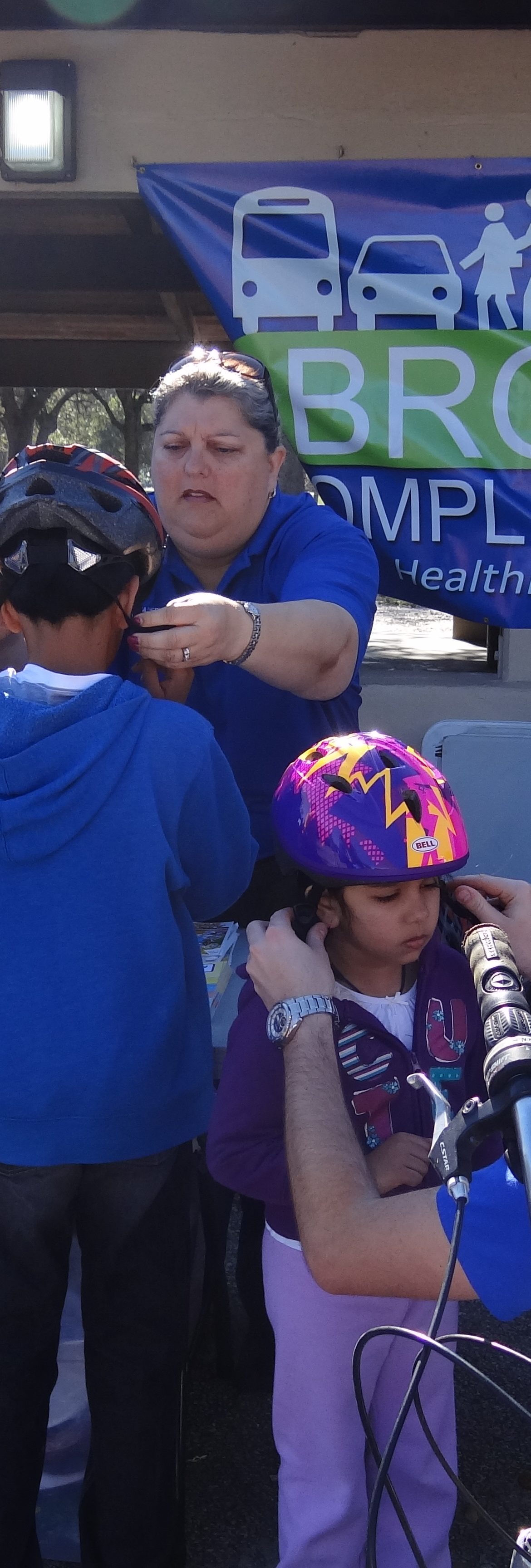
How can the planning agencies in metro areas strengthen the local economy, improve public health outcomes for all of their residents, promote social equity and better protect the environment? Join us for the story of how a handful of metro areas have found smart, data-driven ways to better conceive, select and build the transportation projects to better meet those regional goals.
Join us for the release of Planning for a Healthier Future
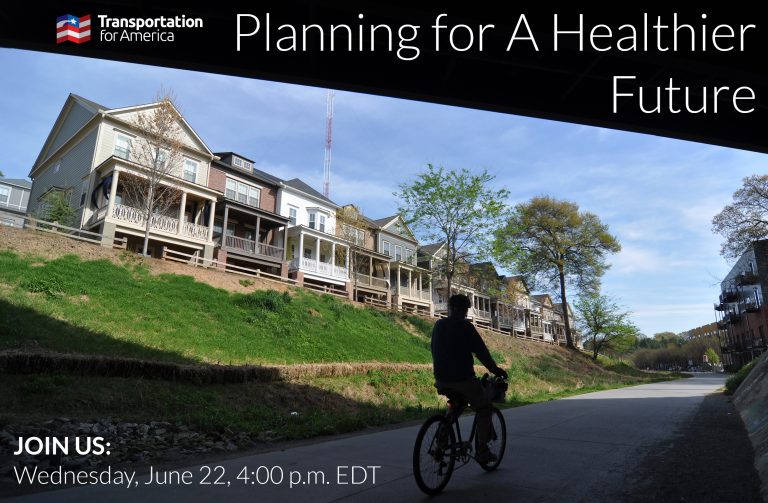
Thanks to 2012’s MAP-21 legislation, all metro areas and states will soon be using a limited array of performance measures. While the in-progress federal requirements will cover a limited range of measures, T4America is releasing a new resource to help advocates and especially metropolitan planning agencies utilize find ways to use performance measures to improve public health, address social equity concerns, and advance environmental quality.
Surgeon General: building walkable communities is essential to our health

Yesterday the Surgeon General issued a powerful call-to-action that focuses on improving public health by encouraging walking and the creation of more walkable places.
What if we labeled unwalkable neighborhoods like we do cigarettes?

The Surgeon General of the United States will unveil a bold new initiative today, aiming to help Americans lead healthier lives—by making walking and physical activity built-in features of more of our neighborhoods.
U.S. Surgeon General issuing a rare call-to-action to make walking safer & more convenient
The Surgeon General will issue a new call-to-action next Wednesday that focuses on encouraging cities and towns to design and build their roads and public places to make walking easier, safer and more pleasant.
Healthy economies need healthy people — Nashville leads the way for other regions
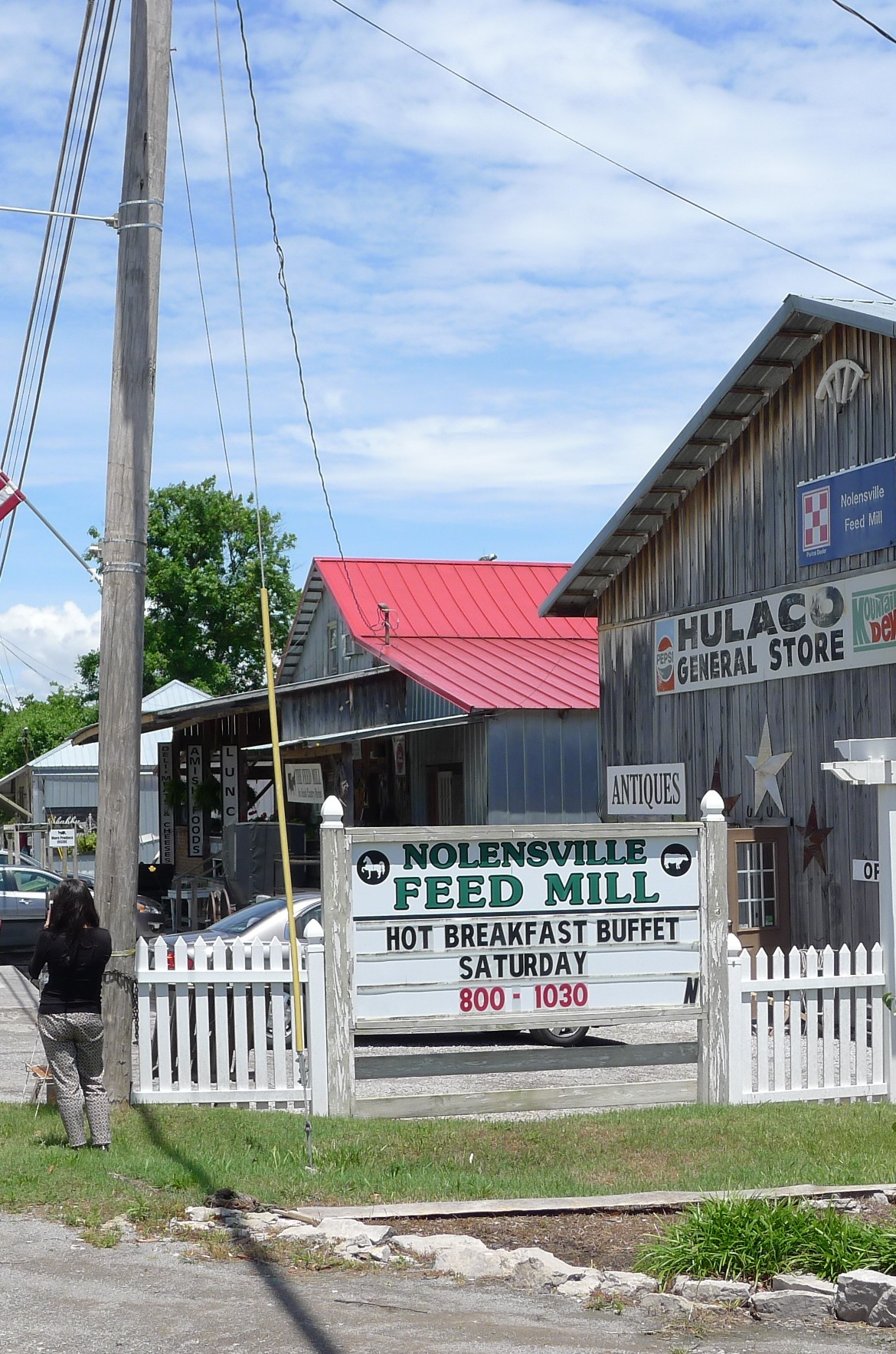
What’s the connection between healthy residents and a healthy bottom line? Why should a local business community care about improving the health of the residents that live there? Representatives from five regions gathered last week in Nashville to learn how providing better transportation infrastructure and building more walkable communities can help improve residents’ health — and boost local economic prosperity and competitiveness.
American Lung Association: smart growth saves lives, improves health
Photo courtesy of Compass Blueprint There are many reasons smarter growth makes sense. By building more sustainably and closer to where people work and shop and plan, we reduce hours stuck in traffic and make it easier to reach life’s necessities. But there is something even more important at stake: our health. According to new […]
Increased traffic is hazardous to our health
Much of the discussion around health and transportation has zeroed in on how a lack of travel options and an unwalkable built environment in our communities reduces physical activity. But when traffic is the leading cause of death among children worldwide and the leading cause of death among Americans between the ages of 1 and […]
Helping kids get active and healthy by “keeping them moving”
 We’re facing an epidemic of childhood obesity, and this could very well be a generation of children who live shorter, less healthy lives than their parents. A healthier transportation system for America’s kids requires change in federal policy. But change will remain out of our grasp without a sense of urgency from everyday people on the ground. So where’s the meeting point between policymakers in Washington and citizens in their neighborhoods?
Active transportation, more walking and biking can help us confront obesity
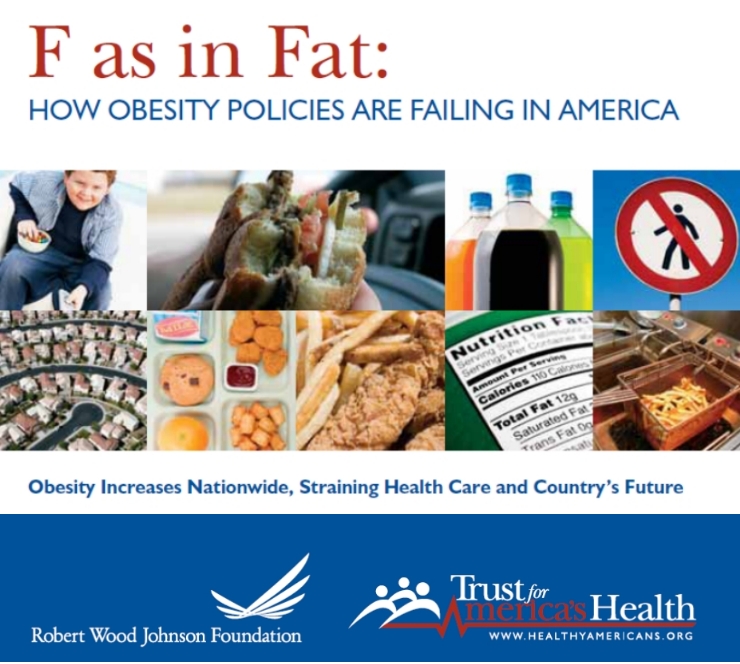 Obesity is on the rise in 28 states and one of the biggest public health challenges facing America, but boosting walking and biking could help turn the tide. That is the conclusion of “F as in Fat: How Obesity Threatens America’s Future 2010.”
America’s veterans need more and better transportation options
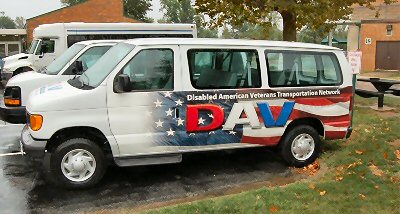 As we celebrate the birth of our country this Fourth of July, we should also remember to honor the men and women who have served in uniform. Keeping our promise with America’s veterans mean giving them the resources they need when they return home, and that includes their transportation needs.
American Public Health Association outlines hidden health costs of transportation
The Patient Protection and Affordable Care Act signed by President Obama earlier this year was a down payment on expanding health coverage and lowering costs. But the work does not stop there. A truly comprehensive approach to health must account for transportation’s role in how we move and our levels of physical activity. The American Public Health Association tackles just that in a new report titled “the Hidden Health Costs of Transportation.”
Nationwide reports identify transportation policy as essential to improving health
 Two reports out this week highlight growing awareness of the integral link between health and transportation. The CDC report acknowledges what T4 America has stressed for months: not only is our nation’s approach to transportation outdated and inefficient, it also takes a toll on our health and quality of life.
Michelle Obama’s Let’s Move campaign a positive step, but must emphasize transportation voices
In February, First Lady Michelle Obama announced her exciting “Let’s Move” campaign and the goal of seriously confronting childhood obesity in the United States within a generation. Now, the campaign – more formally known as the Presidential Task Force on Childhood Obesity – is getting to work on an action plan to influence federal policy. This is a great start, but there’s an omission: the task force does not include a representative from the U.S. Department of Transportation.
T4 America health fly-in participant meets Senator Barbara Boxer
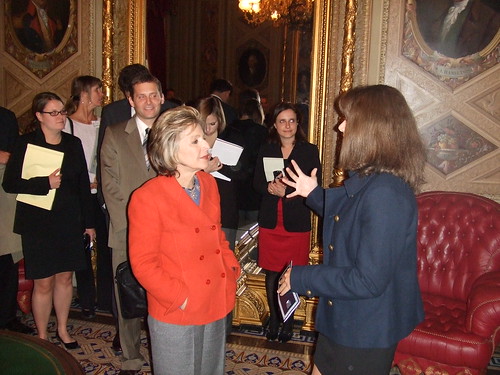 Fourteen-year-old Julia Lopez, a childhood wellness advocate from Los Angeles, CA, met California Democratic Senator Barbara Boxer in the Capitol yesterday. Lopez is in Washington, D.C. to participate in Transportation for America’s “health fly-in” to speak with Congressional representatives about the link between and health and transportation.
It’s time to make the link between health and transportation
Most of the news coverage about what is happening in Washington compartmentalizes health and transportation, missing key connections between the two. This week, Americans from around the country will speak to their representatives, seeking to emphasize those links. The “health fly-in” will commence Thursday and is sponsored by Transportation for America, the American Public Health […]
Our three principles

It’s past time to elevate the national conversation about infrastructure beyond just the price tag.
Learn more about our platformLatest From The Blog


There’s a climate cost to America’s freeways, and…
Apr 23rd, 2024


Progress for passenger rail in the South and…
Apr 10th, 2024

I cannot find the zoom link, I registered…
Jan 6th, 2024

A rare look behind the curtain of Transportation…
Jul 28th, 2023

In what Harrison Ford said was his most…
Jul 25th, 2023

Good example, walking to the local taco place…
Jul 24th, 2023