Already asked your rep to support complete streets? Tell some friends to join you
December 3, 2009By Stephen Lee Davis
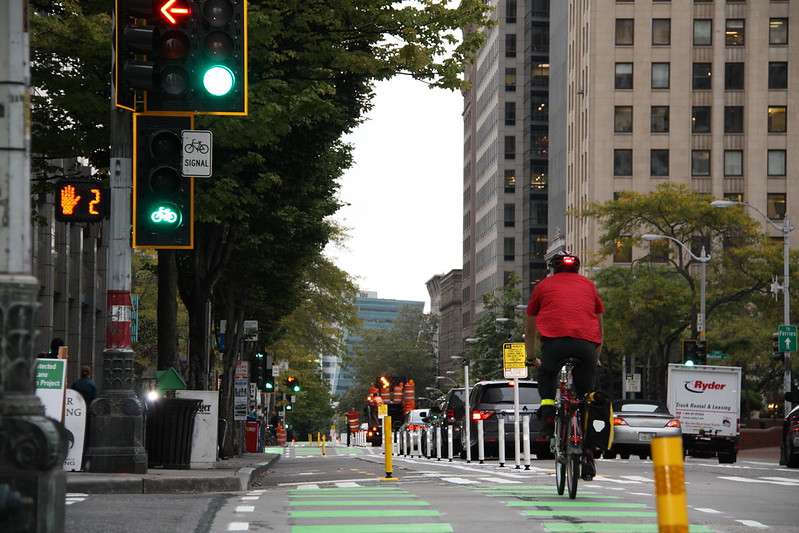
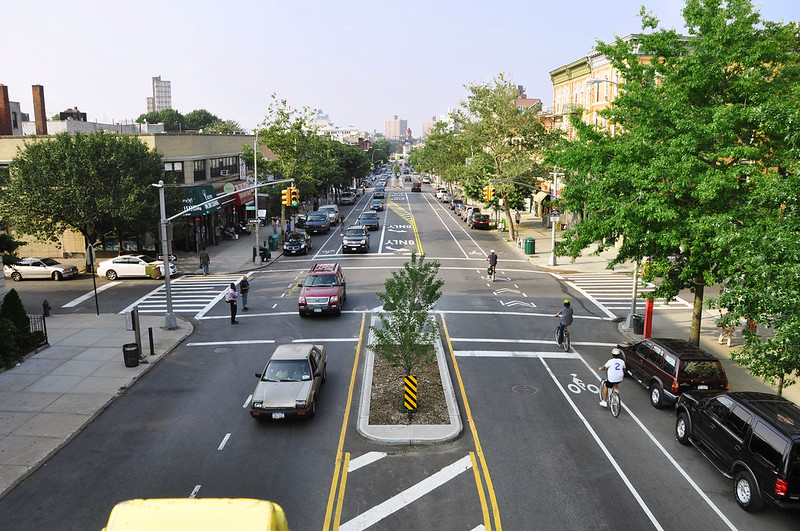
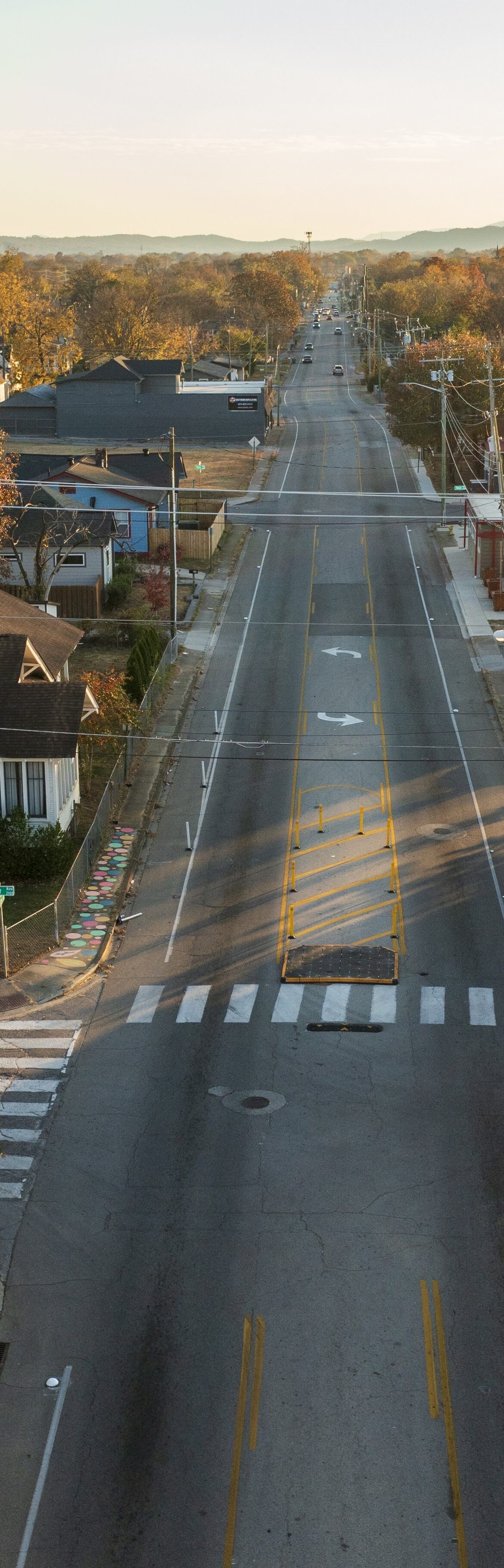
Maybe some people just need a little visual aid to help grasp the devastating toll that our roads have on those who walk them everyday.
400 people are killed in America every single month, just crossing the street, walking from A to B, or riding their bike through town. That’s like two busloads of Americans being killed… every single week.
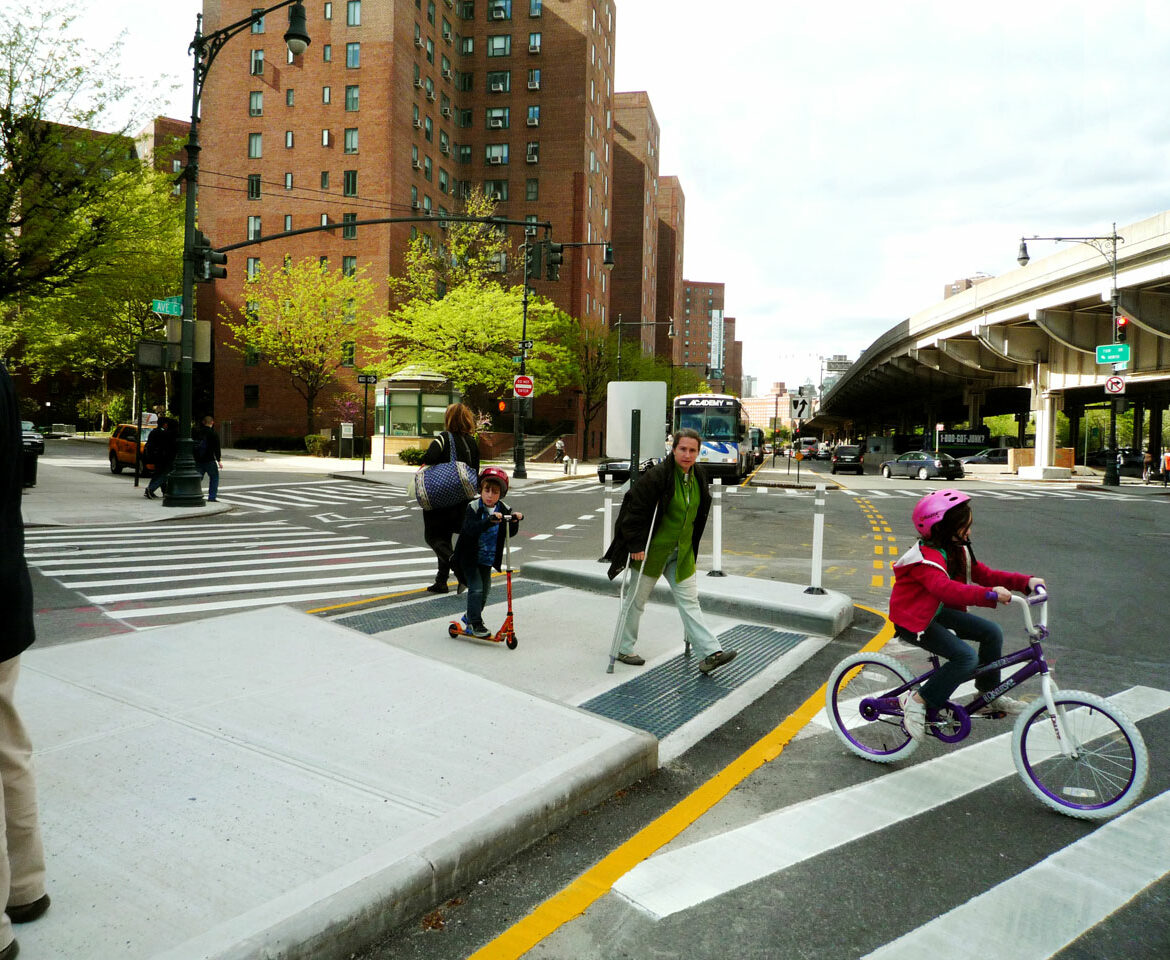
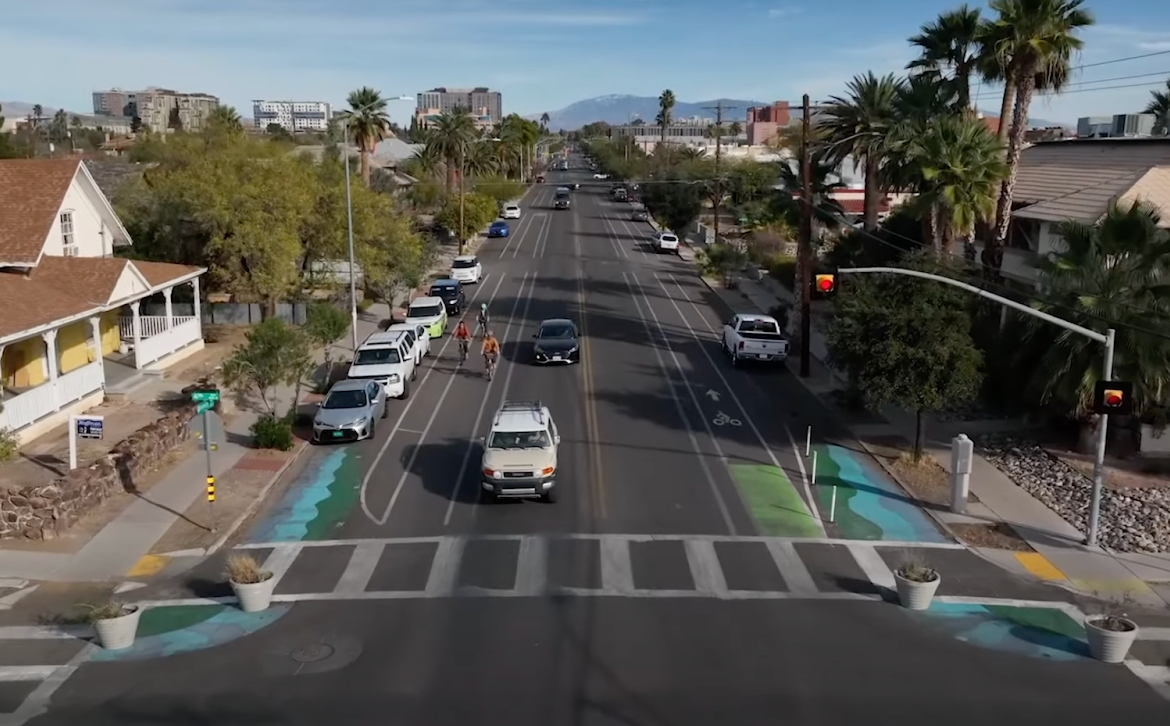
The worst part is that many of these deaths are preventable. We need to start building roads in a way that works for everyone who uses them – motorists, pedestrians, cyclists, and those with limited mobility. A lot of you have already sent messages to Congress telling them that the time is now to support safer streets for all Americans.
TIME Magazine features Dangerous by Design report on pedestrian safety, culminating three weeks of coverage nationwide
December 1, 2009By Sean Barry
This week’s issue of TIME Magazine topped off three weeks of nationwide coverage of Transportation for America’s Dangerous by Design report ranking communities according to the risk for pedestrians.
The excellent TIME piece opens with the tragic story of Ashley Nicole Valdes, “a smart, pretty 11-year-old girl” who was killed while crossing the street in Miami earlier this year and became “a heart-wrenching symbol of South Florida’s notoriously reckless car culture.”
Florida was identified in the report as being the most dangerous for pedestrians. “You see all these people getting run over,” said Ashley’s mother, Adonay Risete, “and you ask yourself: What’s happened to us as people here? We need to get tougher and change attitudes.”
The phenomenal response to Dangerous by Design is a hopeful sign that change may be under way.
More than 150 newspapers, 300 TV broadcasts and 50 radio programs have covered the report, co-authored by the Surface Transportation Policy Partnership, since its release three weeks ago. The report’s findings speak to the need for action: America has a pedestrian fatality rate equivalent to a jumbo jet full of passengers crashing every 31 days. This decade alone, 43,000 Americans – including 3,906 children under 16 – have been killed while walking or crossing the street.
We could make great strides on pedestrian safety by adopting “complete streets” policies, ensuring that roads are designed to be safe and accessible for everyone who uses them, whether motorist, bicyclist, transit rider or pedestrian. You can help by asking your member of Congress to support the pending national Complete Streets Act.
Meanwhile, more than 100 communities and states have adopted such policies, and more are coming. One of the report’s greatest success stories was the swift action of officials in Southwest Florida’s Lee County, who adopted a resolution in support of Complete Streets within 48 hours of the report’s release, and just one day after the local Ft. Myers News-Press editorialized in favor of the policy.
Dangerous by Design was covered extensively in both national and local media, including National Public Radio, TIME Magazine, USA Today, The Christian Science Monitor, The Washington Post, Boston Globe, San Francisco Chronicle, Denver Post, Baltimore Sun, Houston Chronicle, Consumer Affairs, Orlando Sentinel, Detroit Free Press, St. Louis Post-Dispatch, and dozens more.
The Kansas City-Star wrote that the Kansas City metropolitan area’s “widely dispersed population and auto-oriented development are doing no favors for pedestrian safety.”
The Minnesota Daily wrote: “With the implementation of Complete Streets…streets wouldn’t be something we simply drove through, but the destination itself.”
And, the Billings Gazette in Montana drew on the experience of T4 America partner Dr. Michael Vlases to link transportation safety and health. “Bringing walking back into daily urban life is not just about aesthetics,” Vlases told the Gazette. “It’s a matter of public health.”
The “room for improvement” designation easily goes to Harris County, Texas, which according to the Houston Chronicle, “has a policy of not installing sidewalks when it builds a new road, unless a group or city provides the extra money. ‘It’s an expense that doesn’t have to do with transportation,’ said Mark Seegers, a spokesman for Harris County Commissioner Sylvia Garcia. ‘The county does not do sidewalks; it’s not what gets cars from point A to point B.’”
Harris County serves as a reminder of how much work there is to be done.
The steering committee for Dangerous by Design included the American Public Health Association, Smart Growth America, AARP, America Bikes, America Walks, the Safe Routes to School National Partnership and the National Complete Streets Coalition. T4 America is indebted to these partners for their work helping create and release this report.
Florida county heeds call for complete streets days after report’s release
November 13, 2009By Sean Barry
It is always gratifying to see change happen, especially when change happens fast.
This week, within a day of the release of the Dangerous by Design report which showed the four most dangerous cities for pedestrians were in Florida, a key region in Florida had adopted one of the report’s recommendations and the campaign’s key platforms.
The report ranks metro areas across the country based on the relative danger to pedestrians in those areas. Florida newspapers have taken a particular interest in the report because four of the top ten most dangerous cities for walking are located in the Sunshine State.
(The report is a continuation of STPP’s past “Mean Streets” series, which have traditionally contained at least one Florida city in the rankings. Some have made great steps to increase safety. See p.39 of the full report for St. Petersburg’s success story of improving safety through new sidewalks, crosswalks and bike paths.)
In a Monday morning editorial, the Ft. Myers News-Press encouraged officials in Lee County, located in Southwest Florida, to adopt a “Complete Streets” resolution, committing the region to making roads safe for all users. The editorial cited the Dangerous by Design report in its recommendation.
BikeWalkLee, a countywide coalition and T4 America partner advocating for safer, complete streets led the charge for passage.
“During the public comment period, commissioners heard from senior citizens who want to maintain mobility after they no longer drive; parents who want a place for their children to safely walk and bike; high school and college students who want a more livable community as they make their careers here; public health officials concerned about the obesity epidemic, and emergency room doctors who see the tragic results every day of Lee’s dangerous roads,” said Darla Letourneau, a leader of BikeWalkLee.
Lee County Commissioners not only heeded the call, they took action the following evening. By a unanimous vote, commissioners adopted a resolution endorsing complete streets principles. Commissioner Frank Mann called the measure “forward thinking” and “something that we should have been doing for a number of years.”
Quick turn-around like this is heartening, and the enormous amount of media coverage generated by the report’s release could still spark more action in other parts of country. This happy ending is also a reminder to transportation advocates that personalizing policy is a great way to keep our agenda moving forward. “Complete Streets” sound abstract without the proper context, but become much more compelling when the policy’s goal is humanized — combating unnecessary, preventable pedestrian deaths.
Lee County is a great example for other communities and, we hope, a sign of more progress to come. Kudos to BikeWalkLee for their hard work to bring about this change.
Have a similar story to share of a dangerous community making a change this week? Share it in the comments.
Eryn Rosenblum of Transportation for America contributed to this report.
Help us send a message to Secretary LaHood and the USDOT
November 10, 2009By Stephen Lee Davis
As our new Dangerous by Design report illustrates, pedestrian safety is a matter of life or death for thousands of Americans each year. With a loss of life equivalent to a jumbo jet going down roughly each month, it is a tragedy that simply does not get enough attention at any level of government. Tragic, because these are preventable deaths, largely on roads that are not safe for walking or biking.
As a follow-up on the release of the report, Transportation for America is working to arrange a meeting with U.S. Transportation Secretary Ray LaHood, perhaps as soon as next week. At this meeting, we plan to deliver the message from our hundreds of partner organizations and thousands of supporters across the country that safer streets must be a priority!
Sign our petition today and help us send a strong message to the USDOT!
Secretary LaHood has already demonstrated a strong interest in safety with a distracted driving initiative and the creation of a new Safety Council, and we have praised his vocal commitment to livability in our towns and communities. Because the Department of Transportation holds the purse strings, if Secretary LaHood adds Complete Streets to his list of safety priorities, we can ensure that every road project facilitates safe travel for everyone — including vulnerable pedestrians.
So if you have not yet signed the petition, go and sign it now so we can take an enormous stack with names from across the country to Secretary LaHood soon. This is our chance to make a big impression and to let him and the DOT know how many of you care about making our streets safer for everyone.
If you have signed the petition already, be sure to post it to Twitter or Facebook with the links below, or tell a friend about it.
![]() |
Post about this action on Twitter! | ![]() |
Post a link to your Facebook profile |
New York City sees biking go in one direction — up!
November 10, 2009By Stephen Lee Davis
All of the videos from Streetfilms are certainly worth watching, but we wanted to call out special attention to this one, especially on the heels of the Dangerous by Design release yesterday morning. With nearly 5,000 people dying every year on our roads while walking or biking, some cities are working hard to bring those numbers down by making biking (and walking) safer and more convenient.
New York City is one of those places. If you looked at the detailed rankings of the largest 52 metro areas in Dangerous by Design, you might have seen that New York is already one of the safest metros in the country when measured with the Pedestrian Danger Index. Part of the reason for that is the relatively low number of fatalities when compared against the high percentage of people who walk to work in the metro area. But that doesn’t mean it’s inherently safe. New York City has the largest share of pedestrians dying in traffic accidents in the country, with pedestrians making up a whopping 31% of all traffic fatalities.
So for the last few years, the City has been committed to making the public realm and their streets safer for walking and biking, and the numbers are bearing it out in a positive way. Watch this encouraging video from the gang at Streetfilms chronicling the huge rise in the numbers of people bicycling in the Big Apple.
Dangerous by Design
November 9, 2009By Stephen Lee Davis
![]() |
| YikesPedestrian Originally uploaded by Transportation for America |
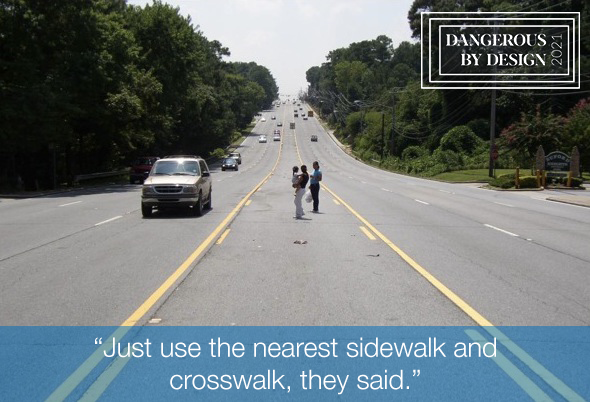
| Look carefully in the turning lane above the center of the photograph. There’s a pedestrian trying to cross this 7-lane urban arterial road. See any crosswalks anywhere on the road? Photo courtesy of Dan Burden. |
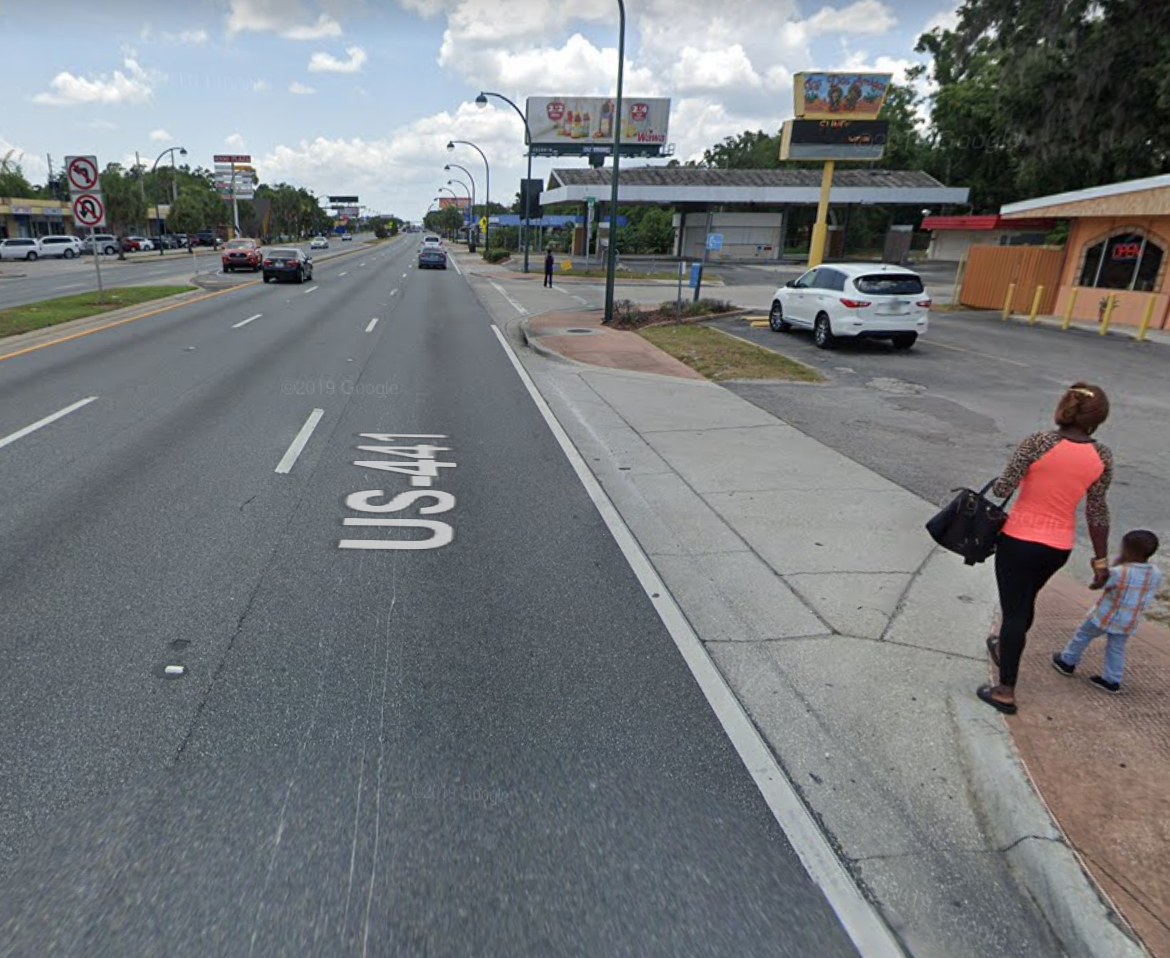
Over the last several decades, many of our cities and communities have seen the same shift of daily business from walkable, downtown Main Streets to wide, fast-moving state highways. These “arterial” roads are the new main streets in most communities, drawing shopping centers, drive-throughs, apartment complexes and office parks. Unlike the old walkable main streets, however, the pressure to move as many cars through these areas as quickly as possible has led transportation departments to squeeze in as many lanes as they can, while disregarding sidewalks, crosswalks and crossing signals, on-street parking, and even street trees in order to remove impediments to speeding traffic.
As a result, more than half of fatal vehicle crashes occurred on these wide, high capacity and high-speed thoroughfares. Though dangerous, these arterials are all but unavoidable because they are the trunk lines carrying most local traffic and supporting nearly all the commercial activity essential to daily life.
Before the top 10 most dangerous city rankings, here are just a few facts you might like to know:
Inadequate facilities. Of the 9,168 pedestrian fatalities in 2007-08 for which the location of the collision is known, more than 40 percent were killed where no crosswalk was available.
Spending disparity. Though pedestrian fatalities make up 11.8 percent of all traffic-related fatalities, states have allocated less than 1.5 percent of total authorized transportation funds to projects aimed at improving safety for pedestrians (for funds spent under current transportation bill.) No state spends more than 5 percent of federal transportation funds on safety features or programs for pedestrians or cyclists, despite a 30 percent increase in total federal transportation dollars beginning in 2005.
Complete streets save lives. Providing sidewalks, crosswalks and designing for lower traffic speeds saves lives. Only one in 10 pedestrians deaths occurred within crosswalks, while six in 10 occurred on arterial-type roads where speeds were 40 mph or higher.
The danger is not shared equally. Older adults, disabled and low-income Americans are being killed at disproportionate rates. African-Americans, who walk for 50 percent more trips than whites, and Hispanic residents, who walk 40 percent more, are subjected to the least safe conditions and die disproportionately.
Aging in place, yet unable to leave the house on foot. An AARP poll of adults 50 years and older found that 40 percent reported inadequate sidewalks in their neighborhoods and nearly half of respondents reported that they could not safely cross the main roads close to their home.
| Rank | Metropolitan Area | 2007-08 Pedestrian
Danger Index |
|
| 1 | Orlando-Kissimmee, Fla. | 221.5 | |
| 2 | Tampa-St. Petersburg-Clearwater, Fla. | 205.5 | |
| 3 | Miami-Fort Lauderdale-Pompano Beach, Fla. | 181.2 | |
| 4 | Jacksonville, Fla. | 157.4 | |
| 5 | Memphis, Tenn.-Miss.-Ark. | 137.7 | |
| 6 | Raleigh-Cary, N.C. | 128.6 | |
| 7 | Louisville/Jefferson County, Ky.-Ind. | 114.8 | |
| 8 | Houston-Sugar Land-Baytown, Texas | 112.4 | |
| 8 | Birmingham-Hoover, Ala. | 110.0 | |
| 10 | Atlanta-Sandy Springs-Marietta, Ga. | 108.3 | |
| See the full rankings and download the report | |||
Health advocates blanket Congress with health & transportation message
October 19, 2009By Sean Barry
![]() |
| 139 Originally uploaded by Transportation for America |
| Dr. Richard Jackson speaks at the podium, flanked by Dr. Georges Benjamin, left, Shireen Malekafzali, Dr. Joe Thompson, James Corless, and Julia Lopez. More info about the speakers can be found in our press release. |
Our transportation investments and the built environment — what we build and where — have an enormous impact on our health and the cost of our health care.
With the debate over health care reform dominating the news daily, Transportation for America and coalition members from across the country took that powerful — yet often ignored or neglected — message to Capitol Hill leaders.
T4 America’s “health fly-in” last Friday connected health professionals and advocates from across the country with their Congressional representatives to highlight the impact that transportation has on our health and wellness.
T4 America kicked off the day with a briefing from campaign director James Corless and four other nationally recognized experts on health and transportation. Then, participants from across the country, from the Pacific Northwest to New England, split up and took the message to their representatives, visiting a total of 37 Congressional offices.
Among the 25 participants in the fly-in, six hailed from national groups and 19 from state and local organizations. Several, including fourteen-year-old childhood wellness advocate Julia Lopez and UCLA professor Dr. Richard Jackson, traveled all the way from California. (Look for a full list of organizations at the bottom of the post)
During the meetings, advocates discussed how the built environment — where we live, work and play — has a profound impact on obesity rates, diabetes, asthma and other quality of life measures. And they discussed policy prescriptions that can increase walkability, grow transit ridership and make physical activity a normal part of our daily routine.
“As a pediatrician and child advocate, my job is to do what I can to make sure as many kids as possible live healthy lives, and the biggest threats to them at this time are injuries — both violent and unintentional — and obesity,” said Dr. Katherine Kaufer Christoffel, a medical and research director at Northwestern University.
“This active transportation stuff really gets at all of those things.”
Dr. Joe Thompson, Director of the Robert Wood Johnson Foundation Center to Prevent Childhood Obesity, participated as a briefing panelist but did not attend Congressional meetings. Thompson serves as the Surgeon General of the State of Arkansas, where an alarming 22 percent of children are obese and 40 percent are overweight. Thompson said the built environment is a critical component of America’s livelihood.
“If we don’t solve the upstream causes of health problems, we won’t be able to hold health care reform together,” he said.
![]() |
| 207 Originally uploaded by Transportation for America |
| 14 year-old health advocate Julia Lopez chats with attendees of the health fly-in after making a few remarks. |
Noelle Dobson, Director of the Healthy Eating Active Living initiative at Portland’s Community Health Partnership, has been stressing the link between health and transportation through her work preparing health impact assessments for new development projects.
“This is all public health has ever been about for me,” she said.
T4 America and participating advocates were promoting three important pieces of legislation that address the health and transportation connection.
One is CLEAN-TEA, a Senate bill that would allocate ten percent of revenue from climate legislation toward clean transportation, walking and biking, and other modes that can help reduce emissions. The second is the National Transportation Objectives Act, which would create explicit, specific targets and benchmarks for the transportation bill, including goals like reducing CO2 from transportation by 40%, eliminating at-risk exposure to pollution, and tripling the amount of walking and biking we do. Lastly is Complete Streets legislation to make our streets safe and accommodating for all users and people — bus riders, bicyclists and pedestrians.
Most fly-in participants met with their representatives’ transportation staffers, but a few were able to meet face-to-face with the representatives themselves. Heidi Klein, a board member for the Vermont Public Health Association, got a few words in with Vermont Senator Bernie Sanders, and two fly-in participants from Montana had the chance to meet their junior Senator, Democrat Jon Tester.
Other office visits included Sen. Barbara Boxer of California, Sen. Lamar Alexander of Tennessee, Sen. Ron Wyden of Oregon, Sen. Dick Durbin of Illinois, Sen. Robert Menendez of New Jersey and Sen. Max Baucus of Montana.
Our thanks to the many advocates and supporters who worked very hard to take this crucial message to Capitol Hill.
Participating organizations:
- National Recreation and Park Association
- National Coalition for Promoting Physical Activity
- Campaign to End Obesity
- American Public Health Association
- American Lung Association
- PolicyLink
- National Complete Streets Coalition
- Trust for America’s Health
- America Bikes
- Safe Routes to School
- State and Territorial Injury Prevention Directors Association (STIPDA)
Even Newt agrees: Let the kids bike
October 9, 2009By Stephen Lee Davis
![]() |
| Newt Gingrich at Manhattan Tea Party Originally uploaded by ajagendorf25 |
Raise your hand if you had former Speaker of the House Newt Gingrich pegged as a staunch advocate for walking and biking to school?
A few days after schools across the country celebrated Walk to School Day, a middle school in Saratoga Springs, New York is in the news once again for their policy prohibiting students from walking or biking to school. Apparently, Newt Gingrich caught wind of their policy and wrote the school district a letter urging them to drop their policy.
Twelve-year old Adam Marino and his mother were thrust into the spotlight back in May when he chose to bicycle to Maple Avenue Middle School in violation of a current prohibition. Adam told the Albany Times-Union this week that biking has improved his health and his studies. School officials said the prohibition was to keep children safe.
Gingrich, the Georgia Republican who led the GOP takeover of Congress in 1994, heard the story and sympathized with Adam. He penned a letter to school officials, writing: “At a time when nearly one-third of American children and teens are overweight or on the brink of obesity, students like Adam who exhibit healthy behaviors should not be punished but rather rewarded.”
Gingrich’s support for the young bicyclist is welcome, but Maple Avenue Middle School’s concerns about safety shouldn’t be dismissed out of hand either.
County and state officials should be working to ensure that Adam and others like him have a safer ride, rather than just declaring it “unsafe” and giving up. The first story about Adam, back in May, pointed out that the school district hadn’t applied for any state funding from the Safe Routes to School program, which can help communities improve streets and add sidewalks to make walking and biking to school safer for children.
Does this mean we can assume the Speaker’s support for Complete Streets legislation and Safe Routes to School to help making walking and biking safer and easier for people just like Adam?
Improving access to healthcare by improving transportation options
July 17, 2009By Lilly Shoup
![]() |
| Photo by Dan Burden |
Yesterday we noted transportation’s impact on health care costs, and how expanding access to public transportation and investing more money in complete streets safe for walking and biking can improve overall health and lower healthcare costs.
At the same time, we should remember that having transportation options and the ability to easily get where you need to go have a huge impact on whether or not you receive care. Folks who can’t get to the doctor or who must wait on rides from family and friends are more likely to stay sick.
A study of over 1,059 households in 12 western North Carolina counties tests the relationship between transportation options and healthcare utilization while adjusting for the effects of personal characteristics, health characteristics, and distance. The report found that people with reliable access to healthcare visited their doctor 2.29 times more frequently for serious illness and 1.92 times more frequently for regular checkups than those who did not.
The ability to reliably and affordably make it to doctor’s visits or healthcare appointments is also a matter of transportation equity. Minorities, households in rural areas, the disabled, and low-income Americans face even greater hurdles because many cannot drive and public transportation is often unavailable, inaccessible or unreliable. (Not to mention public transportation, paratransit or dial-a-ride programs being cut left and right)
We already know Americans are tired of being stuck in traffic and are clamoring for more options for getting around. But they are also demanding prevention as a top health care reform priority, and overwhelmingly support increasing funding for prevention programs to reduce disease and keep people healthy.
Meeting the health care needs of all Americans will require funding infrastructure projects that can create more opportunities for physical activity. The healthcare bill Congress is currently working on is just another opportuniy to demand that transportation options and access issues are more broadly included in the debate. It is not just the cost of care, but the ability to access that care that’s proven to reduce hospitalization rates for chronic conditions.
Planning for the future: Washington’s new Woodrow Wilson Bridge
June 17, 2009By Stephen Lee Davis
![]() |
| A New Trail Originally uploaded by M.V. Jantzen. A bicyclist cruises along I-495/95 on the new Woodrow Wilson Bridge “active transportation lane,” leading to the rare sight of someone not in a car using the Capital Beltway. View more photos of the opening on Flickr from Eric Gilliland, director of the Washington Area Bicyclist Association (a T4 partner.) |
Two weekends ago, the 12-foot-wide bicycle and pedestrian lane of the Woodrow Wilson interstate bridge over the Potomac River held its grand opening in Washington DC, filling with bikers and walkers who can now join the thousands of cars that cross the bridge each day.
The bridge, which connects Virginia and Maryland on the southern part of the Capital Beltway, is a vital transportation link in the region, where Interstate 95 (and the large majority of truck traffic) bypasses Washington, continuing north or south along the eastern seaboard.
Hundreds of bicyclists enjoyed a ride across the bridge for the first time ever last weekend, and the renovations to the bridge also added dedicated space for a future transit line — not something you see everyday on an interstate bridge in the United States.
Building a new bridge to replace the 1961 bridge had been discussed for decades, but the planning kicked into high gear in the 1990’s, with Maryland, Virginia, and the federal government all engaged in the process (DC relinquished control to the states.)
Looking at a map of the Metrorail public transportation system, one can see that only a few miles separate the end of the green line in Maryland and the yellow and blue lines in Virginia. There was no active work to connect the two lines, but a handful of people in the planning process wondered about dedicating some space on the bridge for a future, useful Metro connection.
Parris Glendening, Governor of Maryland from 1995-2003, said that planning for a future transit connection was just common sense.
“Those stations are just a few miles apart as the crow flies, but no one in Maryland who has a choice is going to ride all the way up into DC to switch trains and ride all the way back out to Virginia — and end up only a few miles from where they started,” he said.
(Continue Reading)