Transportation For America » DOT

Transit grants out the federal door, but what about the cuts?
March 8, 2010
By Stephen Lee Davis

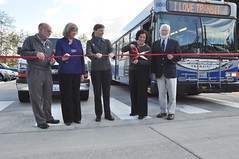
Park and Ride Ribbon Cutting Originally uploaded by WSDOT

Secretary of Transportation Ray LaHood is (rightfully) touting the great news on his blog this morning that the Federal Transit Administration met their ambitious deadline for distributing 100% of the transit funds from the stimulus package. That’s great news, but it should be accompanied by the sobering reminder that these public transportation systems that get people to work each day largely couldn’t use that money to keep from having to cut service at a time when it’s needed the most.

The FTA has now doled out 881 grants totaling $7.5 billion since the stimulus was signed last year, and LaHood notes that these grants have funded the purchase of nearly 12,000 buses, vans and rail vehicles; construction or renovation of more than 850 transit facilities; and $620 million in preventive maintenance to keep systems running smoothly.

But what about the hundreds of agencies cutting back service, raising fares, or laying off workers — like the terrible story from Atlanta we chronicled last Friday, where 25-30% of all service may be history come June?

Unfortunately, the FTA’s hands were tied with the rules for the grants set by Congress, which meant that almost all of the money had to be used to purchase new equipment or perform maintenance, even if those agencies couldn’t afford to hire or train the new drivers to operate the buses or railcars. We say “most of the money,” because a group of lawmakers were able to successfully include a provision in a separate bill during the summer that made it possible for local transit agencies to spend up to 10% of their transit stimulus money on operations. But in many places like St. Louis, where the deficit was ten times the $4.6 million they could now spend on service, that’s not enough to keep from having to make drastic cuts or lay workers off, even while getting an influx of federal money.

With a full transportation bill likely months away, in the short term we need to urge the Senate to include money in any future jobs bills to help keep transit systems running.

With millions who depend on these systems each day to get to work, making sure that reliable transit service doesn’t disappear will help get them to their jobs quickly and conveniently each day, ensuring that many of them stay employed.

Bookmark and Share

TIGER Grants Offer Critical Support to Communities with Innovative Transportation Projects

February 17, 2010
By Transportation for America

Merit-based program an excellent model for the next transportation authorization

The Obama Department of Transportation today broke historic ground in unveiling projects chosen in a first-ever program to award federal dollars on a competitive basis to innovative projects that address economic, environmental and travel issues at once.

The 51 projects announced under the TIGER grant program, funded by $1.5 billion included in the American Recovery and Reinvestment Act (ARRA), meet a broad array of challenges, including:

  • Bridge replacements in Oklahoma, Michigan, Wisconsin, Kentucky and Indiana that can support multiple modes of travel;
  • Port and freight-rail projects to spur economic growth in Tennessee, Alabama, Mississippi, Virginia, Hawaii, Pennsylvania and Ohio;
  • Modern streetcar construction to support vibrant urban corridors in Tucson, Dallas, Portland and New Orleans and light rail in Detroit;
  • Innovative highway funding and operations in Texas, North Carolina, Colorado, South Carolina and Arkansas;
  • Bicycle and pedestrian networks in Philadelphia, Indianapolis, and a complete streets project in Dubuque, IA;
  • The long-awaited rebirth of New York’s former Penn Station as Moynihan Station.

“These are the kinds of projects that will create good paying jobs, spur local economic development, revive our city centers and create regional integrated transportation solutions,” said John Robert Smith, the co-chair of T4 America and former Mayor of Meridian, Mississippi. “Today’s announcement clearly shows the administration’s commitment to supporting livability initiatives in metropolitan regions, smaller communities and rural areas alike.”

A complete list of recipients can be found on the US DOT press release.

Project applications had to show multiple benefits, with priority give to these criteria: 1) that projects improve the condition of existing facilities and systems, 2) contribute to the economic competitiveness of the U.S. over the medium- to long-term, 3) improve the quality of living and working environments for people, 4) improve energy efficiency, reduce dependence on foreign oil, reduce greenhouse gas emissions and benefit the environment, and 5) improve public safety.

Secretary LaHood spoke from Kansas City, showcasing the city’s Green Impact Zone, an area of high unemployment and concentrated poverty that is being revitalized with green buildings, clean transportation options including public transportation and bicycle and pedestrian projects.

DOT Secretary Ray LaHood noted that the program was extraordinarily sought-after, garnering 1,400 applications totaling nearly $60 billion for the $1.5 billion pot. “The sheer popularity of this ground-breaking approach is testament to how many states and localities are struggling to build innovative projects that simply don’t happen under the pre-existing program,” Mayor Smith said.

“We hope this is a glimpse of what the next transportation authorization could look like,” Smith added. “Congress needs to build on this success and authorize the surface transportation program along similar lines to support innovation and integrated transportation solutions in communities of all sizes.”

Bookmark and Share

U.S. DOT Secretary LaHood Announces DOT Safety Council Will Address Pedestrian Safety Following T4 America Report

November 16, 2009
By Transportation for America

Ray LaHood Petition Originally uploaded by Transportation for America
U.S. Transportation Secretary Ray LaHood sits behind a copy of Dangerous by Design and the petition signed by over 4,100 Americans asking USDOT to make safer streets a priority. More photos below.

In a meeting today with Transportation for America, Secretary LaHood commits to working with advocacy groups and reviewing policy to address pedestrian safety.

U.S. Transportation Secretary Ray LaHood today pledged that the DOT Safety Council will take up the issue of pedestrian safety and work with advocacy groups to make America’s streets safer for everyone who uses them.

“The right of way doesn’t just belong to cars — it belongs to pedestrians and bicyclists as well,” said Secretary LaHood. “The DOT Safety Council is going to look at this report and work with advocacy groups to ensure our streets are as safe as possible.”

Secretary LaHood made the commitment during a meeting with Transportation for America and six coalition partners prompted by last week’s release of a report documenting preventable pedestrian deaths nationwide. More than 100 localities and states have adopted complete streets policies, requiring that urban and suburban roadways be designed for the safety and comfort of motorists, pedestrians, bicyclists and public transportation riders alike.

According to Dangerous by Design: Solving the Epidemic of Preventable Pedestrian Deaths (and Making Great Neighborhoods), more than 76,000 preventable pedestrian deaths over the last 15 years in America. That statistic is roughly equivalent to a jumbo jet crashing every month. Most pedestrians were killed on streets designed exclusively to move vehicles, with little or no provision for the protection of people on foot or bicycle, the authors found.

Secretary LaHood already has demonstrated a strong interest in safety with a distracted driving initiative, the creation of a new Safety Council and his overall support for community livability in general. By adding Complete Streets to his list of safety priorities, he and his department can help ensure that every road project facilitates safe travel for everyone — including vulnerable pedestrians.

“Secretary LaHood’s leadership on the entire issue of safety is welcome, indeed,” said James Corless, director of Transportation for America. “In elevating pedestrian and bicyclist safety to a national priority, the secretary is taking a long overdue step that will help to save lives, promote healthy levels of exercise in Americans’ everyday lives and make our neighborhoods, towns and cities even better places to live.”

Corless was joined in Monday’s meeting by representatives from the AARP, America Bikes, the American Public Health Association, National Complete Streets Coalition, the Safe Routes to School National Partnership and Smart Growth America.

“This is an important commitment toward a goal we all share,” said Elinor Ginzler, AARP’s Senior Vice President for Livable Communities. “When Americans walk out of their homes to get to where they need and want to go, they should be confident in their travel safety.”

During the meeting representatives of the Transportation for America coalition presented the secretary with a petition signed by more than 4,100 Americans in the days following last week’s report release. Dangerous by Design was co-produced by the Surface Transportation Policy Project, Transportation for America and the Tri-State Transportation Campaign.

Bookmark and Share

FAQ: What are rescissions? Will my state lose transportation money?

October 5, 2009
By Stephen Lee Davis

Friday, we explained the details surrounding the expiration of the transportation bill on Wednesday night and the one-month extension that was passed. Read that here. Due in part to the failure of a bipartisan plan to shift some revenue to satisfy House budget rules, the states are also losing a total of $8.7 billion in transportation spending, known by the unmistakably Washington-transportation-insider term of a “rescission.”

Here’s our attempt to simplify that issue just a little bit for those who are interested in the policy details. Non-wonks, feel free to skip over this one. Just a fair warning! Click through the jump to read in its entirety.

(Continue Reading)

Bookmark and Share

Sec. LaHood proposes 18-month extension of current transportation bill

June 17, 2009
By Stephen Lee Davis

This morning on Capitol Hill, DOT Secretary Ray LaHood proposed an 18-month extension of the current SAFETEA-LU transportation authorization bill. Beyond simply extending the current bill, LaHood indicated that he wants to include some reforms in the 18-month extension — including a focus on metro areas, extensive cost-benefit analysis, and a commitment to “livable communities” — but was short on other specifics.

No word yet on how this will affect the proposed transportation bill outline to be released by Rep. James Oberstar tomorrow morning. Be sure to check back over the next few days for the latest.

From the DOT press room:

“This morning, I went to Capitol Hill to brief members of Congress on the situation with the Highway Trust Fund. I am proposing an immediate 18-month highway reauthorization that will replenish the Highway Trust Fund. If this step is not taken the trust fund will run out of money as soon as late August and states will be in danger of losing the vital transportation funding they need and expect.

“As part of this, I am proposing that we enact critical reforms to help us make better investment decisions with cost-benefit analysis, focus on more investments in metropolitan areas and promote the concept of livability to more closely link home and work. The Administration opposes a gas tax increase during this challenging, recessionary period, which has hit consumers and businesses hard across our country.

“I recognize that there will be concerns raised about this approach. However, with the reality of our fiscal environment and the critical demand to address our infrastructure investments in a smarter, more focused approach, we should not rush legislation. We should work together on a full reauthorization that best meets the demands of the country. The first step is making sure that the Highway Trust Fund is solvent. The next step is addressing our transportation priorities over the long term.”

UPDATE: The Wall Street Journal has a story up covering LaHood’s proposal, and includes a quote from Rep. Oberstar, responding to the idea of an extension:

In a meeting with reporters Wednesday, Mr. Oberstar was adamant that Congress must pass a new law before the current one expires.

“Extension of current law is unacceptable,” Mr. Oberstar said. “Now is the time to move.”

UPDATE 2: Michael Cooper of the New York Times covers the proposed extension, and gets a statement from Jim Berard, spokesman for Rep. Oberstar. “The chairman is not too pleased with the administration’s proposal,” he said.

Bookmark and Share

Transportation for America applauds new inter-agency effort to connect transportation, housing affordability, and livability

June 17, 2009
By Transportation for America

CONTACT: Ben Grossman-Cohen
202-478-6185
bgrossman-cohen@mrss.com
Download: .pdf .doc

Washington, D.C. — In a bid to ensure that environmental policy helps, and does not hinder, efforts to make our communities more livable, affordable and convenient, U.S. Environmental Protection Agency has joined an unusual partnership with the Department of Transportation and the Department of Housing and Urban Development.

The move, announced Tuesday by EPA Administrator Lisa Jackson, is intended to “help American families … gain better access to affordable housing, more transportation options, and lower transportation costs,” and protect the environment along the way, according to an EPA statement.

EPA Administrator Lisa Jackson joined HUD Secretary Shaun Donovan and DOT Secretary Ray LaHood before the Senate Banking, Finance and Urban Affairs Committee Tuesday to testify about their joint Partnership for Sustainable Communities, an initiative to bridge inter-agency boundaries that sometimes impede progress.

Jackson told the committee that it makes sense for these three agencies to work together:

“Where you live affects how you get around, and how you get around often affects where you live. Both decisions affect our environment. Working together rather than independently, our three agencies can improve the environment, the transportation system, and homes and communities throughout the United States.”

“We’re encouraged to see these agencies working together to lead the way in meeting these national challenges head on,” said T4 America Director James Corless. “We all know that we can’t address climate change, dependence on oil, housing affordability or access to transportation choices independently. These issues are inextricably connected — and any effective solutions must be evaluated comprehensively and dealt with holistically.”

Bookmark and Share

Transportation Secretary affirms smart principles for US transportation system
April 29, 2009
By Stephen Lee Davis

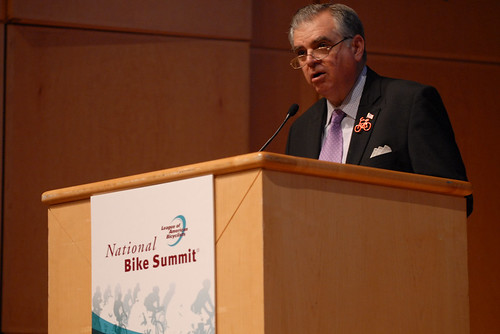
National Bike Summit – Day two-8 Originally uploaded by BikePortland.org
DOT Secretary Ray LaHood speaks at the National Bike Summit in Washington, DC

“Livable and Sustainable Communities.”

Those four words might not be at the top of the list of what one would expect to hear from the person in charge of how the federal government spends our tax dollars on all forms of transportation — ports, railroads, highways, interstates, sidewalks, bike lanes and more — but that’s exactly what U.S. Transportation Secretary Ray LaHood named as a primary goal for DOT while testifying before a Senate Committee yesterday (ahead of T4 America.)

In his remarks, he made it clear that DOT and the Obama administration see the deep connections between where and how we spend transportation dollars and the quality of life for everyday Americans.

One of the clear issues with our national transportation program since 1991 is that it’s been like a huge ship without a rudder — spending billions each year without any clear goals or vision for exactly what those billions should accomplish for us. Economic development? More travel options for everyone? Making transportation affordable and safe for all Americans?

After talking at length about the many challenges facing America, Secretary LaHood made it clear that DOT will be governed by some very clear principles in the future, including better quality of life as a goal for transportation spending:

With these great challenges it is essential that our transportation policies be framed so that we can meet these demands and at the same time be consistent with the major goals I have established for guiding the actions of the Department of Transportation: economic recovery; safety; and livable and sustainable communities will be the key organizing themes as we in the Department reformulate existing policies and develop new policy directions for the future.

You can download his full remarks from the committee web site here, (.pdf) but continue reading for a few select quotes:

(Continue Reading)

Bookmark and Share

U.S. Transportation and Housing Secretaries testifying about livable communities today

March 18, 2009
By Stephen Lee Davis

Updated: Read the DOT release following the hearing here.

We noticed an encouraging announcement from Department of Transportation Secretary Ray LaHood on his blog this morning, following on the heels of yesterday’s post highlighted on the Streetsblog Network. Yesterday he said “we are absolutely committed to more livable, sustainable communities by reducing congestion, by building housing near transit, by supporting all modes of transportation.”

Secretary LaHood will be testifying on Capitol Hill today with Housing and Urban Development Secretary Shaun Donovan about a new joint effort that might put some legs to those values from yesterday’s post.

According to today’s posting on Secretary LaHood’s blog, the two of them will be unveiling an initiative to “revitalize our downtowns, foster walkable neighborhoods, and bring people, employers, and housing closer together through public transportation.”

It’s been encouraging to hear the “livability” buzzword coming from the transportation department on a regular basis — not to mention as a centerpiece of President Obama’s platform. Of course, realizing this quality of “livability” in our communities will require significant changes in transportation spending, underscoring the importance of this year’s transportation bill before Congress. Because “livable communities” are not what we’ll get if we do exactly what we’ve done for the last 50 years.

From the rest of his post:

Fostering livable communities is a key aspect of President Obama’s urban policy agenda and Vice President Biden’s Middle Class initiative. The way we design our communities has a huge impact on our citizens’ social, physical, and economic wellbeing. Yet many Americans live in neighborhoods without sidewalks or access to public transportation.

Therefore, one of my highest priorities is to work closely with Congress, other Federal departments, the nation’s governors, and local officials to help promote more livable communities through sustainable surface transportation programs. By focusing on livability, we can help transform the way transportation serves the American people—and create safer, healthier communities that provide access to economic opportunities.

Bookmark and Share

New Transportation Secretary Faces Unprecedented Opportunity to Shape America’s Future

January 22, 2009
By Transportation for America

Download this Release (.pdf)
Contact:
Ben Grossman-Cohen
202-478-6185
bgrossman-cohen@mrss.com

WASHINGTON, D.C. — President Obama’s choice of retiring Congressman Ray LaHood (R-IL) for Secretary of Transportation shows his commitment to working across the aisle to make government work again. We agree with Secretary-designate LaHood that, “our transportation system and the development it enables must be sustainable” and welcome the opportunity to work with him during the important days ahead.  Although Mr. LaHood’s record on transportation issues is not long, he is by all accounts a pragmatic and committed public servant and we strongly support his expressed emphasis on openness and fairness.

The next transportation secretary has a greater opportunity to shape the economic future of our nation than any of his predecessors in recent memory. This opportunity starts immediately with the economic recovery package. The Department of Transportation must provide critical oversight of the stimulus spending to ensure that transportation agencies use the money both quickly and wisely, by repairing and maintaining our crumbling infrastructure and transit service, and not just engaging in road-building for its own sake.

The DOT Secretary also can have substantial influence on the effort to restore our economy, create jobs and reduce our oil dependency through a major renewal of our national transportation program later this year. The current transportation law, SAFETEA-LU, expires this year. Given the urgent need for a more complete, cleaner transportation system, as well as the long-term decline in motor fuel tax receipts, our nation is due for major reform, and the Secretary must provide important information and insight, not just in crafting a new approach, but in implementing it after it is adopted.

Through all this, the Secretary and his department must work with the new Climate and Energy Czar Carol Browner and the White House Office of Urban Policy in an unprecedented way to make sure our communities are livable, our children can breathe safely, and that our nation can successfully compete in the 21st Century.

Transportation for America — a national coalition of leading housing, real estate, environmental, public health, equity, urban planning and transportation organizations — agrees with President Obama that we need to invest in a new energy economy that will end our addiction to foreign oil, address the global climate crisis and create millions of new jobs.  That is why we stand ready to support Secretary LaHood in any effort to help navigate this unprecedented opportunity.

Bookmark and Share

U.S. PIRG challenges states to invest in 21st century transportation infrastructure

January 16, 2009
By Andrew Bielak

In the run up to the economic stimulus, we’ve been taking a hard look at some of the transportation project lists that states are putting together.

While many of details of the federal stimulus are still being hashed out, our analysis of these state project lists has made one thing quite clear — if we expect to create more jobs, protect our climate, and reduce our dependence on oil, our state and federal governments need to do a much better job of investing in green infrastructure projects that will help us rebuild and retool our economy.

Transportation for America partner and national advocacy organization U.S. PIRG has now released a new report, “Economic Stimulus or More Misguided Spending,” that takes an in-depth look at some of the project lists from the states, and finds some troubling trends:

Most stimulus project lists from state DOTs prioritize new highways while paying relatively little attention to repairing crumbling bridges and roads and even less emphasis on forward-looking transportation options, such as public transit and intercity rail. As a result, they are contrary to President-elect Obama’s stated intention to use smart spending to reduce America’s dependence on oil and emissions of global warming pollution.

U.S. PIRG and its state partners are pushing the report in key states across the country, and have already garnered attention in California, Connecticut, Arizona, and Florida.

With your help, we can push our state governments and federal lawmakers to match their words with actions by investing in a clean, green, 21st century economy. Check out the PIRG report and Transportation For America’s analysis to see how your state wants to spend its stimulus dollars, and be sure to sign our petition urging Congress to fix what’s broken before committing billions to expanding roads and highways.

Bookmark and Share

Older posts »

About Us | Our Partners | Contact Us | For The Media | Become a Partner

Transportation for America
1707 L Street NW Ste. 250
Washington, DC 20036
202-955-5543

Creative Commons License
This site is licensed under a
Creative Commons License
.