The 2025 election showed why transportation matters in the affordability conversation

Affordability defined the 2025 election cycle. Several notable races pushed funding public transportation to the forefront, showing how investing in multimodal transportation can be part of a campaign on affordability.

Transportation is the second largest cost for households after housing, and numerous winning candidates who focus on housing and transportation affordability. And when the issue itself was on the ballot, it continued to perform well: According to the Center for Transportation Excellence, voters once again recognized the importance of continually expanding public transit by approving 84 percent of ballot measures that raised money for public transit. This year’s strong showing is in line with the recent historical trend: voters have supported 84 percent of public transit ballot measures since 2018.

There were wins for transportation across the country, but here are a few notable races:

1. Zohran Mamdani, New York

New York City mayor-elect Zohran Mamdani’s upstart campaign exemplified the centrality of the affordability crisis in the 2025 election cycle. He pushed for fast, fare-free buses based on a previous pilot he co-sponsored as a New York State Assembly member. He notably placed his key transportation proposal under the “affordability” platform on his website, arguing that lowering transportation costs is a crucial way of making life easier for New Yorkers. While we may favor transit frequency and proximity to housing over fare-free transit, the campaign was right: transportation is absolutely at the heart of the affordability conversation.

2. Katie Wilson, Washington

Seattle mayor-elect Katie Wilson started her transportation advocacy as a cofounder of Seattle’s Transit Riders Union in 2011, spending the next 14 years of her career fighting against bus-service cuts while working to establish reduced fares for low-income riders and students. She then added housing to her advocacy, supporting a payroll tax that would fund affordable housing construction. After the current mayor refused to support the ballot measure for the payroll tax she helped craft, Wilson left the Transit Riders Union and began her successful run for mayor, campaigning for affordable, abundant housing and building a “world-class public transportation system.

Her campaign contained an incredibly wide spectrum of transportation and housing ideas that transcend political categories. She campaigned for robust social housing and abundant market-rate, private development in order to make Seattle’s housing market more affordable. She also stumped for shifting trips in cars to other modes, creating pedestrianized superblocks, removing permitting hurdles for transit projects, and prioritizing safety for those walking and biking. She secured an unexpected win over an incumbent because of her promise for affordability through the building of more housing and the expansion of comprehensive public transportation and active transportation networks.

3. Mikie Sherrill, New Jersey

In the New Jersey governor’s race, both candidates championed ideas of smart growth. The ultimate winner of the race Mikie Sherrill supported mass transit investment as a means of combatting congestion, avoiding the siren song of roadway expansion. She also espoused a fix-it-first mindset, calling for repairing existing bridges and roadways before building more, keeping up New Jersey’s recent trend of spending on maintenance over expansion. The Republican candidate Jack Ciaterelli championed stopping sprawl and placing new housing in locations with more abundant transportation options. The New Jersey governor’s race shows that good ideas for tackling affordability in housing and transportation are not limited to any party.

North Carolina votes yes on transportation investments

Charlotte voters also backed an increase in their sales tax to raise more than 19 billion for a wide range of transportation investments. The successful measure will direct 40 percent of new revenues to commuter rail and light rail expansions, 20 percent to improvements to bus frequencies, and 40 percent to roadway expansions and walking and biking infrastructure. While Charlotte and the surrounding suburbs may seem to be affordable in comparison to other metro areas in the U.S., its housing costs are rising quicker than their average household income. At the same time, there is a severe lack of public transit and walking and biking infrastructure. With many North Carolinians lacking or having limited access to a vehicle, investing in public transportation is one of the best ways to address affordability in the area. With this vote, the largest city in North Carolina will finally get commuter rail, extend their streetcar and light rail network, and invest in a network of safer streets for people walking and biking.

In these local and state races, when they are given a choice, voters repeatedly choose to support funding public transportation. Congress would do well by learning from this lesson.

Letter to Congress calls for penalties for failing to improve roadway safety

Nearly 40,000 people are dying on our roads each year, and Congress must take action to address the crisis by requiring changes in policy and practice. Last week, the National Complete Streets Coalition, Transportation for America, and a coalition of 24 other national, state, and local organizations sent a letter to Congress, calling on them to immediately address safety in road design instead of letting thousands more die year after year.

Since the Infrastructure Investment and Jobs Act was passed in 2021, roughly an average of 40,000 people have died per year on U.S. roads. If the trend continues, over 200,000 people will die over the course of the next five-year surface transportation reauthorization bill. The federal government has a fundamental duty to protect those who are getting killed everyday and they cannot wait until this transportation bill expires (or later) to address the roadway safety crisis. That’s why we wrote a letter calling on Congress to hold hearings on improving federal roadway design standards to prioritize safety for all roadway users, change the federal roadway design standards based on the lessons learned from those hearings, and penalize state DOTs and metropolitan planning organizations that fail to improve safety.

Federal roadway design standards favor the speed of cars over the safety of everyone using the roadway, leading to a 40-year high in people killed while walking and biking, and higher roadway deaths per billion vehicle kilometers traveled than any of our peer nations. The federal government provides hundreds of millions of dollars each year to state DOTs and metropolitan planning organizations which they then use to build dangerous roads constructed using roadway design standards that favor car speeds over regularly-placed crosswalks, daylighted intersections, and protected bike infrastructure. When more and more people walking and biking die on these federally funded roads, the government levies zero consequences against the main culprits, state DOTs and MPOs. Congress will try and pass a new “traditional” transportation bill by next year, a supposed “return to basics.” However, our traditional methods of funding transportation have resulted in congestion, crumbling roads, and a record number of lives lost. The U.S. cannot afford to continue with business as usual. Congress needs to hold hearings and learn from experts about road design that protects all road users, alter road design recommendations in response to what they learn, and restrict funding to states and MPOs who exacerbate the roadway safety crisis.

In a letter sent to Congress last week, we proposed three concrete actions for Congress and USDOT to take. You can read them in full in the letter, but they are:

1. Prioritize safety in all road design guidance and within the entire federal transportation program, rather than treating safety as an afterthought.

Federal roadway design guidance is inherently broken. Manuals such as the Policy on Geometric Design of Highways and Streets from AASHTO and the Manual of Uniform Traffic Control Devices value continuous movement of cars over the safety of those both inside and outside vehicles leading to wide, high speed roads. There is no requirement that our federal roadway design standards be proven to improve safety. It is well established that speed increases the deadliness of a roadway and that safety and speed are fundamentally incompatible, yet the design manuals our federal government recommends ignore this basic truth. This creates a dangerous environment for pedestrians, cyclists, people with disabilities, and those inside vehicles. Congress needs to ensure that our roadway design guidance is evidence-based, allows for innovation, and protects those who are walking, biking, and driving.

2. Require measurable improvements on safety from all funding recipients—with penalties for failing to perform.

Congress funneled historic amounts of money to state DOTs and MPOs in the IIJA with big promises to improve roadway safety, however those results have yet to be seen. Congress cannot continue to dole out millions without any enforceable targets, therefore Congress should tie funding to outcomes, including safety. Congress must call on these states to answer for the disappointing outcomes resulting from federal funds. If states and metropolitan planning organizations fail to meaningfully decrease the number of people dying while walking and biking on their roadways, Congress should limit their funds to programs that improve safety and repair rather than allow them to burn millions on dangerous new or expanded roads.

3. Hold hearings in the House and Senate focused specifically on how road design contributes to the roadway safety crisis and holds the key to solving it.

Reauthorization in 2026 represents our best opportunity to orient federal policy and spending toward improving safety. But we need to lay the groundwork for that bill now. Congress must hold additional hearings focused specifically on the ways road design contributes to the roadway safety crisis, why we are failing at all levels to implement safer designs, and how Congress can actively help address this crisis. They need to quickly gain a deeper understanding of the relationship between roadway design and poor safety outcomes, successful interventions to address roadway safety through design best practices, and why states repeatedly fail to implement safe road design. They must call for the best roadway design practices from at home and abroad to be more widely implemented and recognize the roadway safety crisis as a public health emergency. Congress cannot spend the next year writing a transportation bill that fails to address dangerous roadway design and its contribution to the roadway safety crisis. They need to go beyond public support for safety and show their commitment by working with experts to problem solve and address the fundamental issue of flawed roadway design through legislation and appropriations.

Congress cannot ignore the catastrophe they’ve helped create. They need to listen to the local, state, and national voices that are demanding they use their legislative authority, act now, and save lives.

Holding states and MPOs accountable for road safety

A man walks along a busy interstate with no sidewalk

Everything in the federal transportation program has the word “safety” plastered all over it, but the program fails at nearly every turn to actually require safety improvements from those who are picking the projects and spending the money. Our roads will continue to be among the most dangerous in the entire developed world until Congress starts requiring agencies to set clear goals to improve safety on their roads and then holds them accountable for doing so.

T4’s policy proposal for prioritizing safety over speed

In our second principle for reauthorization, safety over speed, we outline the ways that states and MPOs should be held accountable for improving roadway safety: 

  • Requiring states and MPOs to set targets to improve the safety of their roadways for all road users.
  • Assisting states and MPOs that fail to meet their safety targets, by requiring a share of formula funds, as well as federal competitive awards, must be dedicated to safety projects. 

We need a system that requires measurable improvements on safety, and holds everyone accountable for producing results—with penalties for those that are failing to make progress on what should be the guiding principle of every dollar spent. Here’s how we do that.

1) Require states and metro areas to set targets to improve the safety of their roadways for all road users.

States and MPOs must continually move the needle on safety, which means aligning all of their goals, plans, and projects around reducing the number of deaths and serious injuries on their roads—for everyone who uses them. Step one is requiring that agencies set performance targets at levels that would actually improve the safety of their roadways for all road users. (Learn more about our current system of performance management here.) You might be surprised to learn that many DOTs, which receive billions to improve our transportation system—with a top priority of safety enshrined in the federal program—then set annual goals for their roads to get more dangerous. The targets are especially terrible when it comes to the safety of people walking, biking, or otherwise not in a vehicle: 10 states in total set targets for more people outside of vehicles to be injured/killed in 2024 compared to 2022.  

Oklahoma targets vs actual from T4America’s State of the System data hub

Congress should require states and MPOs to set targets that aim to decrease the number of deaths and serious injuries on our roadways for all road users. No one receiving historic amounts of federal transportation funding should be permitted to set “goals” for more people to be killed on their roadways. States and MPOs need to have the objective of killing fewer people every year; it’s the bare minimum the American people deserve.

2) Hold states and MPOs accountable for failing to improve safety with real financial penalties

It’s not enough to say you want to improve or set positive targets that you never reach. For example, Florida sets a comical target for zero deaths every year despite more than 3,000 people being killed each year—a number which has seen increases over the last ten years. 

Florida targets vs actual from T4America’s State of the System data hub

Having targets without any incentives or penalties has led to our current performative system, where safety is only given lip service. We need to end the status quo where we shovel exponential amounts of money into an increasingly dangerous transportation system and call it progress. For states and MPOs that fail to meet these new safety targets, where improvements are required, there should be penalties that hold them accountable for improving safety.

Congress should require USDOT to dedicate a share of formula funds to safety projects for states and MPOs that fail to meet their goals. Formula funds, even those intended for safety projects, are flexible and are very often transferred around to other programs and purposes by states and MPOs. However, if they fail to meet their positive targets for improving safety, they should lose this privilege. Funds intended for safety should be prohibited from being transferred out of core safety programs, like the Highway Safety Improvement Program. If they are unable to improve safety, there is no reason why they should be able to take safety-specific money and spend it on non-safety projects. 

A second major change for these failing states or metro areas is that they would be required to spend a share of their apportionments of the National Highway Performance Program, the largest formula program intended for use on the National Highway System, and the Surface Transportation Block Grant Program on safety projects identified in their newly reformed planning documents for confirmed projects.

This change would mean less potential money for projects like congestion reduction or roadway expansion that increase danger for road users, and more in the bank for everyone’s top priority: safety. There are also rewards: States that are doing a good job on safety by meeting their targets and demonstrating consistent year-over-year improvements in safety for all road users would get rewarded with more of the flexibility they prize so much. 

Finally, failing states and MPOs would be restricted to competitive grants related to roadway transportation safety improvements. These failing states or metro areas would be ineligible to apply for certain programs unless their projects clearly demonstrate that they will improve safety as a main goal.  Failing states and MPOs could continue to apply for discretionary grants such as INFRA or MEGA, but the key proposed outcome of their application should be to improve safety for all road users. These grants are discretionary, and therefore, USDOT should not reward noncompliant states and MPOs with additional funding if they cannot achieve their goals around safety. 

Prioritize safety over speed

All the changes outlined in this series of posts on T4America’s top priority of prioritizing safety over speed are centered on creating a new feedback loop focused on producing better performance, transparency, and outcomes. We need more complete and current data on where and how people are being killed or injured so we can better understand the scope of the problem. All grantees in the federal program should be setting goals and targets to improve safety. They should then pick specific projects to help them reach those goals, using designs that are proven to improve safety. The public should be able to clearly see and understand what projects were chosen, and assess for themselves the merits of those projects. And finally, agencies that fail to make progress on safety should be held accountable for their performance with real penalties.

If safety is truly the priority, everyone with the money must be held accountable for getting us there. This set of reforms will help us make that happen. Never again should we plow billions into a federal transportation law without ensuring that doing so will produce dramatic improvements on safety. 

Reforming state transportation plans to make safety the priority

Finding and deciphering the lists of transportation projects planned by states and metropolitan planning organizations are nearly impossible for the average person. The plans they do have often involve making roads faster and more dangerous and the goals they have are divorced from a supposed priority of safety. These plans need to be transparent and easily understandable so that the public can understand how projects advance transportation priorities.

The U.S. provides billions of dollars in block grants to state departments of transportation and metropolitan planning organizations (MPO), but despite using public dollars, the projects seem unrelated to the USDOT’s “top priority” of safety. The DOTs and MPOs are allowed the freedom to allocate federal funding to projects they prioritize. They are required to document these projects, however in the end there is no real requirement to explain how these projects actually benefit the goals of the federal transportation program, namely safety. If we want to ensure that our program advances safety, we need to make sure that the entities receiving funding explain how their projects advance goals.

T4’s policy proposal for prioritizing safety over speed

In our second principle for reauthorization, Safety over Speed, we outline how to monitor how our states and MPOs are spending on safety:

  • Require states and MPOs to detail in their core planning documents—State Transportation Improvement Programs (STIPs for states) and Transportation Improvement Programs (TIPs for metros)—their goals for safety and clearly explain how the projects they are choosing will advance those targets for safety.
  • All approved STIPs and TIPs should be posted on the FHWA and FTA websites and be fully searchable.
  • Update benefit-cost guidance to prevent transportation agencies from claiming safety benefits in congestion reduction projects without a study that shows congestion reduction will prevent crashes that result in fatalities and serious injuries for all road users.

State DOTs and MPOs receive billions in federal funding, and they are required to assemble lists showing the projects they will advance with those funds over the next four years. These required documents, known as Statewide Transportation Improvement Programs (STIP) and Transportation Improvement Programs (TIP), have to be updated at least every four years and explain which projects are being advanced by those federal dollars. The purpose of these documents is to explain how agencies are prioritizing projects and to help the public understand where their money is going and what it is expected to achieve. They fail miserably on all counts.

To understand a STIP/TIP, you first must try to find it. For a document that is supposed to inform the public, they can be extremely difficult to locate, and nearly impossible to decipher. Each state and MPO houses these documents differently. In some cases, these documents are not even posted publicly. Once you do find a STIP or TIP, it can be a mess to decipher. These documents vary wildly in how they explain information. Some are unsearchable, 100-plus page PDFs listing projects. Most lack any meaningful explanation of why the projects are prioritized.

Image from the Capital Area Metropolitan Planning Organization’s (Austin area) TIP that shows adding a lane will improve safety, pavement condition, and system performance.

Theoretically the projects that states or metro areas are choosing to include in these documents are supposed to improve transportation performance measures, including safety. That’s how the federal program was recalibrated back in 2012: States get lots of flexible money, but have to accomplish certain goals, like fewer roadway deaths.

But this is where this process breaks down: the process by which states and metro areas choose these projects with no real plan fails to connect to or advance any of their priorities To put it another way, a state may set a goal of reducing fatalities and injuries, and then pick a suite of projects to build over the next four years that have zero connection to actually accomplishing that goal. Afterwards, we’re all surprised when safety doesn’t improve or they miss their targets (or they hit their terrible targets).

Because the projects included in STIPs and TIPs receive federal funding, they need to be publicly available, searchable, and readable, so that taxpayers can understand both where their money is going, and what agencies are attempting to accomplish with it. Congress needs to direct USDOT to reform guidance on STIPs and TIPs so that they are housed in an easily-searchable, central database run by USDOT—all easily findable in one place. That means if someone is interested in how their state or MPO is spending money, they should be able to go to a centralized website, click on their state, and filter to find projects that are safety focused. When they explore a project, in addition to the typical information on funding sources and a general project overview, each entry should also include an explanation of how that project is going to improve the state of their system.

However, simply requiring explanations for the projects included in STIPs and TIPs won’t fix this issue. We need to change how states and metros justify their projects, especially around safety and repair. Oftentimes agencies will add a lane, claiming that it will improve the pavement condition of a roadway and improve safety. These justifications, the benefit-cost guidance, claim that congestion reduction will improve safety. In their eyes, creating less congestion creates fewer instances where cars will start and stop, leading to less minor crashes. However if congestion reduction actually reduces congestion (which is not a guarantee), it ends up speeding cars up. During the peak of the COVID-19 pandemic, less people drove, congestion was reduced, and speeds increased, and as a result our roads grew deadlier than ever. Safety is fundamentally incompatible with speed. Faster roads increase the likelihood of deadly crashes and create a hostile environment for pedestrians. We shouldn’t be funding safety programs that actually make it more dangerous for all road users, but our safety guidance values fast roads. To prevent transportation agencies from claiming safety benefits in congestion reduction projects, we need to require them to conduct a study that shows congestion reduction will prevent crashes that result in fatalities and serious injuries for all road users. We need to stop funding congestion reduction projects with grants that should advance safety.

Conclusion

Our transportation system is supposed to serve all road users, so why should we be targeting safety dollars to projects that do not prioritize that goal? In order to make safety our priority and to have real accountability, we need to ensure that states and MPOs are choosing projects that will measurably improve safety for all roadway users. That means clearly outlining what projects they’re working on and explaining how they advance safety. Without reforming the process by which STIPs and TIPs are created and shared with the public, it will be impossible to understand what our money is going towards.


If safety is our top priority, we actually need to measure it

Safety is a top stated priority for nearly every transportation agency. So why don’t we have more comprehensive up-to-date information on the danger of our roads? The limited information we do have fails to explain the scope of our safety crisis, and therefore fails to give us the information we need to address it.

We say safety is our top priority, but we do not have current national data on how many people were killed or injured, or where. The Fatality Analysis Reporting System (FARS) data, the National Highway Traffic Safety Administration’s “yearly” report on deaths suffered in motor vehicle traffic crashes, is wildly out of date and limited. For something constantly described as our highest priority, taxpayers and policymakers are kept woefully in the dark about how bad things are, how we’re trying to address it, and whether or not those interventions are working. We will never improve safety if we don’t measure it better.

T4’s policy proposal for improved safety

In our platform for reauthorization, under our first core principle of “Design for safety over speed” we have a goal to improve the basic data on safety so we can address it. To do this we spell out two things that need to change:

  • Publish safety data, such as the Fatality Analysis Reporting System data, to the public within one year of the end of each calendar year, and expand the data to include roadway environment conditions.
  • Collect and analyze the deployment of safety countermeasures and results, updating approved countermeasures based on this information.

Three limitations of our safety data

1) There is no national dataset on injuries to people walking or rolling that is reliable, comprehensive, and current.

From the timing to the quality of it, the data we have is wholly insufficient in telling where people are getting killed and why, meaning that we can’t change what and how we build. Currently there is a 16-month lag in FARS data. If you were killed in a car crash in December 2023, it would not be published until the spring of 2025 and the data would lack critical details. The point of FARS is to provide crash data in a timely fashion so that we can address issues with our roads, but it has not served that purpose to this point. Even if this data was updated annually, it would lack critical details including road design and injuries that occurred.

FARS data comes from crash reports that are tracked independently by local police departments and compiled at the state level, all with different recording methods and organizational categories. This leads to an incomplete data set that is released later and later every year. Creating a standardized system around data collection that includes the reasons behind a crash, any injuries, and the environmental conditions could help make reporting more consistent and effective.

2) FARS data does not specifically and accurately report on serious injuries at a national scale.

The second problem with FARS is embedded right in its name and purpose: tracking fatalities. A limited number of emergency departments report injuries. Their race and ethnicity classifications can differ and they are not required to report detailed crash information. Many injuries remain unreported because they are not severe enough to warrant a hospital visit or people don’t have the means or desire to enter into the formal healthcare system. In Dangerous by Design 2024, we estimated that 67,336 people were injured in 2022. But that’s an educated guess, not concrete data. Tens of thousands of people are physically harmed by the way we design our roads, but we have no clue about the true effect. This is a policy failure that seriously hinders our ability to understand the true extent of our safety crisis.

Because this data comes from crash reports, many traffic-related injuries are not recorded if they are not “severe.” Each jurisdiction and report also has their own definition for what constitutes a severe injury, making national reporting more difficult. If someone realizes they were hurt worse than they thought and then go to the hospital later—which often happens to people biking or walking when adrenaline subsides—they are not recorded as a serious injury in a crash report. That injury is then not recorded in FARS. To understand the safety crisis on our roadways, we need to include the missing injury numbers from car crashes in our data. We also need to create guidance and standardize how we track these injuries so that injuries are tracked properly.

3) We lack a full picture of danger on our roadways

FARS fails to capture the kind of comprehensive data we need about environmental conditions, infrastructure, the design of the road or its deficiencies—not just “was a crosswalk present” but also “what was the quality of the lighting.” This means we don’t ever have good information on what is creating our most dangerous roadways.

Crash reports provide limited information about where accidents happen and what the conditions and infrastructure look like. For example, injuries that occur on poorly maintained sidewalks are not recorded at all. All serious non-fatal injuries need to be included in this data. Requiring roadway environmental conditions in crash reports will greatly improve the clarity on what we need to improve. FARS data needs to report more details about crosswalk placement and quality, roadway design speed (not just the speed limit), intersection design, lighting conditions and quality, and roadway user visibility. It also needs to include the state of the roadway repair so that we can understand how roads in poor condition affect safety.

Additionally, FARS makes it impossible to truly assess the impact on different groups of people, especially when it comes to people of different abilities. There is no ability to disaggregate people using walkers, wheelchairs, or other assistive devices from people riding skateboards, bicycles, or rollerskates. FARS data groups people with disabilities under the overarching group of “nonmotorists.” This limits our ability to actively address the fatality epidemic among the disability community, the people who most need our help in creating safe infrastructure. The label nonmotorists includes cyclists and people walking with the disability community, all of whom may have differing needs. Having a specified data set for the disability community would help the U.S. target investments to address the dangers of our roadway design for our most vulnerable communities.

With better understanding of how deaths occur, where injuries are happening, and the infrastructure conditions that are contributing to those deaths, we can better understand the crisis and target money to make changes to improve safety. Having annually updated, improved, and comprehensive crash data is the first step in solving our roadway safety crisis. Only after understanding the true extent of our problem will we be able to target real investments to improve the lives of everyone using our transportation system. We have codified safety as one of the seven national goals of the federal program. Yet we know so little about it. We cannot profess to care about a crisis we are failing to measure well. It’s past time for that to change.

Three ways quick builds can speed up safety

People add art to sidewalks along a quick build demonstration project complete with a flex post delineated bike lane and clearly marked crosswalk

It will take years to unwind decades of dangerous street designs that have helped contribute to a 40-year high in pedestrian deaths, but quick-build demonstration projects can make a concrete difference overnight. Every state, county, and city that wants to prioritize safety first should be deploying them.

People add art to sidewalks along a quick build demonstration project complete with a flex post delineated bike lane and clearly marked crosswalk
A quick-build demonstration project in Chattanooga, TN, completed as part of Smart Growth America’s Complete Streets Leadership Academies.

Quick-build demonstration projects are temporary installations to test new street design improvements that improve safety and accessibility. Here are three reasons why you, your elected leaders, and your transportation agency should have them as a tool in your arsenal:

1. Improve safety quickly in the most dangerous places

If elected leaders or transportation agencies are truly committed to safety, they must consider ways to improve immediately.

Transportation in this country often moves at a snail’s pace. Between planning, community engagement, and construction, adding safe infrastructure can take years. But that can leave dangerous conditions unchanged for far too long. If the number one goal is safety, and we know where the most dangerous places are, then we should be doing everything possible to fix them as quickly as possible.

As opposed to the years required for many capital projects, quick builds can go up in a matter of a week, addressing pressing issues immediately. While we should plan long-term safety projects, making safety the number one priority means doing everything we can to implement change in the meantime.

2. Cheaply test specific designs, interventions, and materials

Transportation departments are rightfully worried about building things that will be in place for the next 30 years. It’s hard to move concrete once it’s poured. That is precisely why quick builds need to be used more.

While permanent changes to infrastructure may need years to plan, temporary measures that use paint and plastic don’t require the same level of deliberation. A quick build can test out possible designs using building materials that transportation departments already have on hand. The beauty of this is that it allows you to test a concept in real life (at very low cost), get feedback, and make it better. Quick builds can be iterated upon and provide data inputs for future, permanent projects.

Quick builds can also help foster vital partnerships between local transportation departments and state DOTs. The deadliest roads are owned by the states, with 54 percent of pedestrian deaths taking place on these roads. If localities want to design roads for safety and economic activity while a state DOT wants to move cars as quickly as possible, this can lead to friction. Quick builds allow these stakeholders to learn how to work with each other. Smart Growth America’s Complete Streets Leadership Academies put this idea into action in multiple states.

3. Build needed trust for stronger permanent projects

Building highways through neighborhoods and continually ignoring communities has led to a situation in which low-income and minority groups are disproportionately harmed by traffic violence. It takes years to build up trust in places that have been disregarded. Quick builds can help the process of restoring relationships by demonstrating the responsiveness of local agencies, showing that change is possible. If someone is killed in an intersection, swiftly changing the intersection means much more in comparison to filing a potential improvement away in a list of projects years from implementation.

How federal leaders can help

State DOTs look to the Federal Highway Administration (FHWA) for guidance. FHWA has communicated that quick builds are allowed on state-owned roads, but that’s about as far as it goes—leaving state DOTs to do the heavy lifting on figuring out how to implement one in their state. This piecemeal approach means progress can be slow as each state works alone to discover best practices. To help make more quick builds a reality, the FHWA can provide a proactive guide to quick builds on state-owned roads and run training sessions for state DOT employees and FHWA regional offices.

So much of our transportation policy is based on a reactive response to issues. We wait for someone to get killed on a road, the community speaks out, and then the department of transportation (sometimes) acts. Quick-build demonstration projects are excellent ways to change road design today and are an important tool to finally prioritize speed over safety, but the work can’t end there. Quick builds are just the first step in building a safe transportation system. They are templates for a permanent, future change where safety is prioritized over speed.

It’s Safety Over Speed Week

Click below to access more content related to our first principle for infrastructure investment, Design for safety over speed. Find all three of our principles here.

  • Three ways quick builds can speed up safety

    It will take years to unwind decades of dangerous street designs that have helped contribute to a 40-year high in pedestrian deaths, but quick-build demonstration projects can make a concrete difference overnight. Every state, county, and city that wants to prioritize safety first should be deploying them.

  • Why do most pedestrian deaths happen on state-owned roads?

    Ask anyone at a state DOT, and they’ll tell you that safety is their top priority. Despite these good intentions, our streets keep getting more deadly. To reverse a decades-long trend of steadily increasing pedestrian deaths, state DOTs and federal leaders will need to fundamentally shift their approach away from speed.

  • Why we need to prioritize safety over speed

    Our roads have never been deadlier for people walking, biking, and rolling and the federal government and state DOTs are not doing enough. If we want to fix this, we have to acknowledge the fact that our roads are dangerous and finally make safety a real priority for road design, not just a sound bite.

Why we need to prioritize safety over speed

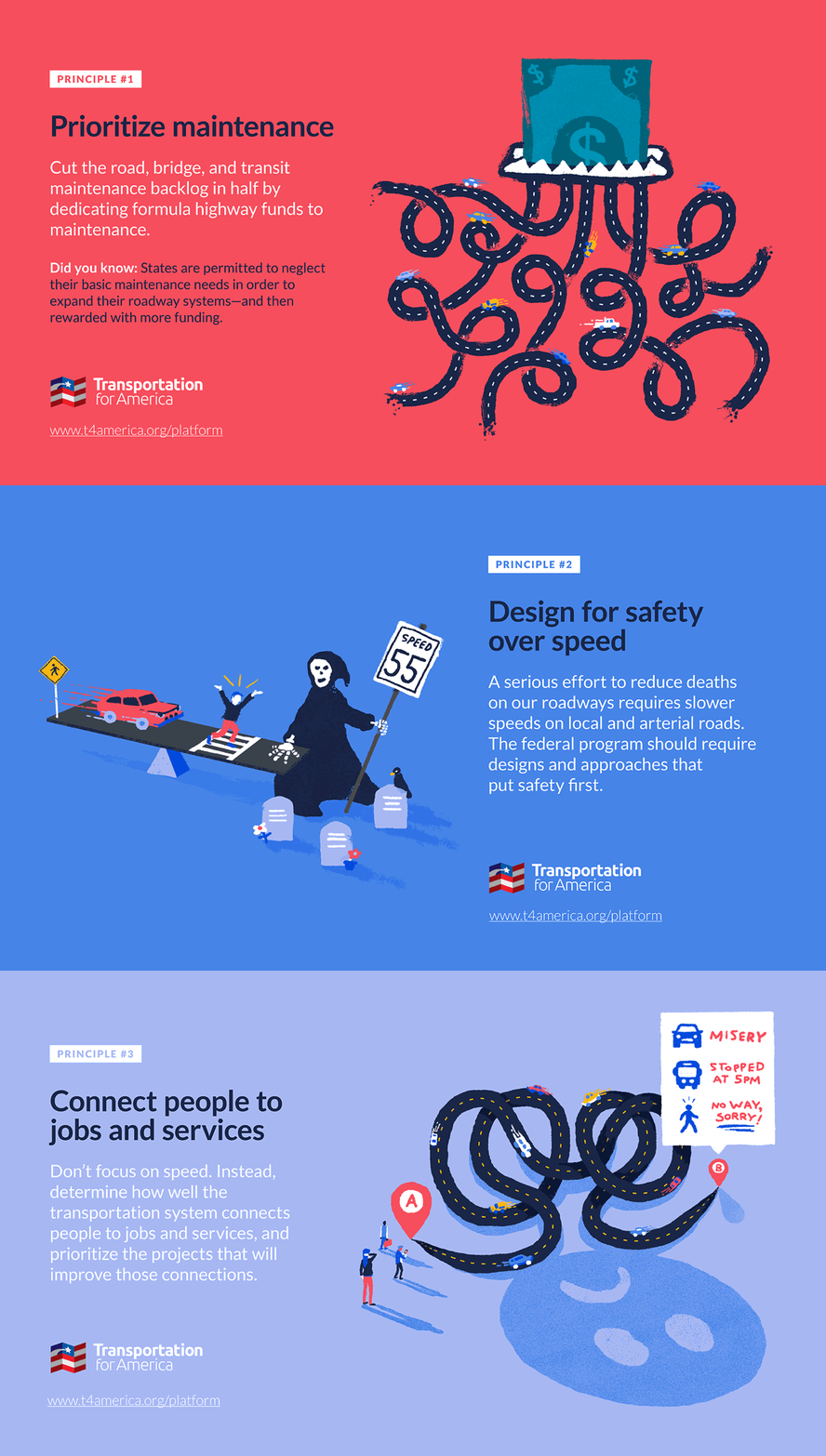
Principle #1: Safety over speed. Any serious effort to reduce deaths on our streets and roads requires slower speeds. Federal funding should require approaches and street designs that put safety first. Cartoon of the grim reaper tipping the scales towards pedestrian deaths while holding a speed limit: 55 sign.

Our roads have never been deadlier for people walking, biking, and rolling and the federal government and state DOTs are not doing enough. If we want to fix this, we have to acknowledge the fact that our roads are dangerous and finally make safety a real priority for road design, not just a sound bite.

Transportation in this country is fundamentally broken, creating a dangerous environment for everyone who uses it but especially for those outside of vehicles. The way we’ve built our roadways has transformed what should be easy trips into potentially deadly journeys. Though our cars have more safety features than ever—cameras, lane keep assist, automatic braking—those advancements have only served to protect people within vehicles. They didn’t save any of the 7,522 people killed while walking in 2022. In fact, as cars become safer for people inside the vehicle, they have gotten even larger and more deadly for people outside of them.

The fact of the matter is that fast-moving vehicles present a danger to people walking. We can’t address this danger if we are unwilling to commit to safer speeds.

We can’t do it all

The policies and practices that inform the design of our roadways often serve one primary goal: to move as many cars as possible, as quickly as possible. That negates the experience of everyone walking, biking, and rolling. Yet, if you asked the same people designing our roadways and dictating these policies whether safety is their top priority, they would absolutely say yes. Our approach to road design, reinforced by federal guidance and manuals, continually tries to juggle both speed and safety, when these two goals are fundamentally opposed.

When we try to prioritize both safety and speed, drivers end up receiving competing messages. Current roadway design requires people to drive perfectly while creating an environment that incentivizes risky behavior such as speeding. Safe roadways don’t ask people to slow down. They are designed so that safe speeds are the most intuitive option.

Less talk, more action

USDOT and other agencies have called for safer streets, but federal funding and policies haven’t led to results. This can be attributed to a variety of factors, including the relatively small amount of money set aside to specifically address safety compared to the much larger amount of money going to build even more dangerous roads.

State departments of transportation are allowed to set safety goals where more people die every year, knowing they will get more funding regardless. Meaningless “safety” targets allow governments to point their fingers and say they’re working on it while building even more deadly roads. The danger is often not addressed until multiple people get hurt. It’s no surprise that the majority of pedestrian deaths occur on federally funded, high-speed state roads.

There are not enough policies to support environments where safe mobility is available for all modes. The Surgeon General called to promote walking and walkable communities and to create a built environment that allows for human connection. The USDOT’s supposed top priority is safety and the Federal Highway Administration has a long-term goal of zero roadway deaths. But there’s no follow through on these statements. We want people to go on walks, and kids to play outside, and for there to be less deaths on the road, but our policies and tax dollars continue to primarily support projects that overlook non-vehicular traffic—at the expense of everyone else. Our transportation system is built on a series of hypocrisies.

If we want a system that moves people without killing them, we need to start putting our money where our mouths are. We need policies that put safety first, placing everyone’s well-being at the center of our roadway design.

It’s Safety Over Speed Week

Click below to access more content related to our first principle for infrastructure investment, Design for safety over speed. Find all three of our principles here.

  • Three ways quick builds can speed up safety

    It will take years to unwind decades of dangerous street designs that have helped contribute to a 40-year high in pedestrian deaths, but quick-build demonstration projects can make a concrete difference overnight. Every state, county, and city that wants to prioritize safety first should be deploying them.

  • Why do most pedestrian deaths happen on state-owned roads?

    Ask anyone at a state DOT, and they’ll tell you that safety is their top priority. Despite these good intentions, our streets keep getting more deadly. To reverse a decades-long trend of steadily increasing pedestrian deaths, state DOTs and federal leaders will need to fundamentally shift their approach away from speed.

  • Why we need to prioritize safety over speed

    Our roads have never been deadlier for people walking, biking, and rolling and the federal government and state DOTs are not doing enough. If we want to fix this, we have to acknowledge the fact that our roads are dangerous and finally make safety a real priority for road design, not just a sound bite.

Congressional briefing emphasizes electrification and public transit to meet climate goals
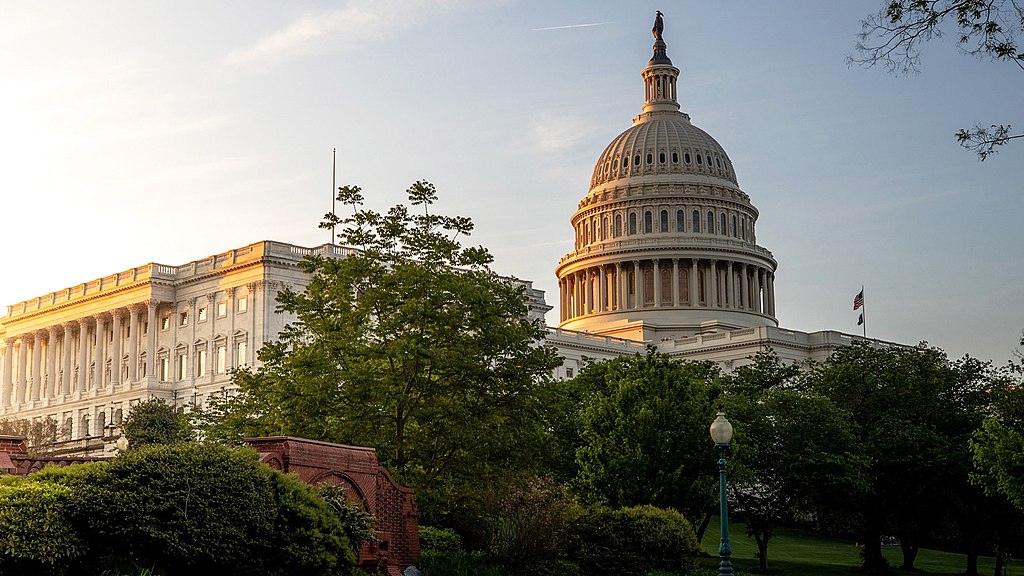
The sun rises behind the U.S. Capitol, casting the dome in a golden glow

54 years since the first Earth Day, the US is still focusing on highway expansion. In light of increasing greenhouse gas (GHG) emissions, due in part to the Infrastructure Investment and Jobs Act (IIJA), Transportation for America and its partners engaged the Future of Transportation Caucus to brief Congress on transportation decarbonization. We explained that to truly decrease emissions we need to electrify transportation systems and support travel options beyond private vehicles.

The sun rises behind the U.S. Capitol, casting the dome in a golden glow
The U.S. Capitol at sunrise. (Wikimedia Commons)

In a briefing on Capitol Hill, T4A Policy Associate Corrigan Salerno showed how highway expansion funds in the IIJA dwarfed historic investments in public transit leading to disastrous GHG emissions increases. The short and sweet of it is that mode-shift needs to be coupled with electrification to decrease our GHG emissions. Taylor Reich from the Institute for Transportation & Development Policy explained that coupling electrifying transportation with mode shift (opportunities to travel outside of a car) will save the government and private citizens trillions, lower energy consumption, and lower emissions.

Miguel Moravec from the Rocky Mountain Institute and Move Minnesota advocate Katie Jones described how states are already incorporating electrification and mode shift into policy. Minnesota’s Climate Action Framework and Colorado’s GHG Transportation Planning Standard require transportation infrastructure projects to abide by local GHG reduction targets. Thanks to these regulations, major highway expansion plans have been set aside in favor of bus rapid transit, active transportation networks, and transit oriented development.

The path forward

Most of the funding for highway expansion projects comes from formula funds with few strings attached, giving state departments of transportation (DOT) the option to expand aggressively. With the Senate voting 53-47 against mandating DOTs and metropolitan planning organizations (MPO) to track their GHG emissions, Congress is not helping increase transparency into our state transportation investments or halt endless highway growth.

Colorado and Minnesota are already implementing solutions and Maryland is trying to catch up. The federal government must meet their decarbonization efforts by bringing these state-level approaches to a national scale.

And there’s a path forward to do just that. Legislation such as Senator Markey’s GREEN Streets Act requires minimum standards for GHG, vehicle miles traveled (VMT), and air pollution reductions. It would also require DOTs and MPOs to publicize the environmental and health impact data for large expansion projects.

We already know that transportation decarbonization is necessary for fighting climate change. Electrifying all cars, a lofty goal on its own, won’t be enough to solve our climate crisis. Goal setting and transparency are integral to decarbonization. Without building more public transportation, establishing more active transportation infrastructure, and giving people the freedom to travel outside of a car, we won’t make significant progress. To truly respect our planet, our federal leaders must do more to address mode shift and electrification.

Four young professionals stand inside the House Chamber, smiling at the camera
The four presenters at the briefing (from left to right): Miguel Moravec, Katie Jones, Taylor Reich, and Corrigan Salerno.

Progress for passenger rail in the South and beyond
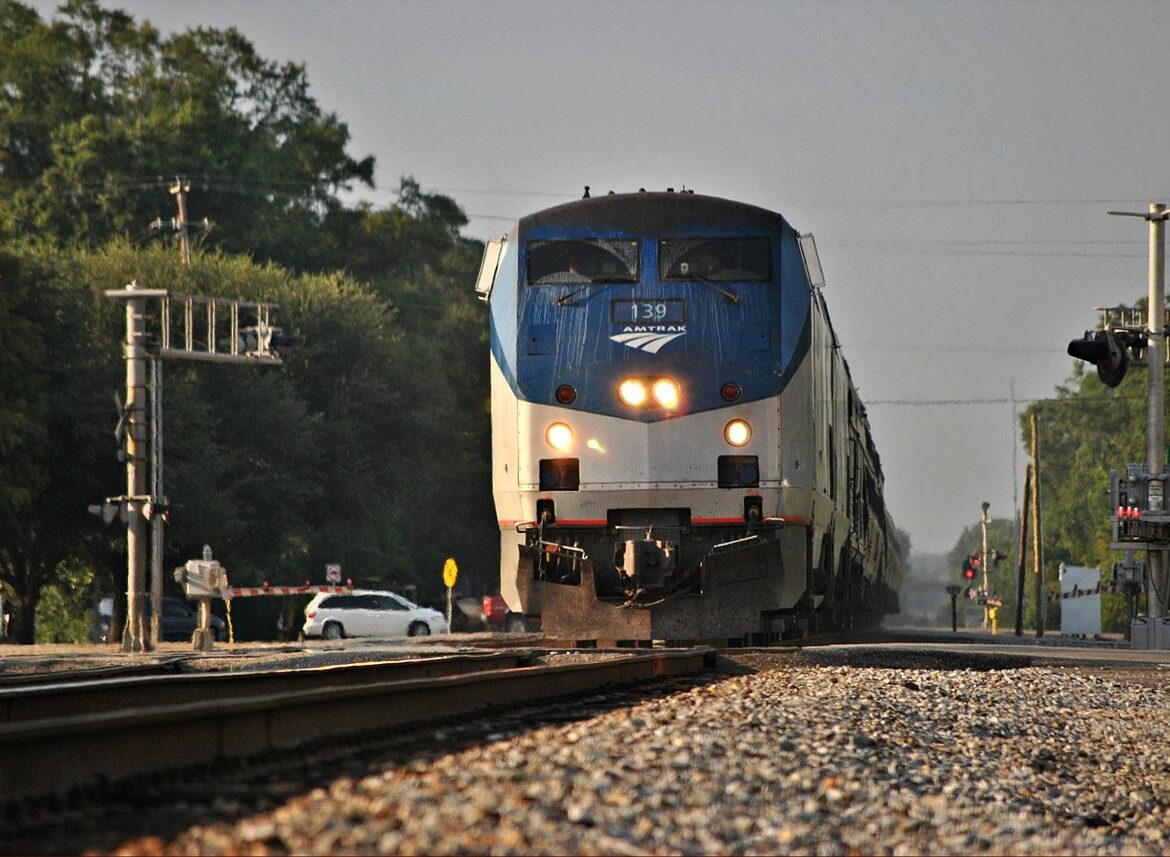
A shiny passenger train chugs down the track in a southern town

Two recent developments at the federal level can help propel passenger rail expansion in the South and across the country. 

A shiny passenger train chugs down the track in a southern town
An Amtrak Crescent line train heads south. Wikimedia Commons photo.

Interstate Rail Compact Grant

The states of Mississippi, Alabama, and Louisiana make up the Southern Rail Commission (SRC), which has been steadfastly committed to expanding passenger rail service in the South for the past 40 years, most recently achieving success for the restoration of service on the Gulf Coast.

On March 14th, the Federal Railroad Administration (FRA) announced that the SRC, along with rail commissions in the Midwest and Mid-Atlantic won an Interstate Rail Compact (IRC) grant. The SRC will match 50 percent of the $400,000 they have been awarded and use these funds to hire more people, market passenger rail, conduct impact studies, and apply for more federal grants. In short, they can spend the money on everything but running the service itself.

The SRC has been fighting the good fight for decades. Passenger rail service in the United States has been on the ropes for decades, with much of the service in the South phased out in the 70s. The situation only worsened after Hurricane Katrina in 2005; passenger rail service has not been running on the Gulf Coast for nearly 20 years.

The grant spells good things for the ongoing fight for passenger rail. In addition to the restoration of service on the Gulf Coast, the SRC has several projects to support, including passenger rail extensions between Baton Rouge and New Orleans, Mobile to New Orleans, and Dallas to Atlanta. This grant will help them further advance their efforts.

Passenger Rail Advisory Committee

Hot off the heels of the IRC grant announcements, the Surface Transportation Board (STB) has publicly announced the membership of their new Passenger Rail Advisory Committee (PRAC). The STB’s duties related to passenger rail service have expanded in recent years, leading to the creation of the PRAC. This committee is intended to advise on increasing route efficiency, mediating between passenger and freight companies, and improving inter-city rail-related processes. Its formation is a testament to continued progress for passenger rail at the federal level, which we hope will translate to support for passenger service across the country.

Among the names of the 21 voting members lies our own chair, John Robert Smith, former Amtrak board member and former member/long-time advisor to the SRC. The inclusion of advocates like John Robert, who have dedicated decades in the pursuit of passenger rail service across the country, will be critical in supporting expansion efforts in the present day.

While these advancements for passenger rail are particularly good news for the South, they’re also proof of what’s possible in the rest of the country. The SRC continues to build upon their recent success in the Gulf Coast, showing what bipartisan leadership on interstate rail can accomplish. As support for passenger rail continues to evolve at the federal level, we hope more leaders will follow their example.