Safety over speed week: The key to slowing traffic is street design, not speed limits

Today, as “safety over speed” week continues, we’re running a guest post from our friends at Strong Towns that uses some simple pictures to explain how street design is a far more powerful tool for slowing down traffic and prioritizing safety compared to the strategy of lowering speed limits.

It’s “safety over speed” week here at T4America, and we are spending the week unpacking our second of three principles for transportation investment. Read more about those principles and if you’re new to T4America, you can sign up for email here. Follow along on @T4America this week and check back here on the blog for more related content all week long. Today’s post was written by Strong Towns and was originally posted in January of this year. We are thankful to Chuck Marohn and his Strong Towns team for letting us repost it here.

The cost of auto orientation—designing our towns and cities around the easy, fast movement of cars—is not just measured in dollars and cents. The number of U.S. traffic fatalities in 2017 topped 40,000 people. Nearly 6,000 of those people were on foot—a 25-year high. Each of those people had a unique story. Each of them had a family.

And after each high-profile crash, we all hear the same litany of advice from law enforcement and traffic safety professionals.

“Be hyper-aware of your surroundings.”

“Always obey the speed limit.”

“Speed is a factor in 30 percent of crashes.”

“Safety is a shared responsibility.”

And yet, we know that people are sometimes going to make mistakes. Even conscientious drivers make mistakes. People walking, going about their business, are going to make mistakes. No one is going to be hyper-vigilant every moment that they’re out in the world. And why should we have to?

We can’t regulate our way to safety. We must design our streets to be safe.

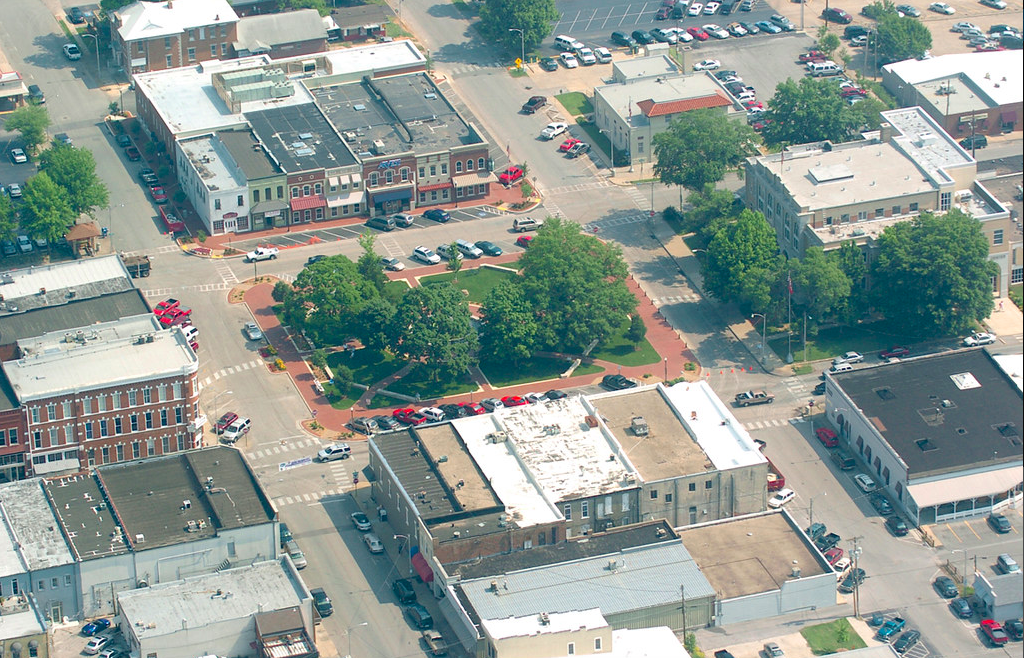
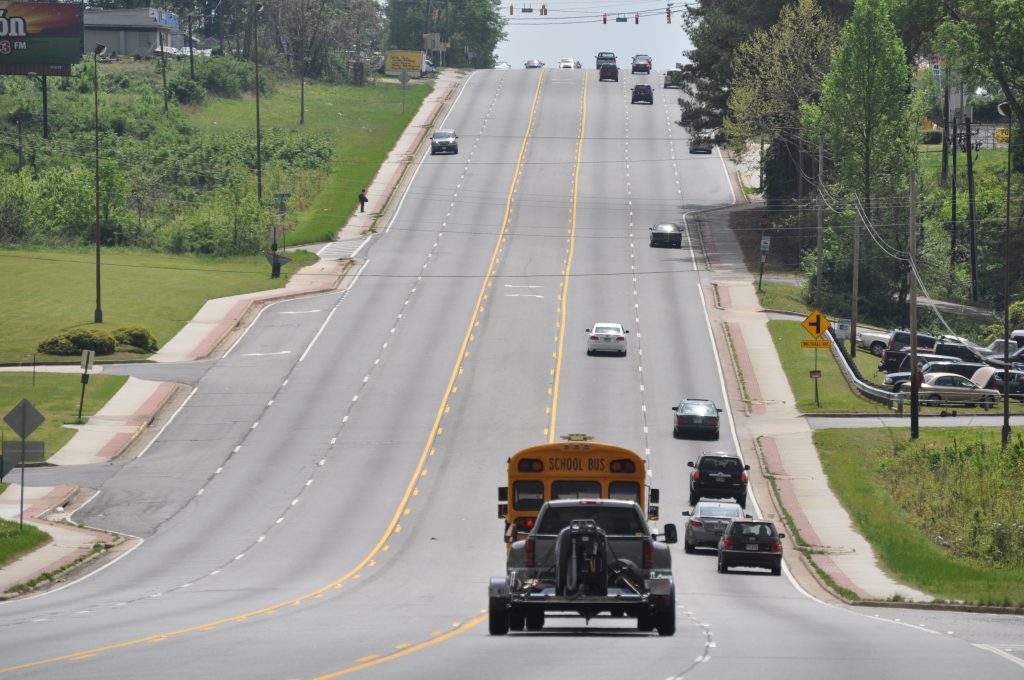
Two simple photos reveal what it means to design a street to be safe, versus counting on the speed limit alone to do the job. This meme was created by planner Wes Craiglow of Conway, AR, and shared on social media by the “Transportation Psychologist,” our friend, Bryan Jones. We first shared it back in 2015, but it remains timeless, so here it is again:

12189751_793987447390525_7047780377547951323_n.jpg

As Wes points out: “The meme is intended to help viewers consider how different street designs makes you feel as a driver, and ultimately affect how you behave behind the wheel. Generally speaking, as depicted by the lower photo, narrower travel lanes, shorter block lengths, and a tree canopy, all contribute to drivers traveling more slowly. Conversely, wide lanes, long block lengths, and open skies, as seen in the upper photo, communicate to drivers that higher speeds are appropriate.”

Look again at the two photos. Imagine yourself behind the wheel of a car on each street. On which street would you drive faster? On which street would you exercise more caution?

“Forgiving” design is a misnomer

12189751_793987447390525_7047780377547951323_n.jpg

The first photo looks like tens of thousands of suburban streets all over America. It’s entirely representative of something the transportation engineering profession calls “forgiving design.” The premise is simple: drivers will make occasional mistakes—veer a bit out of their lane, fail to brake quite hard enough—and if the street is wide, with high visibility in all directions, and free of immediate obstacles such as trees and fences, those mistakes won’t be catastrophic.

The problem: this street feels too forgiving to a driver. Too safe and comfortable. So drivers speed up. The engineers didn’t account for this aspect of human psychology.

This residential street is built like a four-lane highway, and so even though its legal speed limit is 20 miles per hour, it’s no surprise when somebody guns it up to 40 miles per hour or more down a street like this. It feels natural to do so. It feels safe. But it isn’t safe—because on a city street, unlike a freeway, there might be people around. People who will most likely be badly hurt or killed if a speeding driver hits them.

Read transportation engineer Jon Larsen’s explanation of why the forgiveness of slow speeds is better than the “forgiving” design of wide streets.

The paradox of street design: if it feels a bit dangerous, it’s probably safer

12189751_793987447390525_7047780377547951323_n.jpg

The second photo, on the other hand, represents the most basic, frugal approach to designing a street for slow speeds. It’s not perfect. It lacks sidewalks or bicycle facilities, which some of our readers might take issue with—and yes, many places ought to have those things.

But this “slow street” does something really profound and important. It causes drivers to slow down, whether or not there’s a posted speed limit or law enforcement is present, because of the uncertainty and sense of heightened risk.

The street is narrow. Visibility is limited—look at that front left corner of the intersection, where a red fire hydrant stands next to a white fence. The lack of visibility there is not a safety hazard: paradoxically, it’s probably the single biggest thing that promotes safety at this intersection. Because if you’re driving here, and can’t see whether a vehicle is approaching from the left, what are you going to do?

That’s right. You’re going to slow down.

Read Daniel Herriges’s article on why narrow streets can deliver a ton of benefits to our cities and towns at low cost.

Why 20 miles per hour?

If we could keep most urban traffic to 20 miles per hour or less, we could eliminate the vast majority of deaths from car crashes in our cities and towns. We wouldn’t eliminate mistakes—people, both inside and outside vehicles, are going to make them—but those mistakes would rarely be deadly.

mphdeathrate.jpg

The place for wide lanes and “forgiving design” is on a high-speed road. City streets, on the other hand, should be places for people. We know how to design streets that will slow down traffic automatically, without the need for heavy-handed enforcement, and regardless of what the speed limit sign says. We just need to do it.

Read Chuck Marohn’s article on the crucial difference between a street and a road.

Learn more about our Slow the Cars campaign. Do you like this content, and want to help us produce more like it? Become a member of the Strong Towns movement, and support Strong Towns’s work to make our streets safe, welcoming, and productive places for people.


Thanks again to Strong Towns for participating in yesterday’s Twitter chat, for letting us share their content here, and for running our post on slip lanes from earlier this week.
Safety over speed week: Our transportation system values some lives more than others

U.S. transportation policy focuses first and foremost on ensuring that drivers can travel with as little delay as possible. But this laser focus on speed sidelines other more important considerations like the preservation of human life and the health impacts of vehicle pollution. Prioritizing safety in our transportation policy—at the federal, state, and local levels—would be a major step towards a more equitable transportation system.

America’s transportation system is fundamentally inequitable. More resources go to wealthier and more politically connected communities; streets are designed to prioritize high-speed (expensive) vehicles over the safety of people, walking, biking, or taking transit; everyday destinations are out of reach for many people who don’t own or can’t afford a car. Those are just a few obvious examples.

Equity is a key consideration throughout our new principles for transportation, but it’s at the heart of the second one: Design for safety over speed.

In the U.S., our overarching priority in transportation for the past century has been to help cars to go as fast as possible, all the time, no matter the context. The term jaywalking was invented to shame people who dared to use public space that was increasingly becoming the realm of cars alone. We bulldozed entire neighborhoods—almost exclusively communities of color—in cities around the county to make way for new interstates that enabled white flight. And as interstates and other roads filled with traffic we spent vast sums of public money to bulldoze even more homes and businesses to widen the roads, only to watch them fill up with even more traffic.

But our focus on prioritizing speed above all else with the public right-of-way has not had the same negative impact on everyone.

The pollution that this futile pursuit of speed has generated disproportionately impacts lower-income people and people of color. “On average, communities of color in the Northeast and Mid-Atlantic breathe 66 percent more air pollution from vehicles than white residents,” according to the Union of Concerned Scientists. This pollution shortens lifespans and can have lifelong impacts from developmental problems in children to increased rates of asthma, diabetes, and other chronic health impacts.

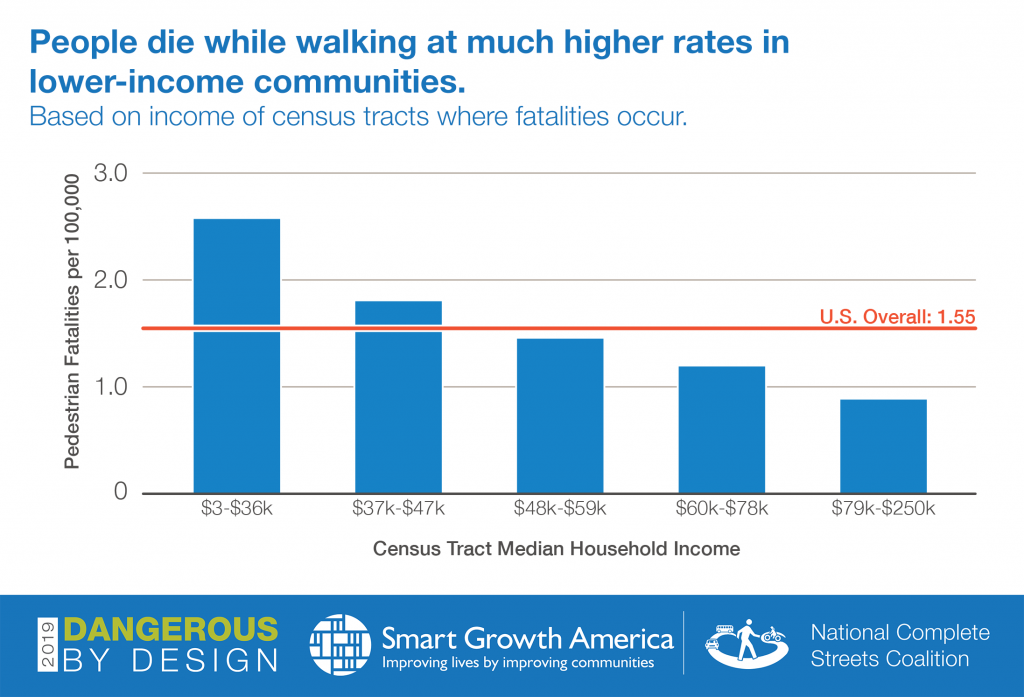
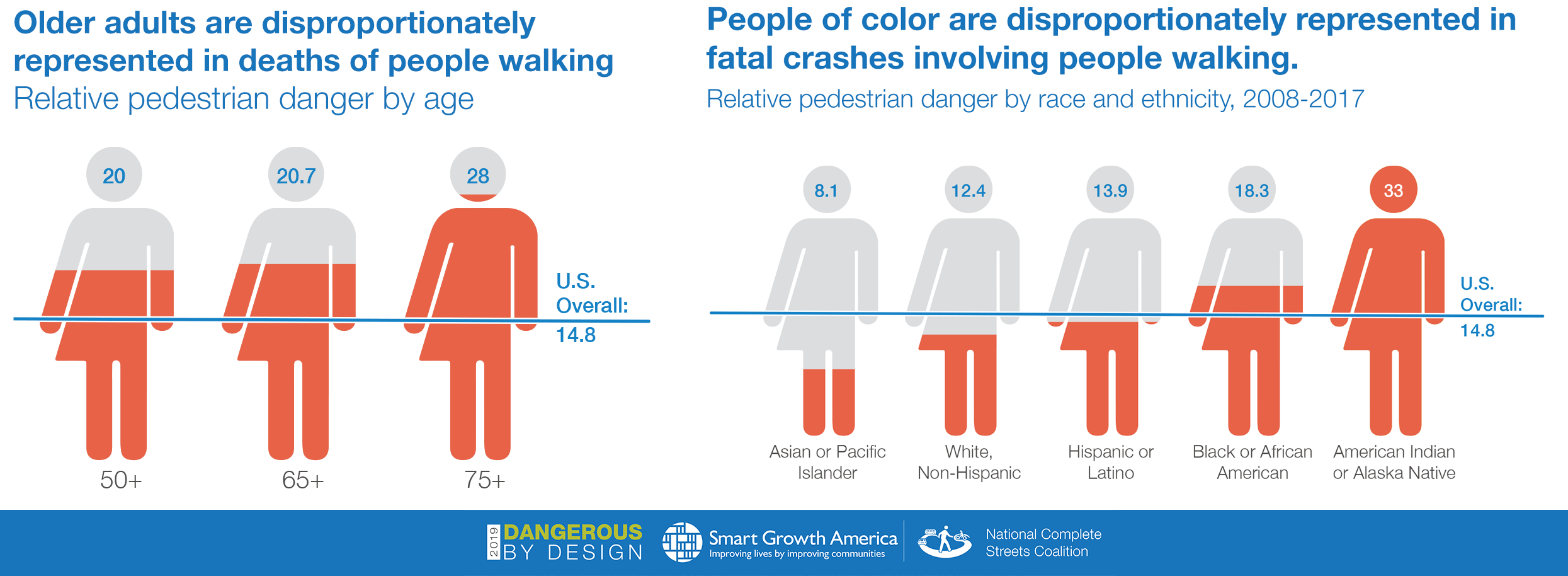
As our colleagues at Smart Growth America noted in Dangerous by Design 2019, “even after controlling for differences in population size and walking rates, we see that drivers strike and kill people over age 50, Black or African American people, American Indian or Alaska Native people, and people walking in communities with lower median household incomes at much higher rates.”

While federal data on traffic fatalities doesn’t include information on a victim’s income level, it does include where a person was walking when they were killed. And people walking in lower-income communities are far more likely to be struck and killed by drivers than people walking in middle-income communities. (One would logically assume that these victims are more likely to live in those lower-income communities.) The disparities in these fatality rates are a direct reflection of policy and funding decisions. Low-income communities are less likely to have sidewalks (in good condition), marked crosswalks, and street design to support safer, slower speeds.

We need to prioritize the safety of those outside of vehicles

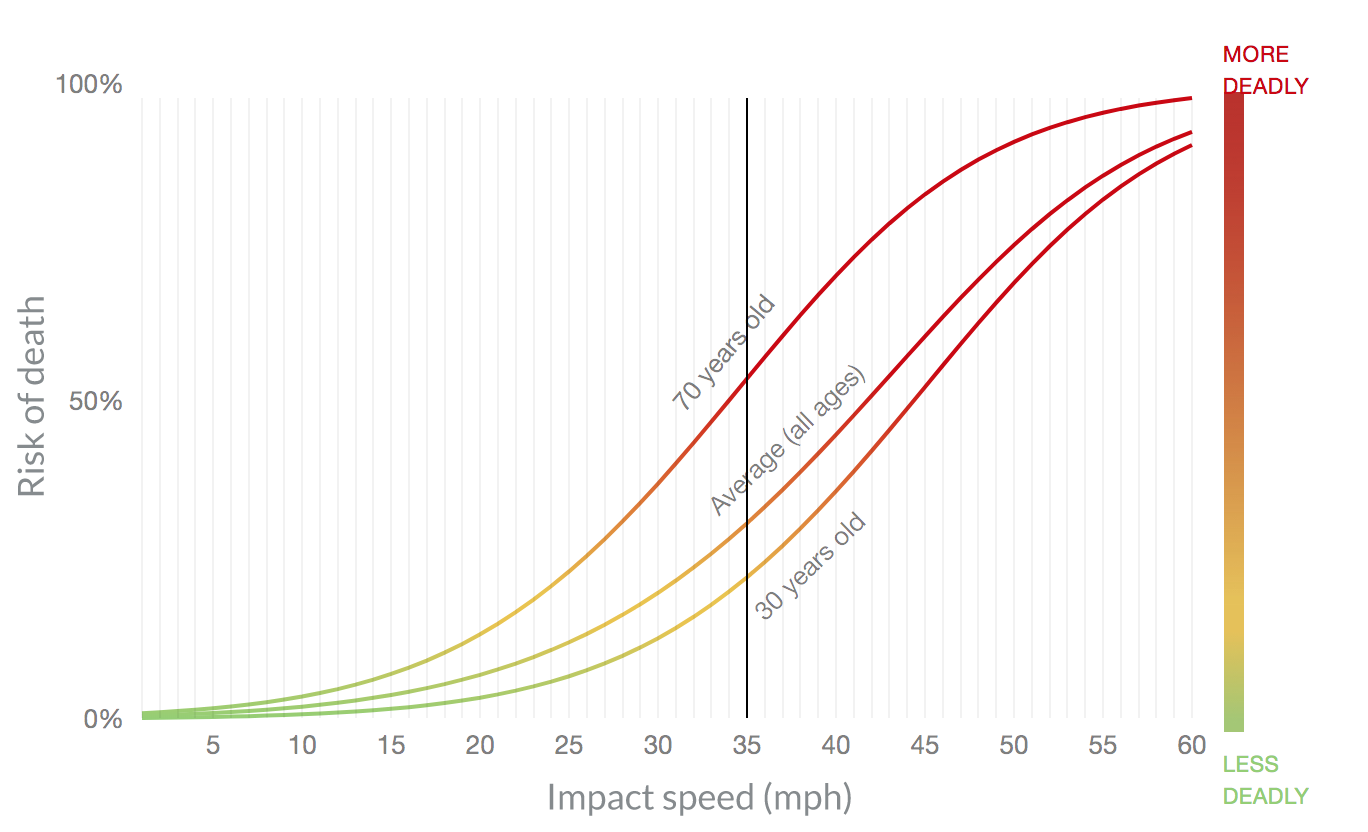
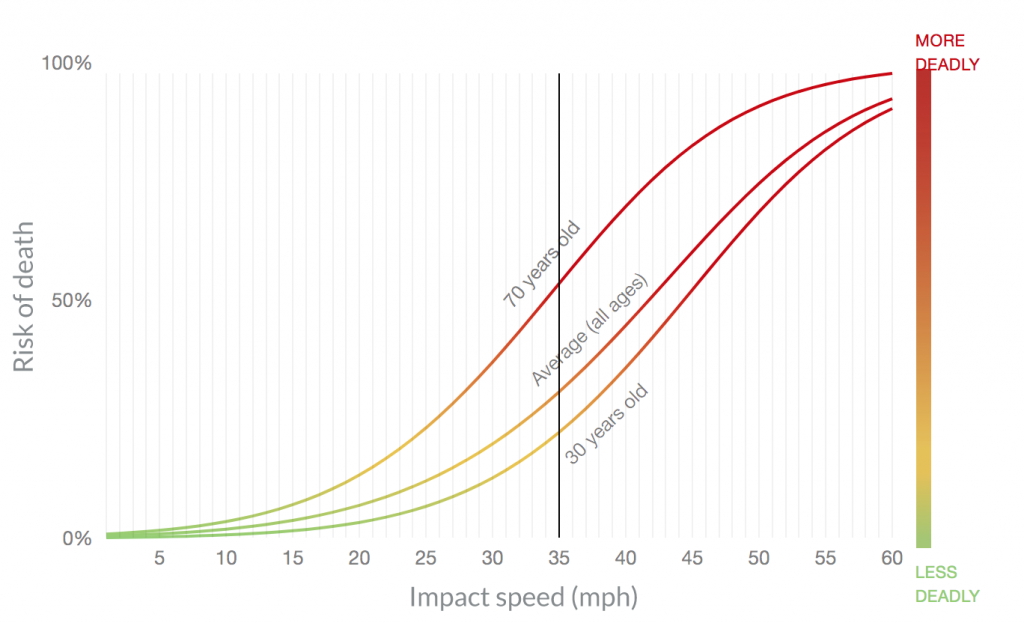
Part of the solution is making sure we’re putting the safety of people walking, biking, and taking transit on equal footing with people driving. In most places, the people more likely to be traveling outside of a vehicle are people who have suffered the most from the previously outlined disparities and inequities. Our call to design local and arterial roads surrounded by development for no more than 35 mph would dramatically improve equity. When you have people walking, shopping, dining, waiting for the bus or otherwise going about their lives, roads designed for drivers to travel at 40 or 50 mph are simply too fast and too deadly. A pedestrian hit by a driver at 50mph is about twice as likely to die as a person hit at 35 mph.

See the full interactive graph at ProPublica.

To be clear, this isn’t just a function of speed limits.

While lowering speed limits is important, what most people don’t understand is that once you’re behind the wheel of a car, you will drive at the speed you feel comfortable. Designing for safety is paramount. Wide, straight lanes and open skies give unspoken cues to drivers that this road is built for speed. In contrast, narrower, perhaps curvier lanes that are enclosed by buildings or streets trees signal to drivers that they should be driving slower.

Beyond being intentional about the safety of people outside vehicles, resource allocation is critical. Many federal grant programs for infrastructure projects, even small but critical ones like redesigning a deadly intersection, require a local funding match. But for many poor cities and towns—both rural and urban—securing such matching funds can be prohibitive. At the local level, officials need to be intentional about tracking where and how funds are being spent to ensure that the streets in lower-income areas designed for safe travel just more affluent areas.

Communities impacted by vehicle pollution should also have a larger voice in planning future transportation investments. Too often these communities are excluded, or their voices are given less weight than others even though they will be the ones who bear the greatest impact from a widening highway or larger road. One example of this is how most projects to widen or expand a roads typically only consider the limited improvements to travel time for commuters traveling through that area, while failing to consider the impacts on those who may need to cross that street, or the increased air pollution for those who live nearby.

It’s simply not part of the typical calculus; all of the underlying metrics in the federal transportation program focus simply on vehicle speed, delay, and throughput. Many states are even planning for more people to die in future years—it’s an implicit acknowledgement that their streets are unsafe yet nothing in federal law requires them to try and kill fewer people. So many simply won’t act.

Safety must be our priority. Making walking, biking, and taking transit safer will save lives and help reduce driving, in turn reducing the health disparities in low-income communities and communities of color.

In the end, this is about whether or not we value the lives of everyone. Today, our transportation policy—particularly at the federal level—values a few seconds saved for motorists each day over the lives of people walking, biking, or taking transit. It values the lives of the wealthy over the lives of low-income people. And it values the lives of white or more affluent Americans over the lives of other Americans. By putting safety at the heart of our transportation policy, we can start to create a more equitable transportation system.

Safety over speed week: Prioritizing safety is intrinsically connected with improving transit service

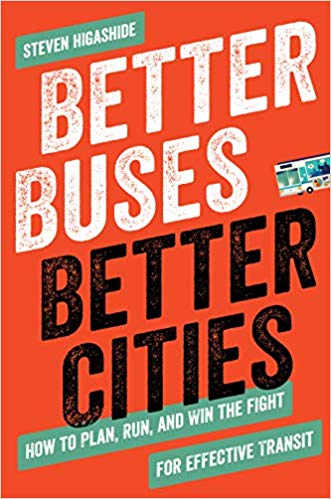
Nearly every bus transit rider starts and ends their trip with a walk, and decisions made to prioritize vehicle speed over safety often have significant impacts on transit. This excerpt from the new book Better Buses, Better Cities helps explain how better bus transit and prioritizing safety over speed are intrinsically related.

It’s “safety over speed” week here at T4America, where we are spending the week unpacking our second of three principles for transportation investment. Read more about those principles and if you’re new to T4America, you can sign up for email here.

The content that follows is an excerpt from “Better Buses, Better Cities: How to Plan, Run, and Win the Fight for Effective Transit” by Steven Higashide, published by Island Press. Steven is a former colleague of ours at T4America as an outreach associate based in New York a few years ago before moving on to the Tri-State Transportation Campaign and then to TransitCenter, where he today serves as the research director. We are proud to see his book in print and are thankful to him and Island Press for letting us share this long excerpt from Chapter 4 entitled MAKE THE BUS WALKABLE AND DIGNIFIED, sourced from pages 59–61 and 74-75. – Stephen Lee Davis, T4America.

On a Saturday afternoon in April 2010, Raquel Nelson, her 4-year-old son A.J., and her two other children (aged 2 and 9 years) stepped off the bus across the street from their apartment in Marietta, Georgia. It had been a good but long day. Raquel and her children had celebrated a birthday with family and pizza. To get home, they took their first bus from the pizza restaurant to a transit center, where they missed their connecting bus and had to wait more than an hour for the next one.

Home was across a five-lane, divided road. And so, together with several other people who had been on the bus, the Nelson family crossed halfway across the street to wait in the median. As Raquel stopped to gauge traffic, one of the other adults in the group decided to start walking. Raquel’s son A.J. broke free from her grip to follow, and Raquel hurried to catch up.

A.J. was killed moments later, by Jerry Guy, who was behind the wheel of a van despite having “three or four beers” in his system.

Raquel and her 2-year-old daughter were also struck and injured. And yet that was only the beginning of her ordeal.1

County prosecutors charged Raquel with vehicular homicide, which carried a potential sentence of 3 years in prison. A jury convicted her, and she was sentenced to 12 months’ probation with the option of a retrial, which she chose. Her case wound through the courts for 2 more years before Raquel agreed to plead guilty to a single charge of jaywalking.

Raquel Nelson’s case made national news. But the loss she and her family experienced is replicated in nearly every city on wide “arterial” roads that encourage high speeds. In the City of Los Angeles, for example, 6 percent of streets are responsible for 65 percent of traffic deaths and injuries. When mapped, pedestrian deaths line up on these roads like dominoes.

Because they tend to have important destinations on them, arterial roads also tend to carry the most bus riders. But the tie between transit and walkability goes beyond pedestrian safety. Nearly all transit riders are pedestrians at some point during their trip. In Los Angeles, for example, 84 percent of bus riders get to their bus stop on foot.

The pedestrian experience is the transit experience, then. A bus rider may appreciate frequent and fast service but still be dissatisfied with her trip if she has to trudge through mud on the way to the bus stop, cross the street with her head on a swivel, and wait in the rain with no shelter. Someone who uses a wheelchair may be unable to use the bus at all if there are no sidewalks leading to the stop.

Poor walkability is corrosive to bus ridership and makes it harder to improve transit service. In Staten Island, New York City, transit planners had to make major adjustments to a redesign of the borough’s express buses after riders complained that the changes forced them to walk in the street or on lawns.

Although Austin’s bus network redesign has generally been considered a success, it ran into the same problems. More than a month after the launch of the redesign, Capital Metro was still moving stop locations in response to complaints that people had to transfer in places without good walking infrastructure. “If you’re going to go to more of a grid-based system and you’re going to have more on-street connections, then you really need to look at the pedestrian experience of those intersections,” Capital Metro’s Todd Hemingson said. (As of April 2019, only about 60 percent of streets in Austin have sidewalks.)

Improving the walk to transit, on the other hand, can have measurable impacts on transit ridership. Ja Young Kim, Keith Bartholomew, and Reid Ewing of the University of Utah found that after the Utah Transit Authority built sidewalk connections to bus stops that lacked them, ridership at those stops grew almost twice as fast as at stops in similar neighborhoods that had not been improved. Demand for paratransit was also stemmed near the stops with sidewalk improvements, saving the agency on its budget.

Although walkability and transit can’t be separated, government usually makes its best effort to do so. Just as transit agencies must convince cities to give transit priority on the street, they must rely on local and state government to create a good walking environment. That’s no given.

The state of walking in America represents an enormous collective failure. Even in urban neighborhoods where many people walk, engineering practices that favor drivers tend to degrade the experience. Intersections can be designed with slip lanes that allow cars to gun through turns. Zoning may allow curb cuts that turn the sidewalk into a gauntlet of traffic. The default rule at most intersections is “right turn on red,” intrinsically hostile to people walking because there’s never a time when they can be sure cars won’t turn into their path.

These decisions are rooted in a philosophy that prioritizes vehicle speeds and is often baked into engineering measures and practices. Engineers often assess streets using a metric called “automobile level of service,” where an A grade is free-flowing traffic. A major traffic engineering manual recommends against striping crosswalks unless at least ninety-three pedestrians already cross the intersection per hour—or if five people were hit by cars at the intersection in the past year. Peter Furth, an engineering professor at Northeastern University, has pointed out that “Synchro, the standard software [traffic engineers] use, is based on minimizing auto delay, and it doesn’t even calculate pedestrian delay.”

Although most streets are municipally maintained, most cities require local property owners to maintain sidewalks abutting their property. This means that wealthier neighborhoods tend to have better maintained and safer sidewalks. The further you get from downtown, the more likely it is that sidewalks themselves will shrink, decay, or vanish. Property owners may not be required to build sidewalks at all, which means many cities simply lack sidewalks in a huge portion of their territory.

Fighting for People on Foot

Pedestrian infrastructure doesn’t cost much relative to other transportation infrastructure. Houston’s $83 million in backlogged sidewalk requests could mostly be wiped out by nixing a $70 million project to add an interchange on an area toll road. Even the $1.4 billion price tag to build functional sidewalk on every Denver street doesn’t look so daunting when the Colorado Department of Transportation is spending $1.2 billion in just 4 years to widen Interstate 70, which runs northeast of downtown Denver.

Shelters aren’t particularly expensive either, costing roughly between $5,500 and $12,000 each. In 2017, medium and large transit agencies spent $297 million on infrastructure at bus stops and stations, compared with $2.2 billion on rail stations—or about 6 cents per bus trip and 47 cents per rail trip.

Creating walkable places requires changing municipal processes so that compact planning (creating neighborhoods where there are many destinations worth walking to) and pedestrian-friendly street design become routine.

This often starts with outside advocacy and political action.

The do-it-yourself movements I mentioned earlier in this chapter ultimately seek not to supplant government but to prod it to action. A year after MARTA Army launched its “adopt-a-stop” campaign, the state of Georgia awarded the Atlanta Regional Commission $3.8 million for bus stop signs, shelters, and sidewalks. Cincinnati’s Better Bus Coalition doesn’t just build benches; it has also published an analysis showing that shelters are disproportionately in wealthy neighborhoods. Streetsblog USA runs an annual “Sorriest Bus Stop in America” contest that has gotten governments in Kansas City, Maryland, and Boston to address bus stop walkability.

In Nashville, a long-time neighborhood activist, Angie Henderson, was elected to the city’s Metropolitan Council on a platform of walkable neighborhoods in 2015. Henderson later sponsored and passed a law requiring most developments in inner-city neighborhoods and near commercial centers to include sidewalks or pay into a citywide sidewalk fund. Denver’s City Council created a $4 million fund to help lower-income homeowners fix the sidewalks in front of their houses and budgeted for three new Public Works employees to manage the program and step up enforcement of sidewalk regulations throughout the city. And Seattle’s Department of Transportation has broken with the engineering guideline that says crosswalks should be striped only where many people already cross or where there are frequent pedestrian crashes.

Within transit agencies themselves, it’s important to raise the profile of the walk and the wait. Metro Transit’s Better Bus Stops Program is a great example. The decision to elevate a routine process into a branded program gave bus stops new stature throughout the agency.

“[The process of siting bus shelters] could be thought of as very dull and unimportant,” Farrington said. “But to package it, to get a great little logo and have it be a substantial program with its own name and people, it’s been a positive spiral of more resources and more support of the work.” She said that staff who had previously worked on park-and-ride stations were now spending more time on bus stops. True, in some ways the program was an outlier, funded by an Obama-era discretionary program, Ladders of Opportunity, that no longer exists. But transit agencies could replicate it using funding from many other sources.

Metro Transit’s program also offers a clear example of how well-resourced, well-planned public engagement can strengthen and educate both the transit agency and the communities it operates in.


Thanks again to Steven Higashide and Island Press for allowing us to run this excerpt. You can buy his book direct from Island Press or find links to purchase at other various outlets there. -Ed

Safety over speed week: Drive like your kid business lives here

Economic slowdowns are generally a bad thing. But slowing down might be good for the economy, so long as we’re slowing vehicle speeds. Streets designed to accommodate (slow) drivers, people walking and biking, and transit riders are better for businesses, save money on health care costs, and can help businesses attract and retain talent.

It’s “safety over speed” week here at T4America, and we are spending the week unpacking our second of three principles for transportation investment. Read more about these principles and if you’re new to T4America, you can sign up for email here. Follow along on @T4America this week and check back here for more related content all week long.

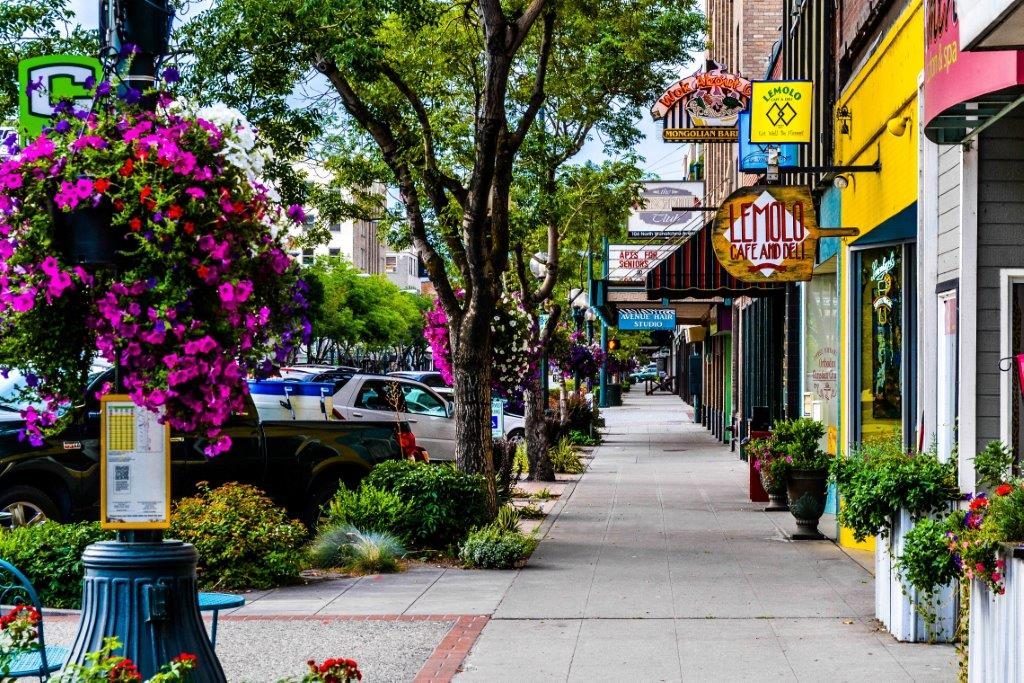
Imagine a vibrant commercial corridor, with people window shopping, eating at a sidewalk cafe, or chatting in a plaza. Perhaps there are cars parallel parked under trees planted next to the wide sidewalk. Some are locking up their bikes while others are waiting at a clearly marked bus stop. Cars are traveling slowly and crosswalks are frequent. 

Now imagine that place where the slow traffic is replaced by high-speed vehicles on the nearby roadway. The sidewalks no longer feel like a place to stroll and window shop and outdoor seating is unpleasant—the people have disappeared because it feels unsafe. The sidewalk might be narrowed and trees removed to accommodate more lanes to move more cars quickly past the once vibrant corridor. The people may be gone, but the businesses are still there and struggling to hang on. 

In America today, we are much more likely to build the second lifeless street that prioritizes speed than we are to build the first vibrant street that prioritizes safety.

Our transportation policies are designed primarily to move vehicles as quick as possible while ignoring other users. Instead of sidewalk cafes and cyclists locking their bikes, the street is empty. Instead of parking and shopping, motorists speed through, on their way to somewhere else. Public transit riders have disappeared too, as this is no longer a destination, it is a place to drive-through. 2

Our focus on keeping cars moving above all else harms local economies. Study after study has shown that business sales at worst stay the same but often increase when we redesign streets to lower speeds and safely accommodate people walking and on bikes. Getting more people (i.e potential shoppers) on the street is key.

Streets with slower speeds are more inviting for everyone, including people walking, biking, and taking public transit, creating the crowds which spend and invest in the corridor. Streets with slower speeds enable environments where people will spend time and linger, creating a sense of civic community, a sense of place. Streets like this are the basic building block of creating and capturing long-term value. And most cities and towns, whatever their size, would never survive without having these incredibly financially productive corridors.


Downtown Erwin, TN photo by Brian Stansberry. Licensed with Creative Commons 3.0

Healthy streets are good for business

Beyond these direct economic impacts of safer streets, making it safer for people to walk or bike can improve community health and reduce medical costs, freeing up public and private dollars to be invested in other ways.

A 2010 report from the National Highway Traffic Safety Administration (NHTSA) found that bicycle and pedestrian crashes caused “$16 billion in economic costs and $87 billion in comprehensive costs, accounting for 7 percent of all economic costs, and 10 percent of all societal harm (measured as comprehensive costs).” Imagine all that money, which could otherwise be spent in local communities. 

Making your downtown a safer place to walk is a key component of economic competitiveness in today’s economy. Research indicates that companies of all sizes are increasingly relocating to walkable and transit-accessible downtowns because that’s where talented workers want to be. Amazon’s recent search for a second headquarters—where access to transit was a core requirement—is just one example of this larger trend. We wrote about State Farm’s similar move to consolidate dozens of offices in just a few transit-connected, walkable locations a few years back.

Congress urgently needs to decide whether or not to prioritize safety over speed with the billions in transportation dollars they give to states and metro areas each year, but fortunately, we do not have to choose between safer streets and our economy. We just have to choose safe streets.

Safety over speed week: Slip lanes would never exist if we prioritized safety over speed

A specific design feature on our roadways is the quintessential embodiment of what happens when speed is the #1 priority and safety becomes secondary. Slip lanes, those short turning lanes at intersections that allow vehicles to turn right without slowing down, are incredibly dangerous for people walking. Yet states & cities keep building them. Why?

It’s “safety over speed” week here at T4America, where we are spending the week unpacking our second of three principles for transportation investment. Read more about those principles and if you’re new to T4America, you can sign up for email here.

Any traffic engineer or transportation official would surely tell you that safety, if not the most important consideration, is truly a core priority. But embedded deeply in our federal transportation program is another guiding principle that stands in direct opposition to safety:  “Cars need to always move fast and never slow down.” Whatever the stated priorities are, this hidden prerequisite makes every other goal a nearly impossible task—especially safety. 

Slip lanes on roads and streets are emblematic of what it looks like in practice to sacrifice safety on the altar of speed, where this underlying goal of “keep cars moving fast at all times” runs counter to the goal of “keep everyone safe while moving from A to B”—even if you say that safety is important. If we truly prioritize safety, as T4America is suggesting in our second principle, we would never build a slip lane on a local street again. 3

What are slip lanes and why do they exist?

It’s important to remember that slip lanes were created to solve one specific set of problems: vehicle speed and delay. 

They were borne of the simple realization by traffic engineers that cars turning right—even on a green light—can produce dreaded congestion because slowing down to a safe turning speed can delay traffic traveling straight. So to solve this one problem, they started adding lanes that allow traffic to make right turns without being required to slow or come to a stop, often accompanied with an additional lane on the approach or the exit. Whether you live in a rural, urban or suburban area, this feature isn’t hard to find: they’re a regular feature in most environments that were designed and built with federal money and guidance over the last 50 years. 

Safety was always at best a secondary consideration, though it really wasn’t considered much at all for decades as traffic engineers started adding slip lanes to road projects all over the country.

Slip lanes are dangerous because they prioritize vehicle speed over the safety of everyone who needs to use the road

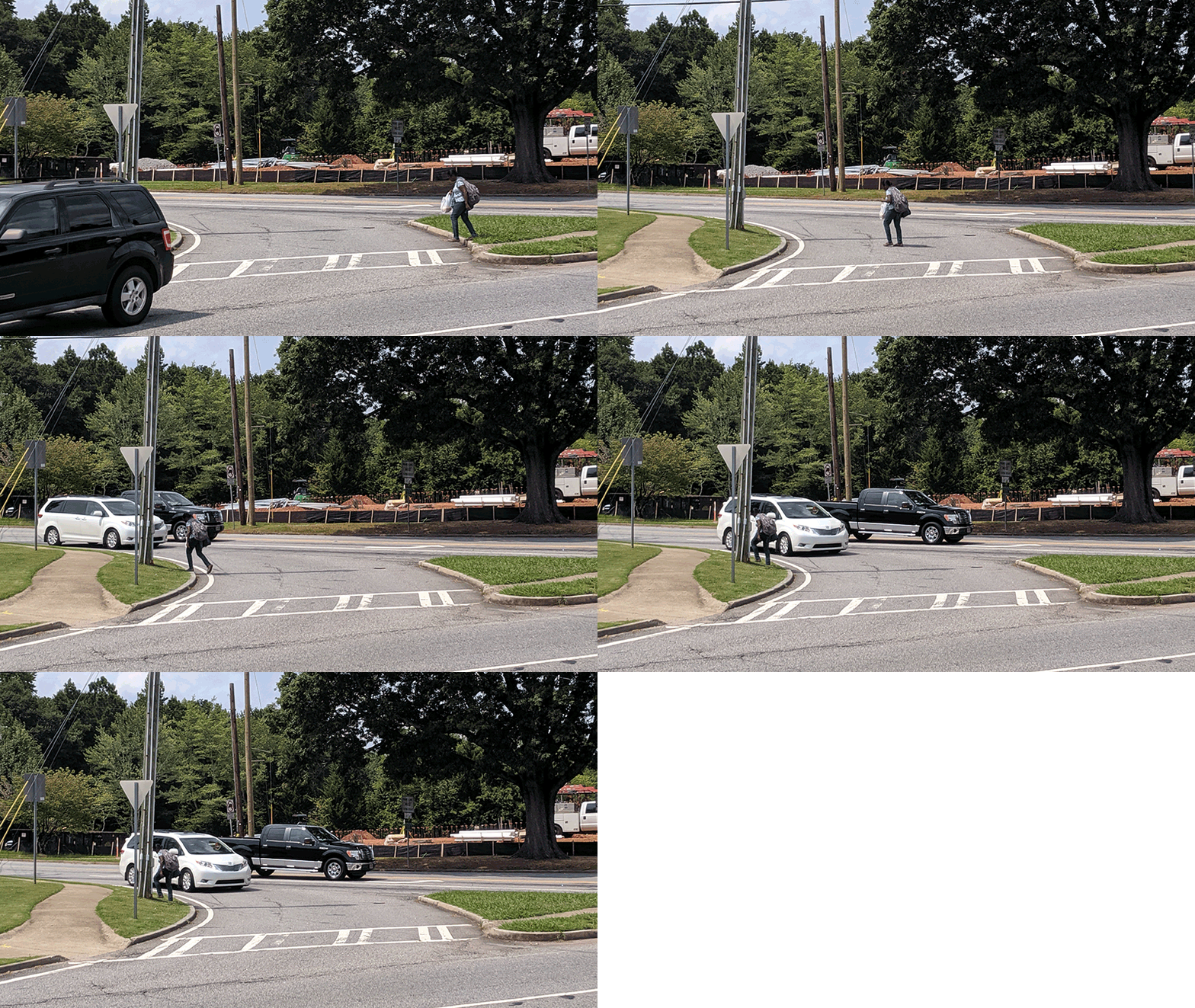
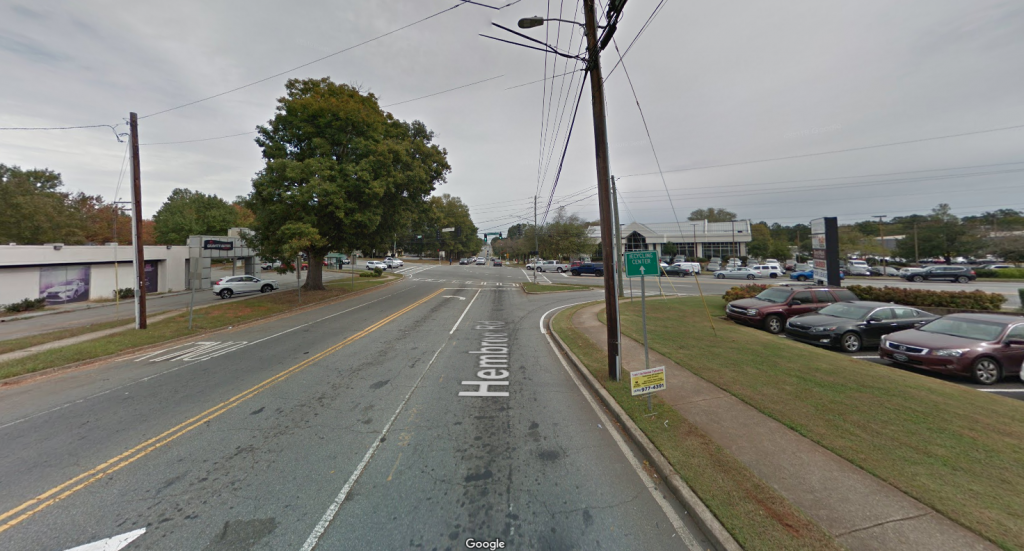
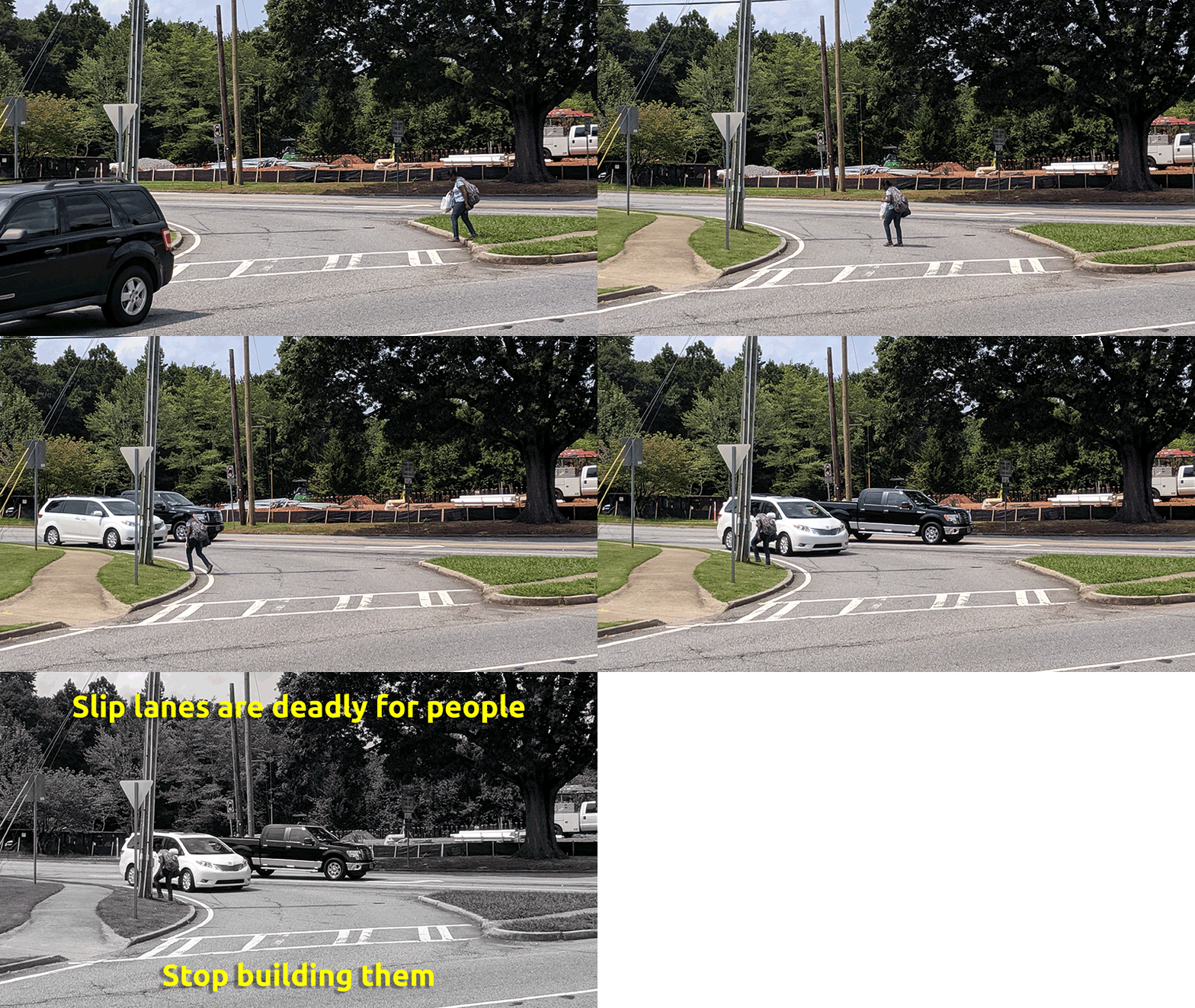
Slip lanes increase the distance that people have to cover to cross a street, put people into spots that are often the hardest for drivers to see, and encourage drivers not to slow down when approaching an intersection and a crosswalk—the precise moment they should be the most careful. This slip lane I saw in N. Fulton County, Georgia earlier this summer is a pretty typical design. 

Traveling east on N. Hembree Road (with a speed limit of 40 mph!), if a driver is planning to turn right here and sees the green light ahead, all the design cues are directing the driver to blaze through the right turn onto Alpharetta Highway without slowing down. That driver could be hitting maximum speed right as they reach the crosswalk across the slip lane—exactly the spot where engineers have said that a pedestrian should “safely” cross this street.

I saw a woman crossing here and I was astonished to see that in the time that it took her to take just three steps from the middle of the street towards safety, a minivan goes from entirely out of the frame to just 10 feet away from her.

Because slip lanes were borne of the sole focus on avoiding vehicle delay, all efforts to make them “safer” will be limited. Safety is not why they exist. Even the Federal Highway Administration (FHWA) knows they are inherently unsafe—it’s astonishing to read their guidance for making them, in their words, “less problematic”:

Intersections should be designed to accommodate safe pedestrian crossings using tight curb radii, shorter crossing distances, and other tools as described in this document. While right-turn slip lanes are generally a negative facility from the pedestrian perspective due to the emphasis on easy and fast vehicle travel, they can be designed to be less problematic.

How are slip lanes emblematic of safety losing out to the ultimate priority of speed?

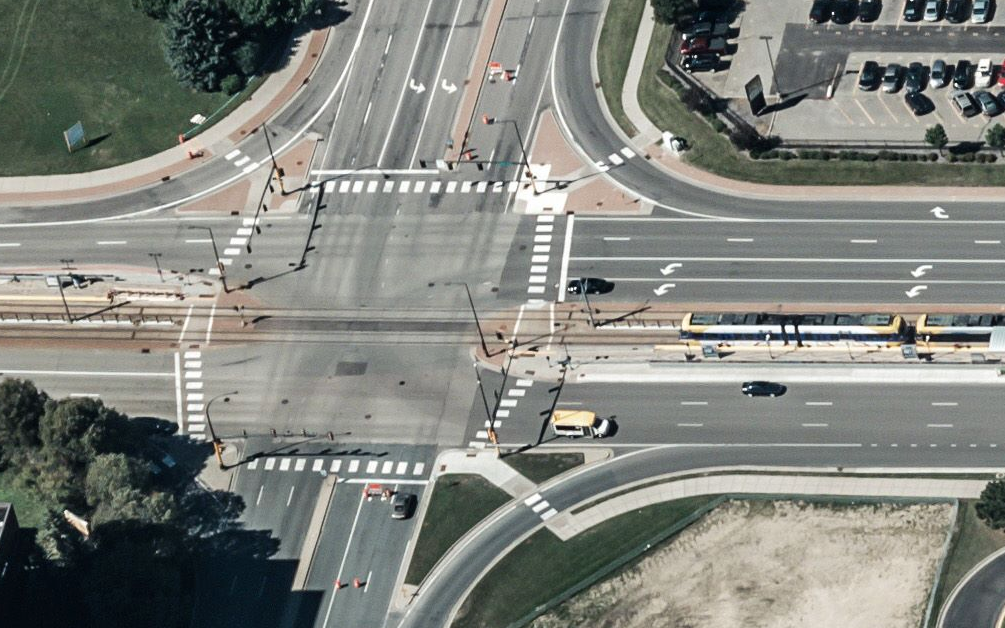
Here’s an intersection in Minneapolis with slip lanes on all four sides. These don’t exist primarily to make anyone safe—safety is an add-on consideration to the primary desire to keep cars moving as fast as possible through this intersection. Those crosswalks and pedestrian “islands” that you see aren’t designed to get anyone across this street in the safest way possible, they are a half-hearted attempt to make the best of a road designed explicitly to keep cars moving quickly above all else. 

Making the experience for people walking on a “negative facility…to be less problematic,” is a pretty interesting choice of words to describe a deadly design feature at a time when pedestrian fatalities are hitting numbers not seen since 1990. But we keep building them because moving vehicles quickly and without delay is the outcome we care about above all others.

What prioritizing safety over speed would look like

As we say in our second principle, local and arterial roads must be designed to put safety first. Protecting the safety of all people who use the street must be a priority reflected in the decisions we make about how to fund, design, operate, maintain, and measure the success of our roads. The next surface transportation law must make safety a priority and start to undo the damage wrought by decades of federal design guidelines and billions in federal transportation dollars.

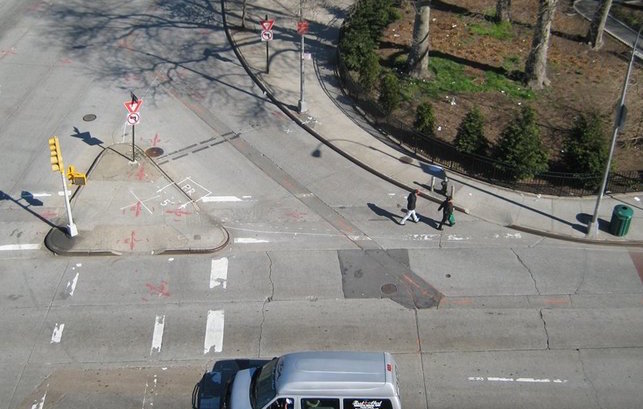
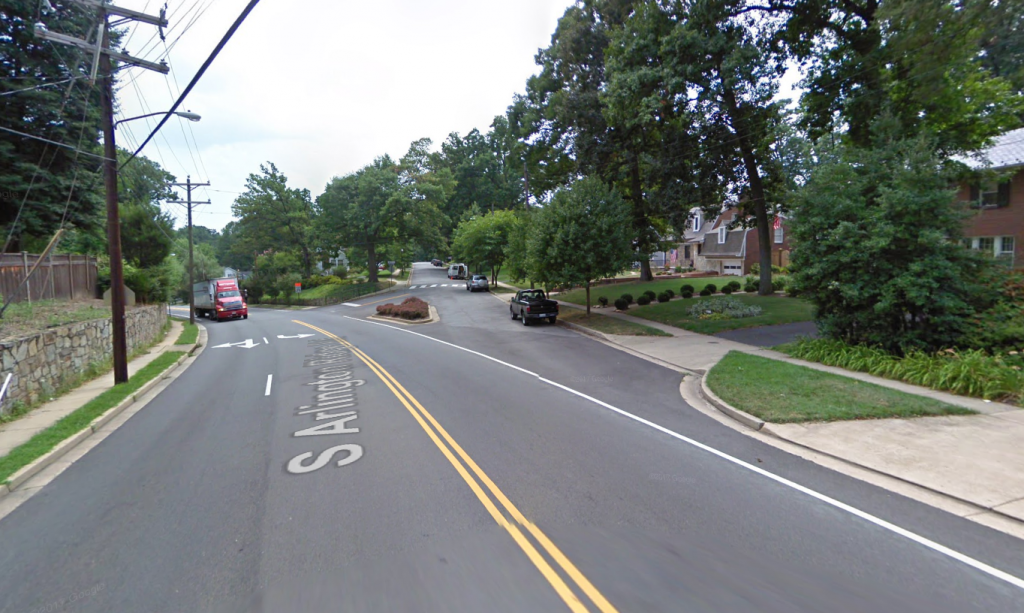
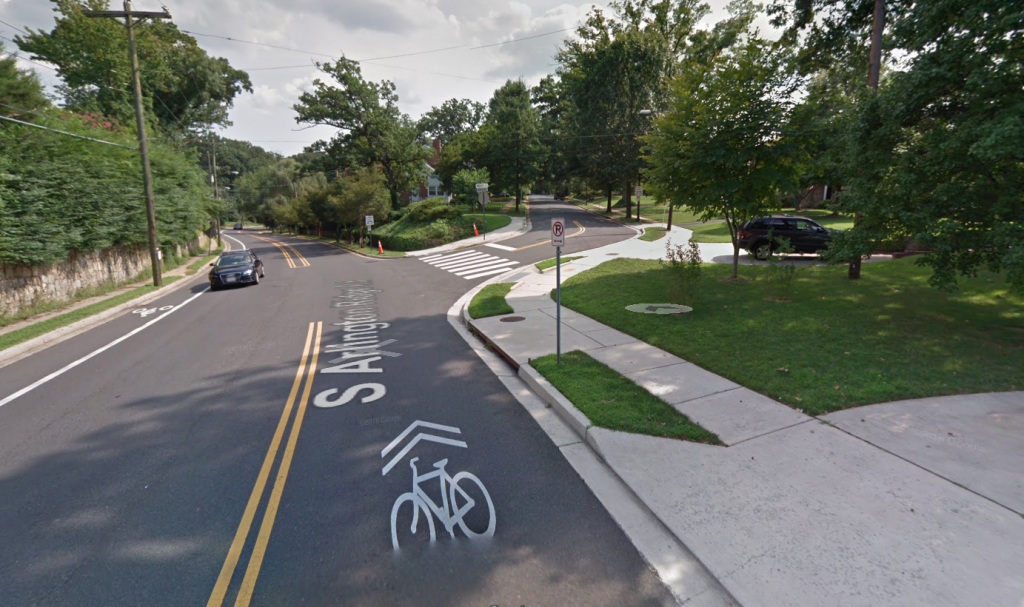
So what would this look like in practice? This small change in Arlington, Virginia is a great example. 

This is a minor collector road that runs largely through a residential neighborhood—not too far from the future home of Amazon’s second HQ. This slip lane made it possible for drivers to whiz into the neighborhood street without so much as a tap on the brakes. Look down the street and what do you see right after cars have sped through the gentle right turn? A crosswalk. That’s what it looked like back in 2009, but here’s what it looks like today:

The lanes were narrowed, the slip lane was eliminated, the right turn was converted into a sharper turn that requires drivers to slow down before turning, and the crosswalk was moved to the safest and shortest point of the intersection where pedestrians will be the most visible. 4

It’s very possible that because cars now have to slow down to turn right, that traffic occasionally slows down on the main road. There could even be a slight back up if a few people are turning right and have to yield to someone crossing the street. But this change is exactly what it looks like in practice to prioritize safety over vehicle speed or delay. 

While this small change is certainly one worth celebrating, this isn’t the standard practice of state DOTs that control the lion’s share of federal transportation funds, and speed remains their number one priority—even if they have a stated commitment to safety. This project was the result of a local county making decisions on their own and with their own funds. Most states will not change their practices unless Congress gives a guiding directive that the lives of the 40,000 people who die as a result of traffic fatalities each year are more important than a few seconds of delay.


Access to safe, convenient transportation is a fundamental right. Today, most Americans are denied this right because their roads—not just their highways—are designed to move vehicles at the highest speeds possible, and roads are not designed for people walking, biking, or taking transit as a priority. Safety may be important, but it’s never the top priority when designing these streets.

Until we come to grips with the fact that moving cars fast at all times of day without delay is a goal that can’t always be squared with our other priorities—especially safety—and until we can admit that perhaps everyone is not going to be able to go fast all the time, we’ll continue building unnecessarily large and expensive roads where thousands of people are killed each year.

No more slip lanes. Because safety should be a primary goal of our transportation investments.

Competition: Which street is the most dangerously-designed?

This week, we’ll be taking a deep dive on our second principle for transportation policy: design for safety over speed. Throughout the week, send photos of streets in your area that are designed for speeds far higher than the posted speed limit or where the speed limit is way too high for the context. On Friday (Nov. 8), you’ll have a chance to vote for the worst offender.

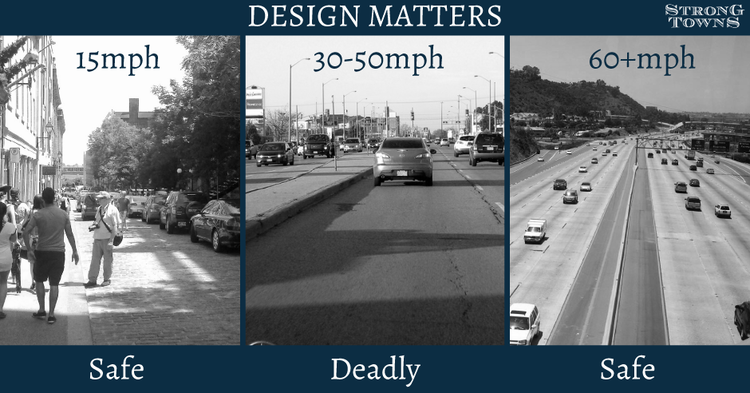
At slow speeds, cars can mix safely with other road users. High-speed interstates remove conflicts to keep people safe. But when people and high-speed traffic mix, that’s a recipe for disaster.

There’s a difference between the speed limit posted on a road and the speed the road has been designed for. People will drive at the speed they feel comfortable, regardless of the speed limit. Wide, straight lanes with open skies, long blocks, and few traffic signals or stop signs tell drivers it’s okay to go fast. Conversely, narrower lanes, more frequent crossings, and street trees can encourage slower speeds that are more appropriate for developed areas.

Off the interstates, in areas with shops & restaurants, offices, schools, and homes, we should be designing for slower speeds—speeds that keep people walking, biking, or taking transit safe and comfortable. Too often these very streets are designed to encourage high-speed thru traffic and then we wonder why our streets are so dangerous to people walking and biking.

Send us photos of dangerous streets in your area! Email us at jenna.fortunati@t4america.org or tweet your photo(s) to @t4america and tell us a little bit about it. On Friday, we’ll poll our followers to identify the most egregious example of a street that prioritizes speed of people’s safety.

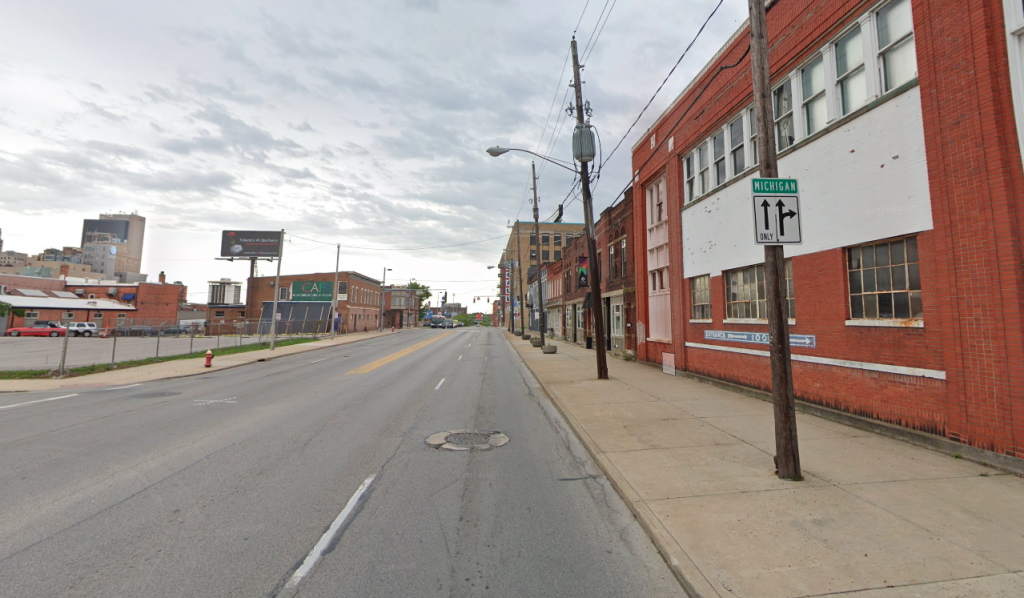
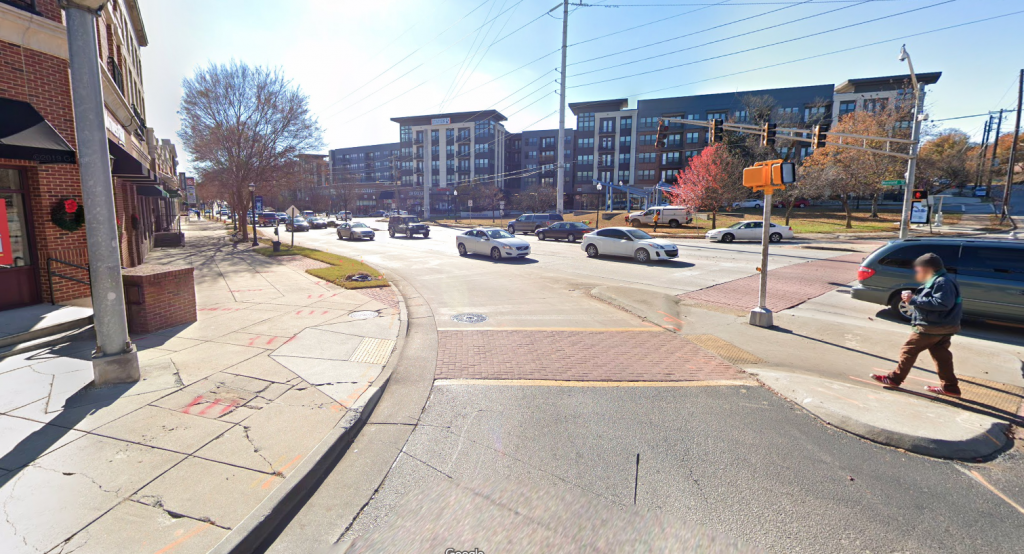
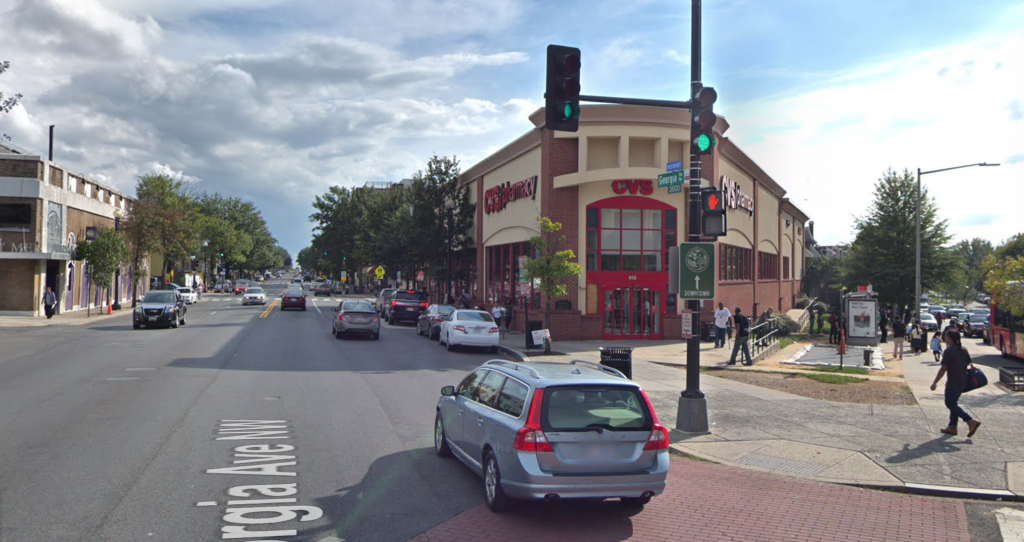
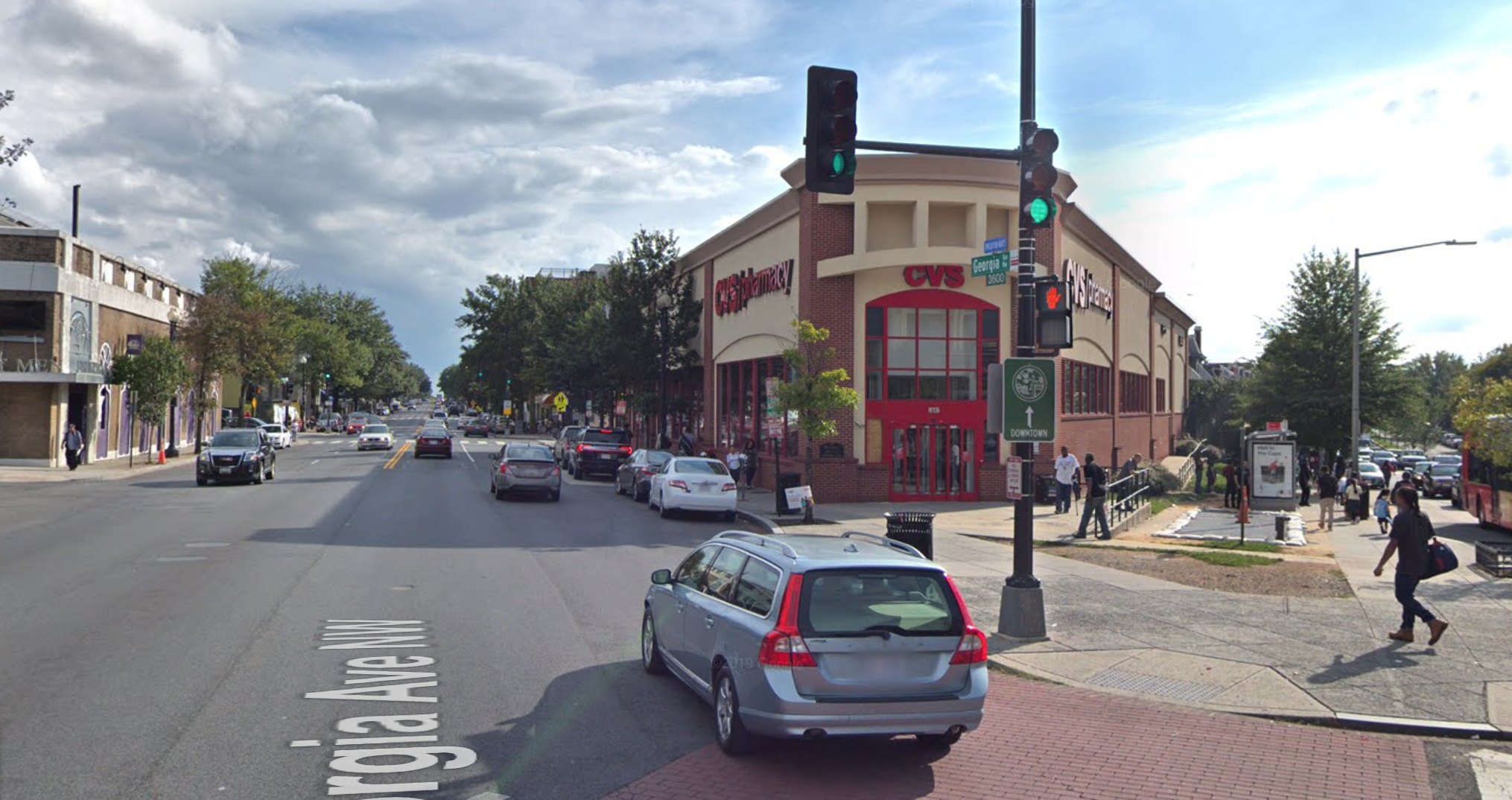
Examples of unsafe streets abound, and it’s not just suburban arterials. Take for example, Georgia Ave NW through the heart of Washington, DC. The posted speed limit is 30mph, but this four-lane, two-way road is arrow straight and drivers rarely travel at or below 30.

Within a few hundred yards of this photo there are laundromats and pharmacies, numerous bars and restaurants, homes for thousands of people, an elementary school, and a church. There’s also a metro stop and a dozen different bus stops—people walking are everywhere. Yet the design of this street clearly prioritizes the speed of car traffic over the safety of everyone else.

We want you to send us photos of streets where cars routinely drive above the speed limit (or where the posted speed limit is way too high) because the street isn’t designed to prioritize safety, or not designed appropriately for its busy context. Snap a photo this week and send them to us with a short description via twitter or email. On Friday, we’ll hold a poll on our Twitter account where you can vote for the worst offenders.

Safety over speed week: There’s one thing that almost every fatal car crash has in common

We face an epidemic of people struck and killed while walking and biking because our local streets—not just highways—are designed to move vehicles at the highest speeds possible rather than prioritizing the safety of everyone. It’s high time to stop sacrificing safety on the altar of speed with the tens of billions that the federal government spends every year. Here’s how Congress could make that happen.

It’s “safety over speed” week here at T4America, and we are spending the week unpacking our second of three principles for transportation investment. Read more about those principles and if you’re new to T4America, you can sign up for email here. Follow along on @T4America this week and check back here on the blog for more related content all week long.

Let’s start with a number: 49,340. 

That’s how many people were struck and killed by cars while walking on streets all across the United States between 2008 and 2017. Almost 50,000 preventable deaths. 

And yet, by and large, we call these crashes “accidents.” We still believe that these 50,000 deaths, and the deaths of almost 32,000 people every year killed inside of vehicles, are either just the cost of doing business for our transportation system, or were the product of bad behavior: distracted drivers, fatigued drivers, drunk drivers, or drivers not wearing seat belts. 

There’s no doubt that distracted driving increases crash risk and should be punished. But distracted driving can’t explain all of these deaths. There’s one thing that almost every crash has in common, though: high vehicle speed.

When crashes occur at higher speeds, they are more likely to be fatal, especially when they involve a person biking or walking.

In 2017—the year in which pedestrian and cyclist fatalities first reached the highest level since 1990—the NTSB issued a landmark study about how speed is the #1 culprit in traffic fatalities, finding that scores of crashes would not have been fatal at lower speeds. 

It’s easy to ignore something that you don’t understand, and most policymakers don’t understand when and how high speed roads can be safe—and when they aren’t. 

When are high-speed roads safe, and when are they deadly?

The only way to make a high speed roads safe is by separating opposing traffic; removing conflict points, like driveways and cross streets; and separating or removing cyclists and pedestrians. Of course, this is something we frequently do: it’s called a limited-access highway. 

But we’ve tried to design for similar high speeds on our arterial roadways in existing communities while retaining all the points of conflict that make those speeds deadly. Think of any suburban road lined with retail, offices, schools, and homes. Those streets—with multiple destinations along them—are designed like highways.5


Graphic from Strong Towns

Our sister organization, the National Complete Streets Coalition, explains that most cyclist and pedestrian fatalities occur on these 35-50 mph arterial roadways in our urban and suburban areas—roads designed for high speed but with all the conflict points of the slower speed streets, like slip lanes or numerous curb cuts for entrances and exits across a sidewalk. 

Reducing speed is the best solution

If we want these roads to be safe, they either need to become limited-access highways (unlikely, expensive and damaging for the local context) or they need to be designed for lower speeds with lower speed limits.

And we know exactly what speed these roads need to be designed for: 35 miles per hour, or less in many cases. But 35 should be the ceiling for these types of roads, not the floor, when it comes to design speed.

We are pursuing higher speed roadways because we have placed jobs and services far away from the homes of the people who need them. We make up for the inconvenient location of everyday necessities with higher speeds in hopes of shorter travel time, but it never works out that way. Instead, we get a lot of traffic congestion as everyone floods onto the same roads, seeking the same far-away, disconnected destinations. Even in free- flowing traffic, people save seconds or, rarely, a minute or two. And for that, we sacrifice thousands of innocent lives each year. More often than not, those killed are children, the elderly or those with lower incomes.

We need to better measure how speed contributes

Currently we only call a crash “speed related” when someone was driving over the speed limit. We don’t track whether the speed limit was inappropriately high, or if the speed  of the car played a factor in the crash or fatality even if the speed was under the posted limit. In fact, numerous local governments across the country are in arguments with states on who has the authority to lower speed limits. 

It’s time to determine and report when speed was a cause of a crash. It’s time to give local governments the authority to lower speeds to make a street safe and appropriate for its surroundings. And engineers should design roadways in support of slower, safer speeds. 

Congress can make protecting the safety of all people who use the street a priority by reflecting this in the decisions they make about how to fund, design, operate, maintain, and measure the success of our roads. The federal program should require designs and approaches that put safety—for everyone—first.