
Bury the BUILD Act and start over in 2027
After this week’s elections, the House’s main transportation committee will see massive turnover come January. So why does the likely Democrat leader on that committee want to start with legislation created by many of those outgoing members to develop a long-term transportation bill in 2027?
Back in May, the House Transportation and Infrastructure Committee passed their portion of a new five-year federal transportation law. The BUILD America 250 Act utterly failed to rethink or reform our country’s broken and bankrupt approach to transportation funding and policy. As I noted back in May, “as with the IIJA before it, the BUILD America 250 Act fails to orient this broken program toward the measurable outcomes that are promised over and over to the American taxpayer.” The BUILD Act was just one more in a long line of bipartisan “compromises” on transportation where everyone agrees to undermine their own priorities in the name of keeping the program limping along and the money flowing.
But this week’s elections totally transformed the dynamics of the next Congress. The House T&I Committee will see significant turnover, with as many as a third of the seats changing due to retirements, lost elections, and new assignments. The full House never debated or voted on the BUILD Act and is unlikely to do so in the less than 20 working days left before the new Congress.
So why bring it back to life? Why would current Ranking Member Rick Larsen—who will take over the gavel on the transportation committee when Democrats take over the House in January—want to use the BUILD Act as the starting point for negotiations in the 120th Congress starting in January? Why start with a bill written at the pleasure of a Republican majority that no longer exists? Is this bill really the best deal that Democrats can get on transportation?
Here are a handful of reasons why House Democrats should tell Rep. Larsen that it’s time to bail on the BUILD Act. Bounce it, bin it, boot it, bury it. Start over and create something better.
The BUILD Act was just more of the same
Back in the spring during a briefing for congressional transportation staffers, we asked them to stop and consider: What’s the purpose of the federal transportation program? Why do we need this bill? Why does this program exist? The answers we heard were not about accomplishing anything concrete:
“To provide steady, predictable funding. To allocate transportation money to states. To make a ‘better’ transportation system.”
To be fair, most of their bosses think about the program in the same exact way. Most are interested in keeping the money flowing to their state in a predictable way. Just keep this thing moving. More money than last time. Maybe create some new programs for this or that noble purpose.
Considering the total insolvency of the country’s transportation program and the terrible outcomes it consistently delivers, we’ve been hopeful that the House would respond with a law aimed at producing measurable progress on outcomes that matter. A bill that improves safety, reliability, and predictability. A bill that would produce real, measurable progress on the state of repair for our crumbling roads, bridges, and transit systems. A bill that would invest heavily in more ways to get around quickly and affordably.
Instead, we just got more of the same with the BUILD Act. This is what you get when “bipartisanship” is a more important goal than producing good policy that maximizes the measurable benefits for the traveling public in exchange for the mammoth levels of deficit spending required to cover this bill’s cost.
We think everyone should be dissatisfied with getting so little for so much money. And with the changes coming in January, we ask: Do congressional Democrats really think that this bill is the best deal they could get in the new Congress?
The BUILD Act went 0 for 3 on producing important outcomes
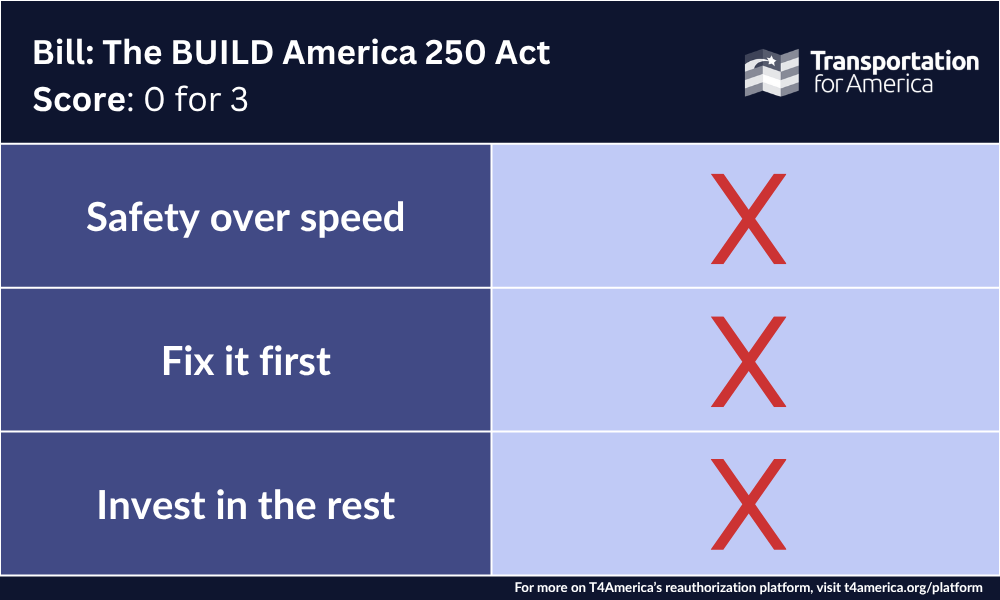
Repairing and caring for what we’ve already built, improving safety, and making it easier for everyone to get where they need to go are widely supported by the public, and should be fundamental purposes for the program. That’s why our three priorities encompass all three. But the BUILD Act struck out across the board on them.

Prioritize repair first
Nearly 80 percent of all voters believe the government should fix existing roads before building any new roads. The BUILD Act would do nothing to institutionalize this basic, commonsense requirement, which is perhaps the most basic aspect of running a transportation system with finite resources. The BUILD Act would not require states to demonstrate progress toward any hard and fast targets for road or bridge conditions. And it makes zero improvements to the current check-the-box performance management exercise, where states can set whatever targets they want with no accountability for improvement. Performance optional.

Safety
We don’t need a new safety program. Say it again. We don’t need a new safety program. We don’t even need more money for the existing safety programs. With safety numbers that are among the very worst in the developed world, we need to orient the entire program around improving safety. The BUILD Act did preserve the Safe Streets for All local grant program, though with a massive 50 percent cut. And it did nothing to keep the Trump administration from continuing to weaponize the program by removing all mentions of vision zero and banning the use of bike lanes or other proven methods to slow speeds and improve safety and mobility at the same time.

Invest in the rest
It’s simple. The BUILD Act increases guaranteed funding for highways, and reduces guaranteed funding for transit. Two decades after completing the interstate system, the BUILD Act fails to invest in the rest and build a world-class transit system. And it did nothing to ensure that money they authorize for transit even gets spent over the next two years. Where’s the good deal, exactly?
BUILD gives the Trump admin more money to control without any new safeguards
Back in 2021, the IIJA created exciting new programs to support emission reductions, electric vehicle charging infrastructure, expanded transportation options, and safe street redesigns; provided historic funding for passenger rail; created a new program to reconnect communities divided by highways; and poured more money into transit than ever before. So what happened to all these things over the last two years, many of which were Democrat priorities?
- Transit grants to build new or expanded service have been frozen by the administration, with just one grant approved in nearly two years. And a recent policy move by FTA could threaten the existence of dozens of transit projects deep in development.
- The main program for planning passenger rail service expansion has been put on pause by the administration.
- Funding for new electric vehicle charging infrastructure was rescinded to go toward the cost of the budget-busting budget reconciliation bill.
- Safe Streets for All program weaponized and the latest round of grants were focused on things like helping people get to the hospital quicker after they get struck while walking on unsafe streets that won’t get fixed.
- Carbon reduction program eliminated.
- Reconnecting Communities program eliminated and promised grants were taken back from local communities.
For the last two years, the Republican-led House and Senate stood by while the administration flouted the intent and will of the bipartisan agreement Congress made to create these programs. The BUILD Act failed to take the initiative to restore these programs, bring back canceled grants, or create any new protections to ensure that their intent is fulfilled by the administration.
Why would Democrats strike a new “bipartisan” deal on transportation when only their priorities were eliminated in the last deal?
The last time Democrats controlled the House, they produced a terrific bill
While the BUILD Act needs to get tossed in the trash on the merits, the past can also produce good ideas as the House drafts a new bill. The INVEST in America Act, produced by Chairman Peter DeFazio and the House T&I committee in 2020, was excellent. It went 3 for 3 on our priorities, and had bipartisan support for the best repair provisions Congress has ever produced. Unfortunately, the House then got steamrolled by the Senate during negotiations, which produced the IIJA, which was not nearly as strong. Incoming leadership in the House should look to the INVEST Act for inspiration in 2027.
A new Congress should produce a new bill
Incoming House leaders should not advance a bill that was produced with the help of so many members of Congress who just got sent home by their voters. And on the flip side, the huge influx of new members who were just sent to Washington should get their chance to craft a different approach to transportation—a new Congress should mean a new sheet of paper.
The dynamics have certainly changed. A better deal can be had. Congress should bury the BUILD Act and start over fresh.