Ten things to know about the BUILD Act’s failure to produce better outcomes
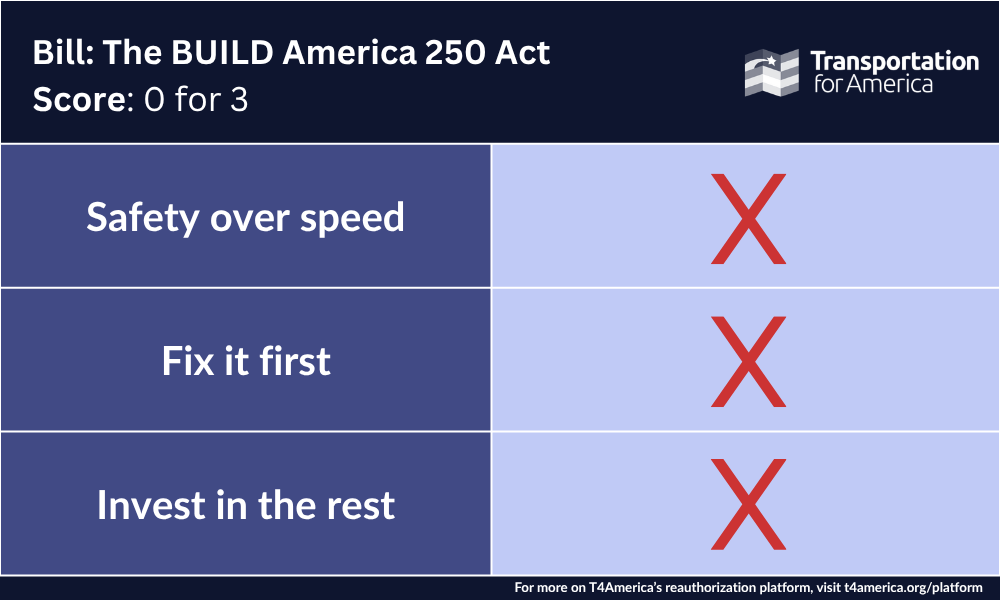
The BUILD America 250 Act is a lot like the IIJA—minus a whole lot of funding for transit, rail, and reducing emissions. Here are ten things to know about the bill and how it fails to meet the mark on T4America’s simple three priorities.
The BUILD America 250 Act, approved by a House committee early on Friday, May 22nd, is a lot like the IIJA—minus a whole lot of funding for transit, rail, and reducing emissions. Here are ten things to know about the bill and how it will fail to advance T4America’s simple three priorities.
After a year of hearing that “the House is definitely going to release and markup a draft bill sometime this month,” Lucy kept the football on the ground, and the House finally released a five-year, $474 billion reauthorization proposal last Sunday on the eve of this year’s Infrastructure Week. Predict the same thing every month, and eventually it will come true.
How will Congress pay for this enormous bill? The short answer is they won’t—your grandkids will. A modest amount of new funding will come via a controversial new fee on electric vehicles, but that’s a drop in the bucket compared to the enormous gap between revenues and spending. Just like the Infrastructure Investment and Jobs Act (IIJA), an enormous subsidy from all taxpayers would be required to cover annual spending that is roughly double what the gas tax brings in each year. And all that for a fairly status quo proposal that fails to meet the moment and will not deliver a transportation system that safely, affordably, and reliably gets us all where we need to go.
But in a bill with less money than the IIJA, it’s transit and passenger rail that take the hit.
Though leadership on the House Transportation and Infrastructure Committee describes it as a $580 billion bill, in reality, it includes only $474 billion in guaranteed funding, representing a cut from the $539 billion guaranteed by the 2021 Infrastructure Investment and Jobs Act. Nearly all of that difference comes from cuts to transit, passenger rail, and scrapped competitive grant programs. Highways? They get a healthy bump in guaranteed funding.
1) There was a notable attempt to prevent a repeat of the Trump administration’s massive flood of grant cancellations
This administration has been unwilling to follow the current transportation law, as evidenced most clearly by their abrupt 2025 cancellation of billions in grants that were previously awarded to states and local communities. The BUILD Act included some surprising language aimed at preventing a repeat: “the Secretary may not terminate, withhold, or delay the execution of a grant agreement for a grant or award (in part or in whole) made using funds made available under this Act” based on any arbitrary reasons or a change in preferences of a new administration. While this provision would be a step in the right direction, it unfortunately does nothing to restore the billions in grants rescinded under the IIJA.
Another way to think about this provision: it will successfully prevent the cancellation of grant funding for the kinds of projects that this administration will absolutely not select in the first place. This is a move in the right direction, but it’s slamming the proverbial barn door after the horses are already in another zip code.
Rep. Jared Huffman (D-CA) did attempt to restore the canceled IIJA grants via this amendment during Thursday’s marathon committee markup. This amendment, which failed on a voice vote, would have retroactively applied to all grants awarded under IIJA, noting that “the Secretary shall obligate and execute grant agreements for any project that was selected, awarded, or publicly announced for funding by the Department on or after November 15, 2021” via the IIJA or Inflation Reduction Act, and prevent the Secretary from canceling them. When it was offered during the markup, Chairman Sam Graves backed the Trump administration’s decision to cancel these grants, noting that Sec. Duffy inherited a backlog of unobligated funds, so the only solution was obviously to cancel them all and take back the money.
Rep. Huffman had some support, but considering the fact that canceled grants spanned republican and democrat districts alike, you’d think that a sizable number of committee members—but especially those in the minority—would be loudly standing up for those communities and making the restoration of these grants one of their fundamental prerequisites for support.
Apparently not.
Grant cancellations aside, here are nine other things to know about the BUILD America 250 Act, organized around our three simple principles. (Note: We’re just calling it the BUILD Act from here on.)
Fix it first
Overall, this bill fails to make meaningful strides towards prioritizing maintenance and repair on our roadways. States are not required to demonstrate progress toward any hard and fast targets for road or bridge conditions before building new road capacity with federal-aid highway programs. There is no change to the current paperwork exercise of performance management, and states are not required to set any targets they’d be held accountable for meeting. (Read more about this T4America principle)

2) Dedicated bridge repair funding is back, but lacks accountability
Congress eliminated a dedicated bridge repair program back in 2012, but what’s old is always eventually new again, and the BUILD Act creates a new dedicated formula program for bridge repair. Some IIJA bridge programs are consolidated into a new $9.2 billion annual program—creatively called the Bridge Program. Each state would receive $75 million, plus an amount based on factors like bridge area and the amount of bridge area in poor condition. Some money is set aside to be spent on the thousands of oft-overlooked bridges not on the federal-aid highway system (though states can opt out of this), and 25 percent is set aside for states to run a competition for awards to locally-owned bridges. States have to produce a new report describing progress made on reducing the number of bridges in poor condition, but there are no real penalties for failure.
Beyond this formula program, there’s a new $2 billion annual competitive grant program (without guaranteed funding) that’s focused on improving the safety, efficiency, and reliability of bridges on the National Highway System only. While the details are different, with dedicated funding and little accountability, the BUILD Act’s approach is not that dissimilar from our pre-2012 approach to bridge repair.
3) The slightest of head nods toward repair accountability
The National Highway Performance Program (NHPP) is the largest highway-focused program that states have control of. Within this program, states will have to develop and maintain a state asset management plan. Under BUILD, any state that fails to develop and implement its asset management plan will see the federal share for projects within NHPP drop down to just 65 percent. While that sounds like a move in the right direction, there are no requirements that states set or meet binding, positive targets on repair. That’s not going to cut it.
4) Reconnecting Communities is functionally dead
This bill completely eliminates the Neighborhood Access and Equity Grant program, which was best understood as the authorized, long-term version of the Reconnecting Communities pilot program, which technically ended this year. This likely means the end of federal money spent on repairing divisive infrastructure, and the end of a program T4America helped create back in 2020.
The concept of Reconnecting Communities survives as a project eligibility within a new grant program (STAG) that would replace the BUILD competitive grant program. (Yes, this is confusing. The BUILD grant program is the one formerly known as TIGER and RAISE.) But considering that this administration canceled nearly every single unobligated Neighborhood Access and Equity grant project, it’s unlikely that any reconnecting-style projects would win funding in this new grant program under this administration. The Senate should resuscitate this program, and there was an amendment offered during the markup to restore the Reconnecting Communities program and rename it.
Safety over speed
While there are a few changes that could be perceived as small improvements to safety policy, the program fails to make improving safety a centerpiece priority across the entire program and will do very little to reverse the U.S.’s roadway safety crisis. (Read more about this T4America principle)
5) Safe Streets for All local grant program survives
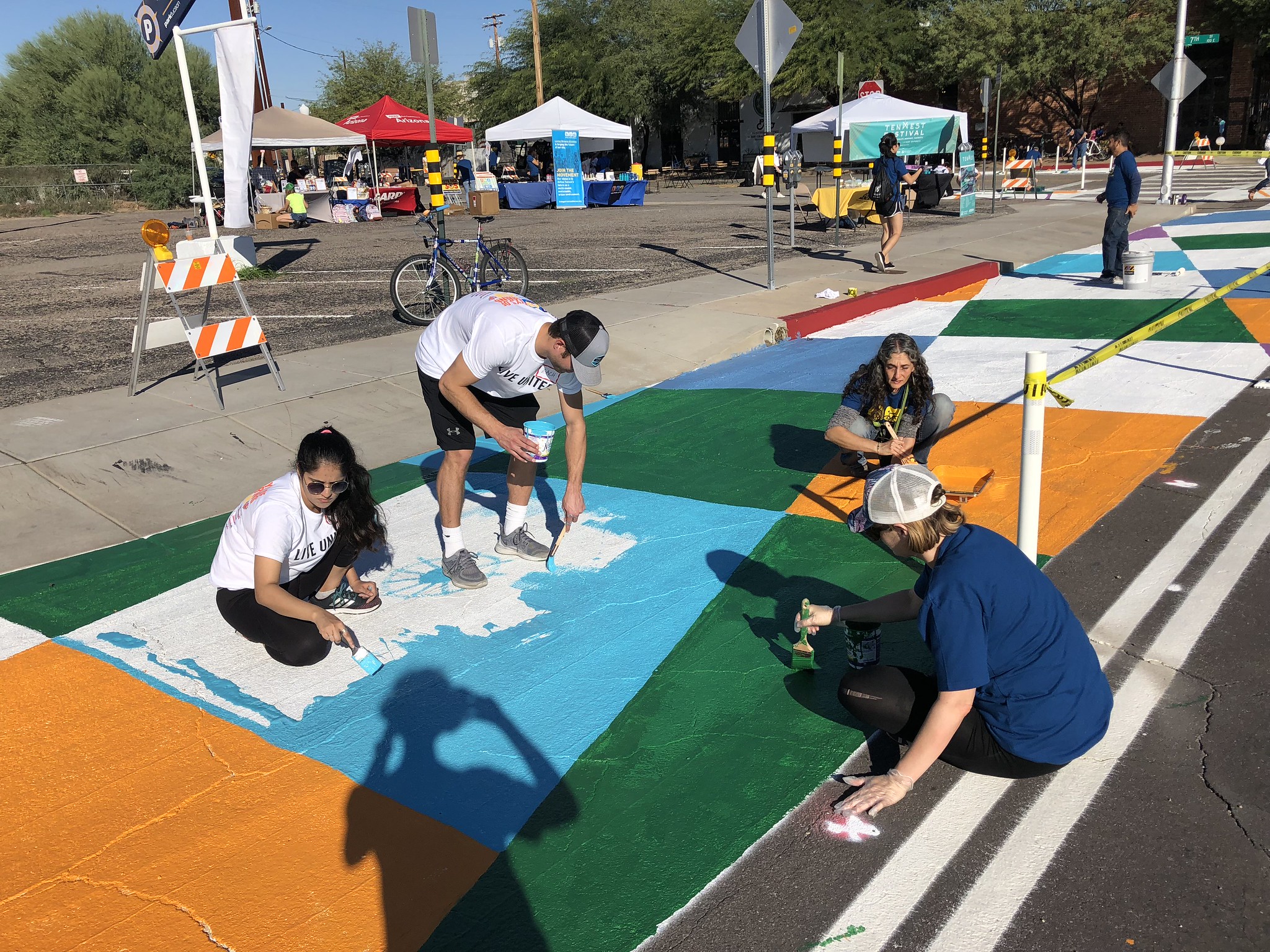
Perhaps the best news in this entire bill is the survival of the Safe Streets for All (SS4A) grant program, which is only available directly to cities and local communities (including tribes) for projects to make concrete changes to their streets to improve safety. SS4A’s survival is good news for safety, and it was also moved into the highway title of the bill and given guaranteed funding through contract authority, sparing it from future appropriations fights. In IIJA, 40 percent of SS4A funds were (likely mistakenly) set aside for planning, and one of the eligible uses was for quick-build demonstration projects. The BUILD Act reduces that set-aside to a much more rational 5 percent. That might seem too low, but considering how much money has been put into planning over the last five years, it’s time to pour more money into implementation and actually building projects to improve safety.
The bad news is that the program is roughly half the size it was during the IIJA, and all mentions of Vision Zero were eliminated. And we’re putting a lot of faith in a program that has already been weaponized by this USDOT. USDOT has selectively canceled SS4A grants they didn’t like and also changed the criteria to let applicants know they won’t select projects that make people safer by removing parking or repurposing lane space. This USDOT wants to improve safety with SS4A grants, as long as those improvements don’t come at the expense of their other, higher priorities.
6) States aiming for more people to die on their roads have to inform the Secretary
Under our weak system of measuring performance, numerous states have routinely set targets for more people to be injured/killed on their roadways. These targets have been posted publicly on FHWA’s website, but the BUILD Act makes a subtle change to require the Secretary to notify Congress when states do it in the future. But there will continue to be no penalty for setting these regressive targets, and Congress has not shown any appetite to create actual accountability for reducing roadway deaths. But it will be harder for Congress to claim they didn’t know that states were aiming for such bad performance.
Invest in the rest
While the BUILD Act increases guaranteed funding for highways, guaranteed transit funding is going down. There are a few changes to provide some modest flexibility to use capital dollars for operations, but there are none of the dramatic increases in transit capital or operations funding on par with what it would truly take to invest in the rest and build a world-class transit system. (Read more about this T4America principle.)
7) Guaranteed highway money is going up while transit is decreasing.
IIJA provided an historic increase in guaranteed funding for highways and transit. That’s only the case for highways this time around.
Though the bill’s authors are quick to note that transit contract authority is increasing over IIJA levels, the guaranteed amount for transit is actually going down, thanks to the loss of advance appropriations. Transit goes from $91.2 billion in guaranteed funding in the IIJA down to $87.6 billion in BUILD. Highways, meanwhile, jump from $351 billion up to $376 billion in guaranteed funding. This also means that transit is dipping below its typical 20 percent share of the overall bill. The 80/20 split has often fluctuated slightly above or below that 20 percent threshold, but the decrease is still notable.
8) Changes to the transit capital program…which is currently frozen by the Trump administration
No one should be celebrating any positive changes in the program for building and expanding transit systems, considering that it has been ground to a halt by the current administration. The bipartisan authors in the House have failed to recognize this reality nor have they done anything in this bill to attempt to require this administration to follow the law and administer this program in this new five-year proposal.
There are some changes to streamline transit capital project delivery, including rewarding transit agencies that have recently navigated the federal process successfully with a speedier process. Likely recognizing the increasing costs of bus rapid transit projects and other “Small Starts” projects, BUILD raises the funding threshold for these projects up to $1 billion (with a 50 percent max federal share) and changes their name to Streamlined Starts. The law would broaden the eligibility for Core Capacity projects, which could make it possible for projects to do things like investing in automation to increase throughput on a busy rail line. And transit projects in the pipeline can receive extra credit in the evaluation process for local policies in favor of housing development near transit.
On the negative side, the IIJA-created program for procuring low- and no-emission buses is toast.
9) A new focus on transit safety, crime, and fare evasion
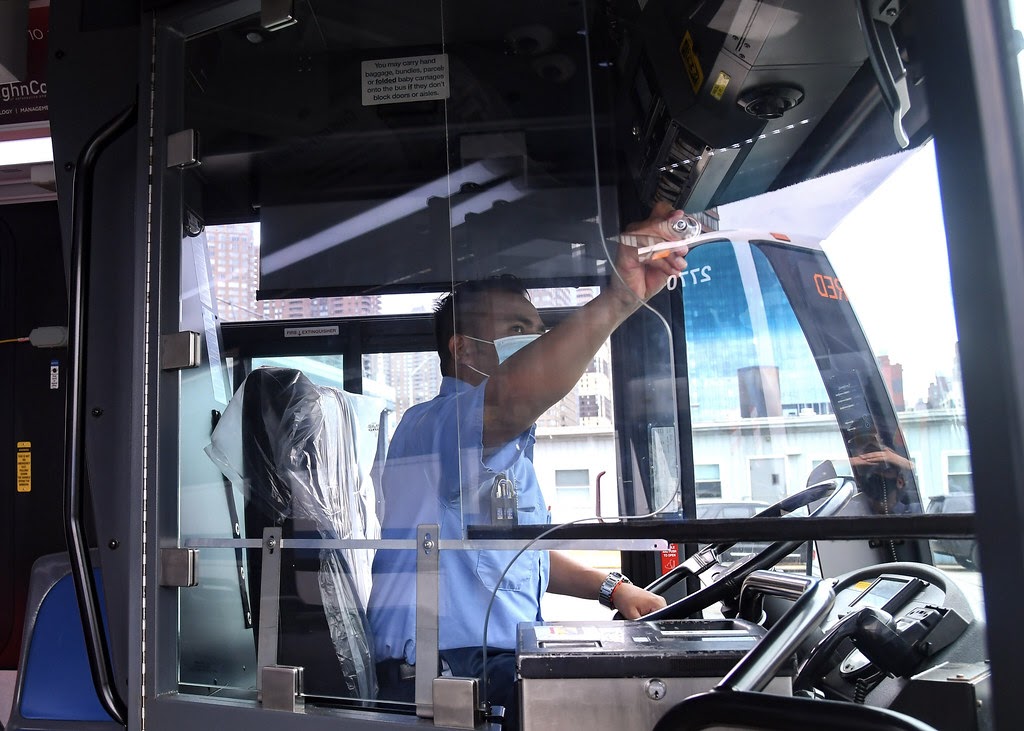
There’s a significant new focus on transit safety and fare evasion—both with funding set aside from transit formulas, but also in new policy requirements.
Instead of just one percent, urban agencies will be required to spend 1.5 percent of their transit formula funds on a wide range of eligible transit safety and security projects, including fare evasion prevention, new technology, and new police officers. Agencies have to start gathering and reporting data to FTA on how much money they are losing to fare evasion, and there are requirements for making fare evasion a criminal or civil offense. There are no penalties for the states or cities that continue building streets and roads that ensure that anyone’s walking trip to transit might be the most dangerous part of their journey.
10) Passenger rail loses out big time
After $66 billion guaranteed in IIJA for rail, the BUILD Act provides zero dollars in guaranteed funding for passenger rail and reduces authorized spending below IIJA levels, while making some marginal improvements around rail permitting and Amtrak accountability, and logically combining several programs.
The result of losing the guaranteed funding means that Congress will have to do something it didn’t have to do over the last five years: consider every year whether or not it will provide the authorized amounts of rail funding. Policy improvements aside, the rail title overall decreases federal investment in passenger rail and is a step back. We expect the Senate Commerce Committee to take a different approach.

The bill was approved by the House Transportation and Infrastructure Committee on a 66-2 vote in the wee hours of Friday morning. Stay tuned on the blog for more on the law and the next steps.