
Restructuring Amtrak will only be successful if it brings real change
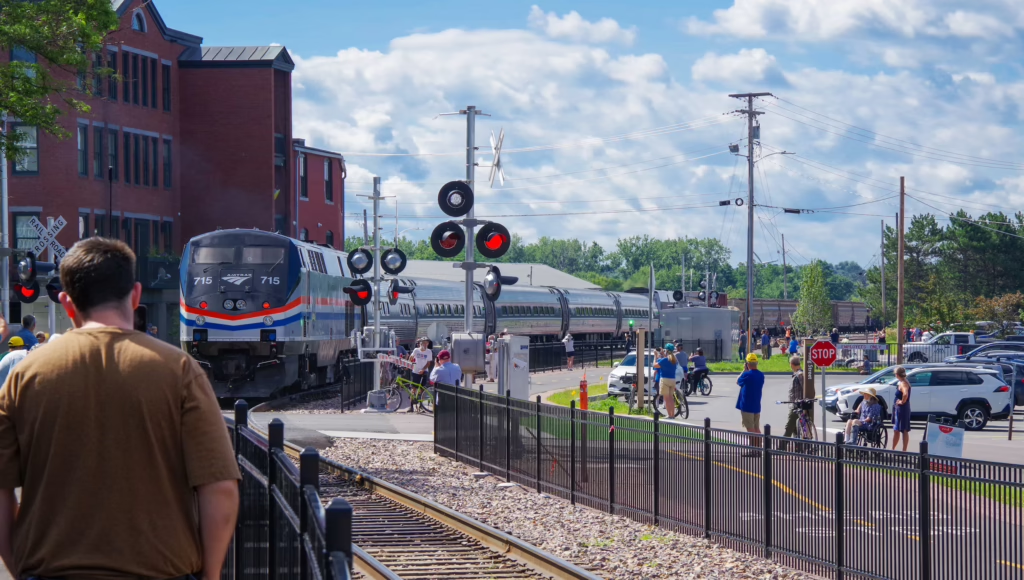
Amtrak’s leadership is moving to restructure the nation’s passenger rail service in the most significant way since its creation 56 years ago. Americans lack the reliable, affordable, and connected passenger rail service they deserve, but will the proposed restructuring and reforms get them there? The answer is complicated.
Congress created Amtrak through the Rail Passenger Service Act of 1970 to deliver high-quality, safe, and on-time passenger rail service. But it would be tough to argue that Amtrak has successfully delivered on those goals, and many things within Amtrak are indeed broken. The Amtrak Office of the Inspector General (OIG) produced a damning report this year:
“Amtrak no longer has enough train capacity to meet existing demand,” and that “Amtrak will need to find a balance between expanding service and improving existing service.…Strengthening oversight, coordination, and management practices will be essential as the company balances its core responsibility of running a safe railroad with expanding service, modernizing its infrastructure, and managing unprecedented levels of investment.”
Amtrak’s board has responded with a dramatic proposal to divide Amtrak’s responsibilities into three subsidiaries—an Infrastructure Manager, Rolling Stock Manager, and Passenger Rail Services—all functioning under the parent company. If you have more questions than answers after reading the preliminary proposal, you’re not alone. It is extremely light on details and represents only high-level functional categories.
Transportation for America has spent decades working on the reforms and investments needed to deliver reliable, affordable, and connected passenger rail service, and we support reimagining how we organize passenger rail in this country. This moment provides an opportunity to rebuild broken relationships and affirm Amtrak’s commitment to providing high-quality, on-time, and safe passenger rail service. But any effort to restructure and reform Amtrak must strengthen existing networks, make operations transparent through public data on cost allocation and on-time performance, and modernize equipment and maintenance with predictable and standardized practices. What follows are four concerns with the plan, and three areas of opportunity with concrete suggestions for making them even stronger.
Four concerns with the proposed restructuring
1) The proposed restructuring is far too vague.
The proposal outline lacks detail and depth, making it difficult to truly understand how Amtrak intends to organize its new structure and how it would work in practice. There are so many specific issues that need further clarification to render an intelligent verdict on this plan. The board shouldn’t commit to such dramatic action without a more detailed plan for execution.
2) Creating three separate entities is a double-edged sword
While separating passenger rail services, infrastructure, and rolling stock into three different entities could accelerate decision making and better match authority to responsibility, it could also create silos and make coordination more difficult. Each branch must understand its responsibilities and role in advancing overarching goals, but creating silos could allow for finger-pointing, inhibiting Amtrak’s ability to provide high-quality services.
3) Restructuring deserves transparency
Administrative changes will increase up-front costs, but Amtrak can and should implement cost-containment measures to prevent duplicative processes across branches. Amtrak must communicate how much money would be spent in this process. Restructuring must not add layers of complexity that make Amtrak’s business more opaque and further erode organizational trust. Greater transparency must be a bedrock value.
4) On-time performance needs to be the top priority
Leadership needs to provide a clear mandate of delivering strong on-time performance and expanding passenger rail. This would allow staff to make timely and effective decisions, problem-solve with clear priorities in mind, and move passenger rail in the right direction.
Three opportunities to address longstanding challenges
Here are three opportunities we see for Amtrak to make significant improvements within this restructuring proposal, along with some detailed recommendations that T4America has developed:
(1) Addressing maintenance issues due to unavailable inventory
Amtrak has well-documented maintenance problems. A 2024 OIG report found that at least 900 units (railway vehicles or train cars) were taken out of revenue service for a total of approximately 13,000 unit-days in 2022 while Amtrak waited for out-of-stock inventory items. Eighty-seven percent of mechanical employees said a part they needed was unavailable weekly, and 31 percent of employees proactively told interviewers that at least one item they needed was out of stock daily.
Unavailable inventory means downgrading passengers from sleeper to coach cars, consistently delaying trains, and even canceling them outright. This problem is also grossly underreported. Amtrak’s Fleet Reliability metric, which should theoretically capture every cancellation, delay, or anything where fleet availability affects on-time performance, does not measure any of these instances resulting from unavailable inventory.
If Amtrak is to restructure, it must solve this issue and begin to effectively analyze the impact it has on on-time performance, customer satisfaction, lost revenue, and the system at large. Restructuring itself may not solve these problems, but it does serve as a moment to push for long-term organizational change.
T4America’s proposal: A National Equipment Leasing Pool
Current inefficiencies and delays also harm the passenger rail system through massive cost increases. A National Equipment Leasing Pool, a non-profit entity charged with procuring, owning, and leasing passenger rail equipment to service providers nationwide, would allow for flexible deployment, easier maintenance, and better value for the entire national passenger rail ecosystem.
With access to standardized and accessible equipment, operators would no longer have to individually procure their fleet. The BUILD America 250 Act attempted to create a new pool but limited its applicability to interstate rail compacts, of which only four exist nationwide. That’s too limited—other regions would not be able to access and lease equipment from the pool in a timely manner. We need a more comprehensive approach.
Implementing this pool through an Equipment Advisory Board (see under #2 below) is essential to reducing delays, decreasing costs, and promoting collaboration across systems and the entire network.
(2) Improving standardization across the network
One way to make passenger rail more cost-effective is to standardize all railcars, equipment, and other tools. Today, equipment used in Mississippi could be drastically different from that used in Iowa or the Pacific Northwest. And when equipment can’t be widely shared across the country’s network, costs go up for everyone. Expansion also becomes easier with a more standardized network.
The July 2026 OIG report points out that new designs are also risk-prone and have slower development compared to their older counterparts. For example, the NextGen Acela struggled to meet regulatory safety standards in 2023, resulting in a multi-year delay. At its launch two years later, the public received only five new trains, and since then, trains have faced technical issues, door malfunctions, and restroom problems. Reducing over-customization provides tested and proven equipment and helps prevent a repeat of stories like this.
But NextGen Acela trains are not the only service with standardization problems. Every premium design or over-customized amenity and trainset poses schedule risks, causes capacity issues, and hikes up costs, especially when companies have no experience designing complex builds for technically wonky and unproven requirements.
Amtrak needs a formal process for engaging manufacturers, operators, and rail labor to clear up what is scalable and feasible when it comes to trainset and equipment requirements and requests.
T4America’s proposal: Equipment Advisory Board
To successfully implement a successful National Equipment Leasing Pool, Amtrak also needs to form an Equipment Advisory Board, with the authority to procure, design, own, and lease equipment. This would be a significant step toward solving the nation’s standardization, scaling, and cost-effectiveness problems.
Relevant industry experts and stakeholders from manufacturing, vendors, and on-board personnel would focus on standardizing rolling stock across the country, improving collaboration among Amtrak, vendors, and the manufacturing industry, and allowing scalable, cost-effective procurement. OIG agrees: The July 2026 report argued that developing realistic and feasible requirements from an Equipment Advisory Board would “minimize maintenance and service problems that are often endemic to new, unproven mechanical systems” just as “opting for less complexity early on would likely help reduce the risk of cost increases in the procurement, design, and manufacturing processes.”
With manufacturers engaged in procurement conversations in early stages, unproven designs and unrealistic requirements would be sorted out, creating more scalable infrastructure and reducing costs and delays. Click here to read our proposed makeup of an Equipment Advisory Board.
(3) Dumping flawed modeling that hampers service expansions
The 2025 launch of the new Mardi Gras service is a terrific illustration of the deep flaws in Amtrak’s modeling for determining likely ridership and revenue figures.
For example, Amtrak initially predicted the Mardi Gras line would only see 38,000 riders in its first year of service. Later, those estimates were increased to 71,000. But one year in, ridership more than doubled those estimates, hitting 150,000 riders and bringing in over $5.2 million in ticket revenue. These flaws in Amtrak’s modeling, which substantially underestimate ridership and revenue figures, make it politically impossible for any governor or state legislature to fund new services. Strong projections make the story more powerful and increase the likelihood that elected officials will care and provide funding.
Alongside the Trent Lott Institute of the University of Southern Mississippi, the Southern Rail Commission made the case for the new lines with a thorough analysis rooted in on-the-ground realities. This analysis, unlike Amtrak’s modeling, included the fact that New Orleans is a major tourist destination with Mardi Gras, the New Orleans Saints, and scores of other events that draw people from along the coast year-round. After the success of the Mardi Gras Service, the Rail Passengers Association further developed this modeling, turning it into a robust tool for effectively analyzing and projecting ridership and revenue for future lines.
—
Restructuring alone won’t solve these persistent problems. If we want to bring the nation’s passenger rail network into the 21st century, we will need to do more than just restructure Amtrak. To build out world-class passenger rail, we need a system that ensures cost-effective procurement, rolling stock availability, and interoperability across services. We look forward to the Amtrak board producing greater detail on this proposal, and to additional oversight and input from Congress on this significant change.
On Nov. 10, 2026, Transportation for America leaders brought these concerns and proposals to Amtrak’s Board of Directors during the special public meeting.