Repair Priorities: State trends
Policymakers continue to emphasize “fix-it-first,” but the data tell a different story. Our analysis in Repair Priorities shows only marginal improvement in road conditions, leaving the costly backlog of roads in poor condition largely unchanged.
State spending
Repair should be the top priority for any entity receiving federal transportation dollars. Some states are already moving in that direction and have adjusted their highway capital budgets in recent years, shifting funds away from road expansion toward repair and preservation.
South Dakota is still leading the nation in prioritizing repair with their spending, having dedicated 72 percent of its highway capital budget to roadway repair between 2018 and 2024. During that time, the state saw their roads remain in good condition, with only a small share rated in poor condition. New Mexico is close behind, with 63 percent of its highway capital spending going to roadway repair over the same period. Alaska, Maine, Michigan, Maryland, Nebraska, North Dakota, New Hampshire, and Wyoming all allocated more than 50 percent of their highway capital budgets to repair.
Some states still saw worsening conditions despite high repair investment. Even while allocating more than 50 percent of their highway capital dollars to repair, Alaska and Wyoming saw only modest decreases in the percentage of roads in poor condition from 2018 to 2024.
Some states continue to dedicate substantial portions of their highway budgets to expanding road networks rather than maintaining their existing roads. At 68 percent, North Carolina allocated by far the largest share of its highway capital funds to expansion in 2023. Arizona, Tennessee, Washington, Iowa, and Utah also maintained high levels of spending on expansion, each allocating around 40 percent of their budgets.
Bridge spending can also shape pavement priorities. Virginia, Rhode Island, and West Virginia dedicated significant portions of their budgets to bridge maintenance and expansion—up to 51 percent in Rhode Island—limiting available funds for roadway repair or expansion.
Road conditions by state
While pavement conditions at the national level remained relatively flat between 2018 and 2024, the outlook is mixed when you drill down to individual states. 31 states saw improvements in their roads between 2018 and 2024, with Oklahoma, New Jersey, Massachusetts, Vermont, Rhode Island, Arkansas, Kansas, and Iowa recording decreases of at least 10 percent in their share of roads in poor condition. Some of these states are continuing a trajectory of improvement, continuing trends that go back to the 2009 data.
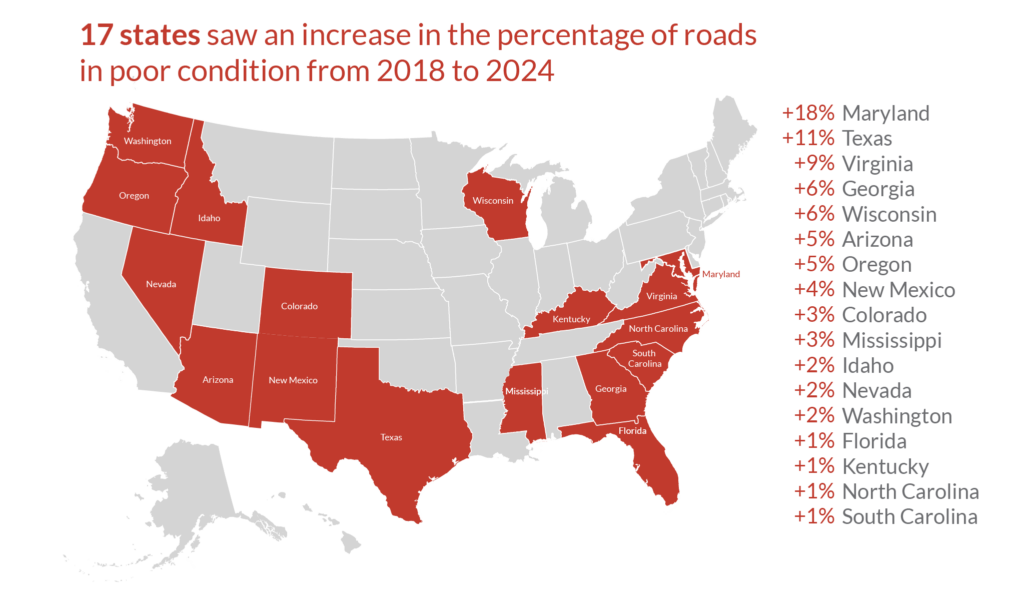
Conversely, a number of states saw increases in the percentage of roads in poor condition during this period. Arizona, Maryland, Georgia, Oregon, Texas, Virginia, and Wisconsin experienced the greatest increases, with states such as Texas and Virginia showing a considerable decline in pavement conditions since 2009.
Seven states have at least 30 percent of their major road network in poor condition as of 2024: California, Connecticut, Hawaii, Mississippi, New Mexico, Rhode Island, and Washington. Of those, Rhode Island continues to rank the worst, with more than 40 percent of roads classified as poor. Several of these states were also among those with the highest share of poor roads in 2017, which was the baseline year used in the previous 2019 edition of Repair Priorities. California, Connecticut, Hawaii, and Rhode Island appeared in the category with the highest percentage of roads in poor condition in both reporting periods, suggesting a lack of willingness to prioritize maintenance ahead of other investments.
By contrast, Indiana, Iowa, Kansas, Oklahoma, Tennessee, and Vermont report the lowest percentage of roads in poor condition as of 2024, each reporting fewer than 5 percent. Several states that ranked well in 2017 continue to report relatively strong pavement conditions. Idaho, Nebraska, Tennessee, and Wyoming again rank among the states with the lowest shares of roads in poor condition, suggesting consistent maintenance performance over more than a decade.
Nebraska, North Dakota, Tennessee, Vermont, and Wyoming report the highest percentage of roads in good condition. In Vermont, more than three-quarters of federal-aid roads are in good condition, the highest share of any state. These states also ranked among the highest in the percentage of roads in good condition in 2017.