Repair Priorities: Key Findings
Policymakers continue to emphasize “fix-it-first,” but the data tell a different story. Our analysis in Repair Priorities shows only marginal improvement in road conditions, leaving the costly backlog of roads in poor condition largely unchanged.

Positive trends in repair spending
Since the first edition of Repair Priorities in 2011, states have made modest progress on repair spending. Between 2004 and 2008, states spent more on road expansion than on repair. Between 2009 and 2014, spending on expansion and repair was roughly equal. Since then, states have started to spend more on repair than on expansion. (25 percent on expansion vs. 39 percent on repair on average from 2018-2024.) Yet, with rising construction and maintenance costs, even increased spending may not yield the same results as in the past. And this positive shift in spending has failed to radically move the needle on road and bridge conditions.
Over time, many states have shifted a greater share of funds toward other priorities, particularly bridge maintenance and repair. Yet, despite historic levels of investment in bridges, including a brand-new $27.5 billion formula program specifically set aside for them, the overall condition of the nation’s bridges has only incrementally improved. The total percentage of bridge decks in poor condition improved by just 0.58 percent, but at the same time, the total percentage of bridge decks in good condition decreased by 3.2 percent. The scale of the challenge is such that even a significant increase in repair spending will not be enough to overcome years of underinvestment and delayed action.
Though spending trends have improved, states continue to borrow against the future by building new roads, often in hopes of reducing congestion, even though transportation investment strategies focused solely on adding lane-miles fail to reduce congestion over the long term.
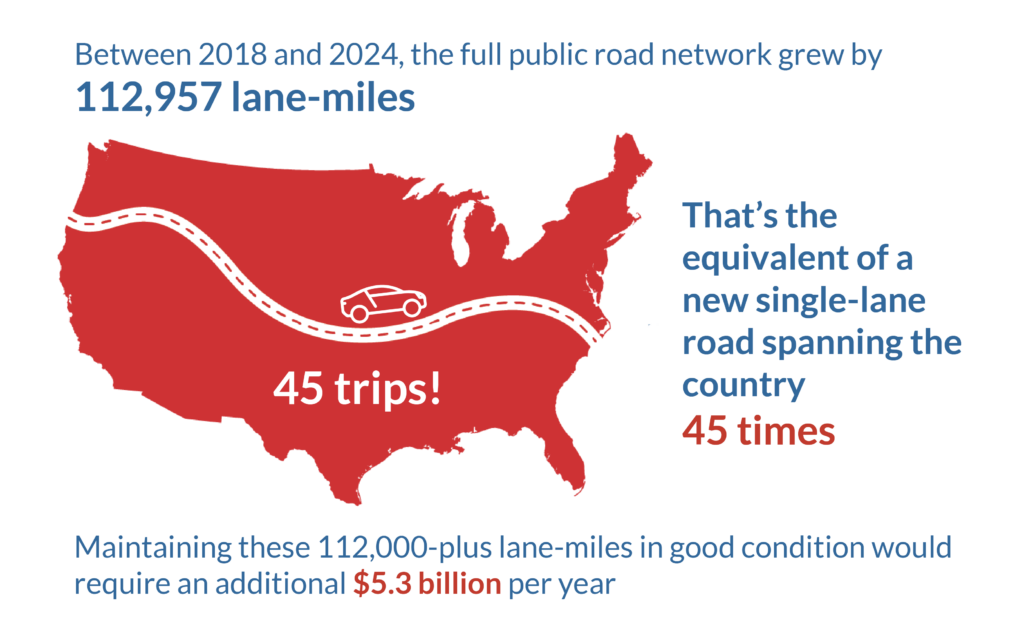
Every new road is not an asset, but a financial obligation that creates new annual costs. The national network of public roads, across all jurisdictions, grew by 112,957 lane-miles between 2018 and 2024. That’s the equivalent of a new single-lane road spanning the country from coast to coast 45 times. Meanwhile, maintaining a single lane-mile of road in a state of good repair costs approximately $47,296 annually in 2024 dollars, based on inflation-adjusted estimates (see Appendix B). Just to preserve the new 112,000-plus lane-miles added during this seven-year period would require an additional $5.3 billion in annual maintenance obligations from states.
Worrying changes in the growth of “other” spending
Some states allocate a substantial share of funding to what we categorize as “other” expenditures, which include the FHWA-defined categories of relocation, traffic operations and control systems, safety, engineering, and environmental enhancements. Between 2018 and 2023, this category of spending grew to a sizable share of some states’ overall transportation spending. For instance, “other” expenditures made up nearly 41 percent of Washington State’s expenditures between 2018 and 2024.
These investments could signal a shift in spending to achieve better safety outcomes, but the growth in this category also points to a worsening problem with data transparency and accountability. What kinds of projects are these programs actually funding, and are these existing categories sufficient to describe the types of complex project improvements, like complete street rehabilitations, that are becoming more common in some DOTs? The fact that the taxpaying public doesn’t have an easy way to decipher this spending data—representing billions of dollars—is an enormous red flag for the already low levels of accountability in this program.
An urban problem: We aren’t spending enough on repair in the places where most Americans live
States are spending slightly more on repair for roads in urban areas than in rural areas, about $19 billion annually in urban areas compared to roughly $17.6 billion in rural areas. Yet conditions remain significantly worse in urban areas, where heavier traffic, more wear and tear, and higher per-lane-mile costs make upkeep more expensive.
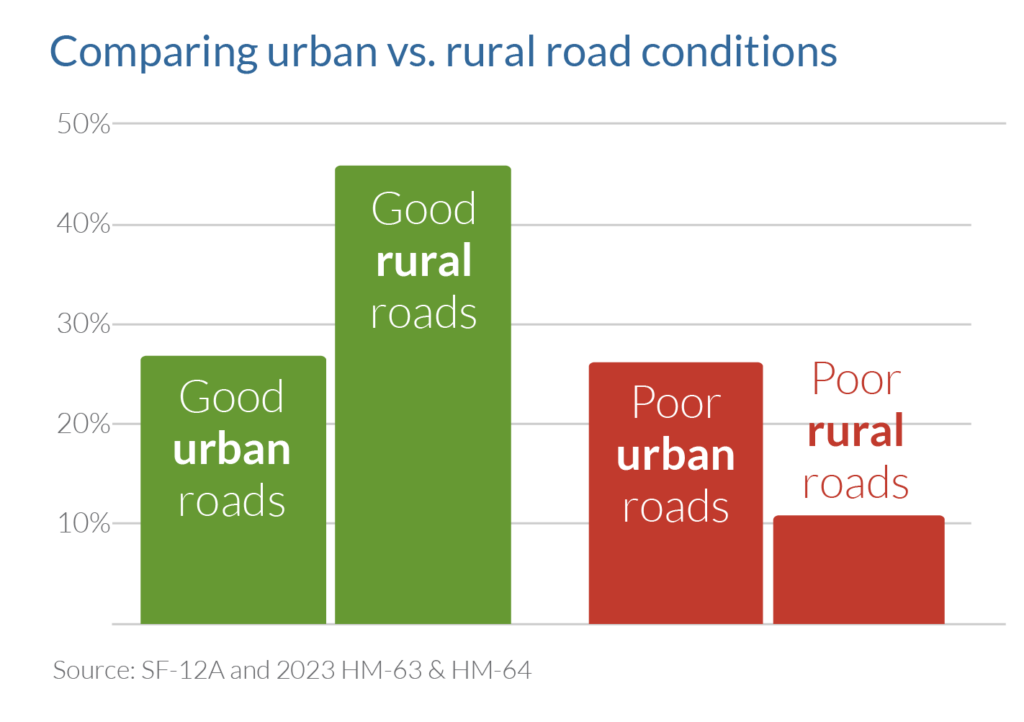
Data from 2023 shows that 26 percent of urban roads are in poor condition, while 27 percent are in good condition. By contrast, 11 percent of rural roads are in poor condition, and 46 percent are in good condition.
Urban areas are home to roughly 80 percent of the nation’s population, which rely on these busy roadways to reliably get to the places they need to go. The combination of higher population exposure, impact, and repair costs suggests that urban roads should require a larger share of repair investment than they currently receive for their upkeep, but our current spending priorities ignore that reality.
Because urban areas are typically more congested than rural areas, it can lead many state DOTs into the endless cycle of attempting to “fix” that congestion by expanding and widening their roadways. Not only does this incredibly costly strategy always fail to improve congestion long term, it actually creates more traffic—a concept known as induced demand—and too often comes at the expense of prioritizing basic repair and maintenance of the roads they already have.
Incomplete reporting of roadway conditions
A significant challenge in assessing roadway conditions nationwide is incomplete reporting. Based on 2024 data, 9.8 percent of federal-aid lane-miles nationwide have no reported pavement condition information. This is the result of a problem that has worsened over time: Only percent of roads nationwide were left unreported in both 2009 and 2017. Reporting gaps also vary widely across states. Some states, including Indiana, Maryland, and Kansas, have reported on nearly all of their road conditions. In contrast, other states have far higher shares of unreported conditions. Iowa, Massachusetts, and Indiana have the largest reporting gaps, with more than half of reported federal-aid eligible lane-miles lacking condition data.
These gaps in reporting make it difficult to track whether conditions are improving or deteriorating, and reduce public transparency on how federal transportation dollars are being spent. In states with very high rates of unreported conditions, rankings of road conditions may not fully reflect the true condition of the road network, emphasizing the need for more complete and consistent data collection.