FY 26 INFRA awards are another reminder that our federal transportation program centers roadway expansion
Data analysis for this piece was provided by Research Manager Joseph Womble.
Despite overwhelming evidence that roadway expansion does not solve traffic congestion, federal grant programs continue to prioritize roadway expansion over maintaining existing infrastructure. Time and time again, the Trump-Duffy Department of Transportation has exacerbated this issue. Their recent announcement of $426 million in Infrastructure for Rebuilding America (INFRA) grants is just the latest example.
To start the federal fiscal year, Department of Transportation officials recently announced that they’re investing more than $426 million to “eliminate [transportation] bottlenecks and congested highways” through the Fiscal Year 2026 INFRA program. Although these funds are supposedly for large projects that generate economic, mobility, or safety benefits, a closer inspection suggests the current administration is using these terms as code words to cover “roadway expansion projects” that won’t meet any of its stated goals.
Finally: Another program for roadway expansion
The 2015 FAST Act established the Nationally Significant Freight and Highway Projects program to provide the billions of dollars in financial assistance needed to support highway, bridge, freight, and highway rail-grade crossing projects. But even though the FY 26 INFRA Notice of Funding Opportunity proposes selecting projects that invest in high-quality infrastructure, modernize aging assets, expand system capacity, and strengthen economic competitiveness, an awarded project cannot—in classic Trump administration fashion—limit existing roadway capacity or reduce the level of service.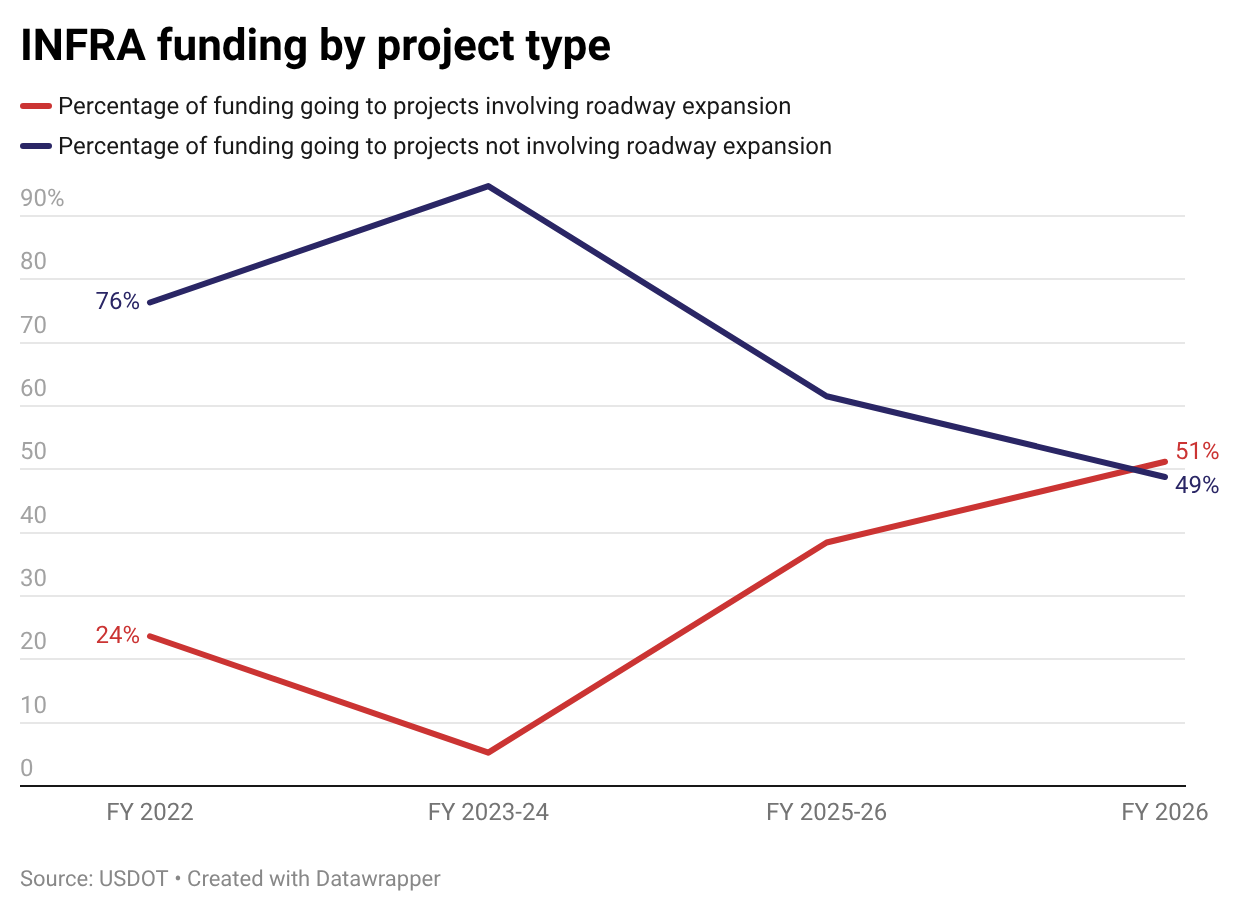
Unsurprisingly, given this project criteria, FY 26 INFRA grants prioritize roadway expansion projects more than any other year since the Infrastructure Investment and Jobs Act (IIJA).
A program that says it prioritizes safety, state of repair, and mobility outcomes seems like it should be a slam dunk for Transportation for America. However, INFRA highlights the silent truth: It’s easier to get money from the federal transportation program to lay more asphalt or add a lane than to invest in long-term maintenance or real safety outcomes. It also highlights how easy it is for everyone working in state departments of transportation to freight railroad companies to claim they care about outcomes. But in reality, there is no accountability for those outcomes because there is no plan to measure or evaluate them.
A system stacked against road repairs
Meet the I-4 North Capacity Improvements, an awarded FY 26 INFRA project that would add one general travel lane along twenty miles of I-4 in Florida to relieve bottleneck congestion. Expansion is a tried-and-tested approach that’s continued to fail in Florida. For example, when the state expanded I-75 from four to six lanes between Naples and Fort Myers, traffic doubled. And when traffic doubled, officials wanted to expand it again. Money meets a multi-million-dollar rabbit hole.
In our analysis of awarded FY 26 INFRA projects, we found that more than half of the total awarded funding went to roadway expansion projects, largely to “address congestion” and bottlenecks. We also found that state of repair was the smallest awarded category, which is a bad look for a program that claims to modernize existing assets. Previous rounds of INFRA projects allocated significantly more funding to projects that provided multimodal accommodations, expanded truck parking, and improved state of repair.
We’ve spent years calling attention to our concerns about roadway expansion as a way to address congestion: it doesn’t work. In Congestion Con, we found that although the U.S. added 30,511 new freeway lane-miles of road in the largest 100 urbanized areas between 1993 and 2017, delay increased in those urbanized areas by a staggering 144 percent. This happens because of induced demand.
The problem is not that traffic engineers don’t believe in induced demand (or, at least we’d hope). The problem is that it’s hard to get funding for a large construction project that doesn’t involve adding an extra lane. Do you need to resurface your road? Implement structural repairs? It’ll probably be easier to fund those improvements alongside adding an extra lane than it is to find any federal funding set aside to repair your roadway.
You get a roadway expansion project! (If you voted for us)
We also found that awarded projects in FY 26 are sharply skewed toward states that voted for the Trump administration. Our analysis shows this pattern more clearly now than in any previous year. 
Meet the State Route 71 Gap Closure project, one of the three projects awarded to a state that voted for Kamala Harris in 2024. This project will expand the current four-lane expressway between Interstate 10 and Mission Boulevard in California to an eight-lane freeway, adding one high-occupancy vehicle (HOV) lane and one mixed-flow lane to the existing two mixed-flow lanes in each direction for approximately two miles. Los Angeles County officials argue the project will deliver direct safety benefits by converting the congested four-lane expressway into a freeway. We’ll see how those benefits pencil out.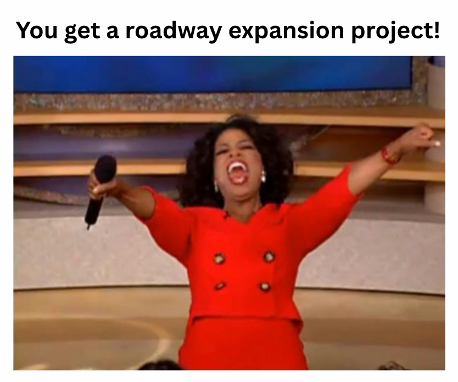
This is our concern with claiming a program delivers safety outcomes that it doesn’t measure while building a system that supports the opposite outcome. If we wanted a federal transportation program that truly prioritized the state of repair and safety, we would measure the impact of such projects on repair and safety. Instead, USDOT funded another roadway expansion project, seemingly implying that reducing congestion is a safety improvement.
FY 26 INFRA awards are a small issue representative of a big problem
The issues with INFRA are notable, but not unique to this grant program or to the Trump administration. The current USDOT has only exacerbated a problem that has existed since the creation of our federal transportation program. Instead of focusing on outcomes, we focus on how much we spend and on what. We get worse roads because we prioritize bad projects that are “cost-effective” to build, and we’ve built them so often that we could do it with our eyes closed.
If we truly want a program that improves the state of repair, safety, or even freight bottlenecks, Congress needs to rethink the very structure and purpose of our transportation program. Getting a better transportation system requires a better surface transportation reauthorization bill that bucks the status quo, which has failed to deliver what Congress has promised for decades.