Transportation For America » ray lahood

Distracted driving hits the mainstream: Oprah dives in deep

January 19, 2010
By Stephen Lee Davis

In a show that was overwhelmingly informative, shocking and sobering, Oprah Winfrey focused her top-rated talk show yesterday on the epidemic of distracted driving and the preventable injuries and fatalities caused each and every year. Secretary Ray LaHood for one, appreciated the focus on an issue that he’s spent his first year trying to elevate in our national consciousness.

It is fitting that The Oprah Winfrey Show chose the Martin Luther King Day of Service to air its program on distracted driving. Spreading awareness about this deadly epidemic is a huge contribution to the safety of millions of Americans. For that public service, I enthusiastically thank Oprah. And I encourage everyone who didn’t see the show to visit Oprah’s website where you can watch segments of the show, read the transcript, and SIGN THE PLEDGE! Oprah’s online pledge draws a line in the sand that says, “NO! We will not do this anymore.”

The most heart-wrenching part of the show was the “after the show” feature that had relatives of those killed in distracted driving accidents share the names of their loved ones and tell their stories. The first two families to tell their story had relatives killed while walking and biking, respectively.

Is it just me, or does it seem like this show could represent a bit of a tipping point for this issue? Then again, many of the automakers spent the recent Detroit Auto Show rolling out new (dangerous) ways to use phones and the internet while behind the wheel.

What do you think?

Bookmark and Share

Feds announce change to consider livability in funding transit projects

January 13, 2010
By Stephen Lee Davis

TriMet MAX on the Transit Mall Originally uploaded by paulkimo90
From the Transportation for America Flickr group.

Following through on a policy change hinted at for much of 2009, Transportation Secretary Ray LaHood announced this morning that federal transit officials would begin considering expanded criteria as they select which transit projects to fund, bringing a new focus on improving livability and sustainability.

At the Transportation Research Board’s annual conference this morning, Secretary LaHood made it clear that a wider range of positive benefits would be considered in the application process for new transit lines or systems. These applications were being unfairly burdened by the previous administration’s cost-effectiveness measurement, which left out such benefits as energy efficiency, economic development and reduced emissions.

“Our new policy for selecting major transit projects will work to promote livability rather than hinder it,” he said. “We want to base our decisions on how much transit helps the environment, how much it improves development opportunities and how it makes our communities better places to live.”

Of course, the one problem that this will not fix is the very high demand for a limited supply of New Starts funding. Even under the old narrow rules for winning approval, only a small percentage of the many applicants were receiving limited funding, and even then, the federal government was only matching about half of local funds, compared with at least 80 percent for road projects.

Still, this change is keeping in line with the positive reforms contained in Chairman Jim Oberstar’s draft reauthorization bill released back in the summer. In June, we quoted the bill’s section on New Starts reform, noting that the proposal to remove the cost-effectiveness requirement and include other “livability” criteria “equalizes the treatment of proposed transit projects and elevates the importance of the benefits that will occur in the community once the project is built.”

The Obama administration and all the leaders at USDOT and the Federal Transit Administration are to be praised for their leadership in changing this program for the better. The next step is securing a greater share of funds for public transportation in the upcoming reauthorization and improving federal match rates to equalize the choices state or regional leaders face between new highways and new transit lines.

Update: Chairman Oberstar responded with a statement of his own praising the change, also observing that New Starts needs greater funding to meet the overwhelming demand. ”Now we need increased investment dollars to follow this reform, so that we can move forward with transit projects that relieve congestion, reduce emissions, increase our energy independence, and promote more livable communities across the country,” he said. (From Elana Schor’s post on Streetsblog Capitol Hill)

Bookmark and Share

Secretary LaHood takes on Senator Coburn’s “stimulus waste”

December 10, 2009
By Sean Barry

Transportation Secretary Ray LaHood didn’t pull any punches in a blog post yesterday about one senator’s “stimulus waste” list.

Senator Tom Coburn is a persistent critic of transportation “enhancements” and the author of a failed amendment earlier this year to strip bicycle and pedestrian projects from a spending bill. His latest waste list includes two bike paths. Coburn told the Washington Times, “When we run $1.4 trillion deficits, the money we spend ought to be a high priority for the American people as a whole.” To which LaHood retorts: “What he really means is that, because he doesn’t get bikes, no one else does either.”

LaHood goes on to cite an American Recovery and Reinvestment Act project extending a bike trail between downtown Minneapolis and the new Minnesota Twins stadium.

“I guess a better connection to Minneapolis’s central business district doesn’t count as infrastructure to some folks,” the secretary wrote. In fact, projects aimed at improving biking, walking and livability are central to both economic recovery, livability and future prosperity.

“We don’t call that waste,” LaHood concluded. “We call it progress.”

Bookmark and Share

56 million people in rural America looking for better transportation solutions

July 17, 2009
By Lilly Shoup

Ray LaHood on a trainA top priority in the transportation debate is addressing the mobility needs of the 56 million residents of rural areas and small towns in America – about 20 percent of the population of the United States. Rural areas and small towns often fall through the cracks of federal transportation policy, which focuses on statewide priorities for building new highways and often overlooks local needs and preferences.

Access to jobs, schools, shopping, and critical community services is just as vital for Americans living in small cities, towns and rural communities. Transportation for America has been working closely with our coalition partners on this important issue for some time. Now, it looks like Secretary of Transportation Ray LaHood is also getting on board.

Listening to folks at the La Crosse Interstate Fair in Wisconsin this week, he heard many of the same things that we already know:

  • It’s getting harder financially to depend on a truck or car for all of a family’s transportation needs.
  • Rural residents need public transportation just like city-dwellers do.
  • Access to commercial air service is increasingly difficult for rural areas.
  • Shippers of grain and other products need better freight options to get rurally produced goods to markets.

Clearly, the transportation system in rural areas and small towns faces challenges and demands that are unique from those in our metropolitan areas. Small cities and towns have higher concentrations of older Americans and families in poverty who would absolutely benefit from more affordable transportation options, beyond just driving. In addition, children in rural areas are 25 percent more likely to be overweight or obese than those in urban areas and face unique barriers to being active and maintaining a healthy weight. Non-metro areas have a larger share of people over age 65 (15 percent) than the country as a whole (12 percent) particularly across the middle of the country. (According to 2004 numbers.)

These challenges are amplified by global changes in the economic marketplace, insufficient funding to maintain substandard or unpaved roads, improve public transportation services, and upgrade or replace substandard and deteriorating bridges.

Our nation’s transportation infrastructure should provide access for all Americans, regardless of their geographic location, age, income, or disability status. While there are no easy answers here, Secretary LaHood’s comments are a good starting point for reframing the debate towards policy options that benefit all Americans, regardless of geography.

Bookmark and Share

T4 thanks Oregon’s leaders for helping green jobs find a home
July 1, 2009
By Stephen Lee Davis

Over the last 60 years when streetcar tracks were torn up and the streetcar companies were consolidated into bus companies or forced out of business, we lost more than just convenient public transportation in our cities. We also lost an industry that created jobs and supported industry across the country. Take a ride in almost any city running a modern streetcar or light rail system, and you’ll almost certainly be riding in a foreign-made product.

Because most railcars are almost entirely produced overseas, other countries have been enjoying the economic benefits of America’s booming transit ridership with new light rail and streetcar lines opening from coast to coast.

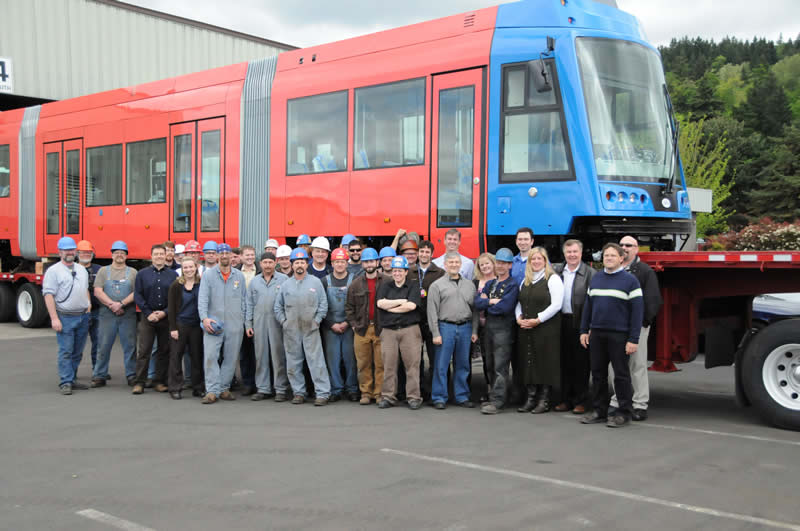
That began to change today in Portland, as the first American-made streetcar in almost 60 years was unveiled to the public. The streetcars are made by United Streetcar LLC and their parent company, Oregon Iron Works. The new streetcar, which cost $2.9 million and was responsible for creating 90 jobs, according to the Portland Mercury, was unveiled in a special ceremony today with transportation secretary Ray LaHood. Updated: Here’s the post summing up the visit on LaHood’s blog.

To let everyone in Oregon know how significant Transportation for America thinks this event is, we took out an ad in The Oregonian today to congratulate Portland and their congressmen for making an investment in clean, green jobs in Portland that will pay huge dividends for years to come for Portland and the state of Oregon.

T4 Oregonian Ad

The good news is that it wasn’t just one streetcar. Oregon Iron Works has an order for six more for Portland, and a $26 million order from Tuscon, Arizona. (below, Oregon Iron Works workers pose with an American-made streetcar. Photo from their site)

Oregon Iron Works Streetcar

The Infrastructurist muses on the potential for this Oregon company to lead the way and revive an old industry for the U.S:

If our Spidey sense is right – as, well, it usually is – this company and Oregon have seized an incredibly valuable first-mover advantage in what could prove to be an important domestic industry in years to come. After American cities tore up streetcar tracks and junked their rolling stock en masse in the middle of last century, dozens of [them] are now planning or considering a new system. With oil at $70 a barrel in the depths of brutal global recession, our guess is that number will only grow in the years ahead.

So how about we bring these clean, green jobs home to the USA? Having American companies meeting the demand for new public transportation railcars equals good jobs and a useful product that can help us reduce our dependence on oil, cut emissions, and get us where we need to go quickly and efficiently. What’s not to like?

Bookmark and Share

Administration releases their principles for an 18-month transportation bill

July 1, 2009
By Stephen Lee Davis

When DOT Secretary LaHood was on Capitol Hill a few weeks ago discussing the Obama Administration’s plan for a transitional transportation bill, he mentioned that their plan for an 18-month extension would “enact critical reforms” while stopping short of a fundamental overhaul of the program — leaving that for the full six-year bill.

A lot of transportation advocates were left wondering what sort of reforms the administration would propose. Today we got a first look at their general proposal (via Transportation Weekly.)  Update: Elana Schor @ Streetsblog has the details on the National Infrastructure Bank.

As you may remember, Chairman James Oberstar and his House Transportation and Infrastructure Committee are at odds over the timing of the authorization bill. Oberstar and company want to pass a full six-year authorization bill by September, while the Administration favors an 18-month transitional bill to patch the soon-to-be insolvent Highway Trust Fund.

At the forefront of the administration proposal is a $20 billion transfer from the general fund to keep the Highway and Mass Transit Accounts in the Highway Trust Fund from going bankrupt, keeping them solvent until March 2011. They propose to return the money to the general fund over 10 years.

In a section titled “Downpayment on Reform,” the administration outlines three proposals, including $310 million to help states and metropolitan planning organizations (MPOs) voluntarily improve their project evaluation process, helping them choose worthy projects based on data , preparing them “for improved accountability standards and merit criteria in the long-term reauthorization.”

The second proposal would provide $10 million for “USDOT to develop performance goals and establish guidelines for states and localities on project evaluation.” And in language that sounds similar to the stimulus spending, the third proposal aims to improve the transparency and accountability in transportation spending, to “lay the groundwork for further accountability reforms in the long-term reauthorization.”

Lastly is a section on livable communities and improving regional access:

Livability: developing guidelines for community plans and providing funding for approved projects with special emphasis on convenience of transportation options, reductions in travel times, smart growth, preservation of open space, and more integrated responses to land use and transportation needs.

Chairman Oberstar is still opposed to any extension and it’s worth noting that any 18-month proposal would have to pass through his committee in the House. Read the full memo to Congress below.

(Continue Reading)

Bookmark and Share

Today’s Headlines — 05/27/09

May 27, 2009
By Andrew Bielak

  • Not everyone is happy with U.S. Transportation Secretary Ray LaHood’s support for more transportation options and less overall driving. (thenewspaper.com)
  • New York Times columnist Bob Herbert throws his support behind an infrastructure bank to help stimulate the economy.
  • Decline in advertising sales causes more financial pain for New York City’s transit agency. (New York Times)

Bookmark and Share

Daily Headlines — 05/22/09

May 22, 2009
By Andrew Bielak

  • Transportation secretary Ray LaHood responds to criticism from columnist George Will during his appearance at the National Press Club. (Streetsblog)

Bookmark and Share

About Us | Our Partners | Contact Us | For The Media | Become a Partner

Transportation for America
1707 L Street NW Ste. 250
Washington, DC 20036
202-955-5543

Creative Commons License
This site is licensed under a
Creative Commons License
.