
Birth and marriage rates have nothing to do with funding transit
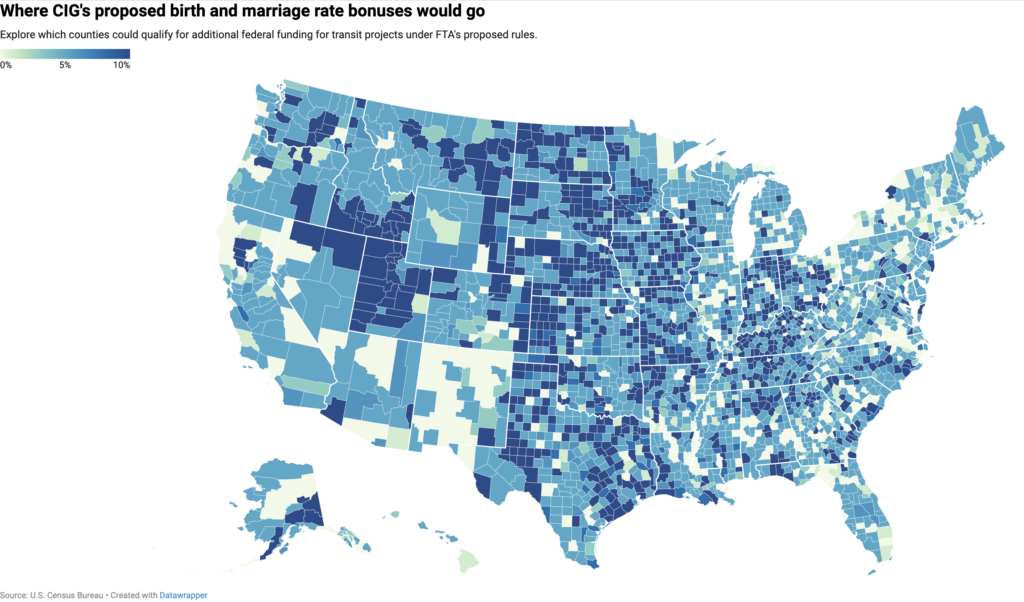
The Trump administration wants to reward transit projects based on local birth and marriage rates, two measures that have nothing to do with whether people will actually ride transit. Meanwhile, projects that have spent years in development could be forced to navigate an entirely new set of rules.
Since returning to office, President Trump and his administration have prioritized encouraging people to have more children. Transportation Secretary Sean Duffy in particular has pushed to increase birth and marriage rates, and now those rates are being considered in how several USDOT programs award funding. The latest is the Federal Transit Administration’s Capital Investment Grant (CIG) program, which has historically been the primary federal funding source for transit improvements and expansions.
On October 1, FTA finally released proposed updated policy guidance for the CIG program. Rather than focusing on building better transit in places where people will actually use it, the proposal is using criteria that have nothing to do with improving transit.
Before we explain why, it’s worth noting that the Trump administration has ground this pipeline of transit projects to a total halt, advancing only one minor transit capital project during its 21 months in office. So we’re talking about an administration supposedly wanting to improve a program it has already brought to a complete standstill. Projects are stuck in the development pipeline with little information about when they might move forward. And projects that were expecting to sign grant agreements months ago—including projects that have already started construction, like Maryland’s Veirs Mill Road “Flash” bus rapid transit project—have been left in limbo. Now, these projects might have to navigate a completely different set of rules in the eleventh hour.
How the marriage and birth rate “bonus” would work
Historically, transit projects funded through CIG have received up to 60 percent of their funding through the federal government, though most receive closer to 40 percent. That means transit projects typically have to secure more than half of their funding from state or local sources, whether through a local sales tax dedicated to transit or a state budget allocation. Highway projects, on the other hand, are typically covered at 80 to 90 percent.
FTA uses metrics such as projected cost-effectiveness, mobility improvements, and environmental benefits to calculate how much federal cost share a transit project should receive. Under the new guidance, after calculating the base rate, FTA “proposes to increase the CIG [federal] percentage share by an additional five percentage points if the average birth rate in the corridor is more than one percent above the national average” and “proposes to apply the same approach to adjust the CIG percentage share based on average marriage rates.”
A corridor that exceeds the national average by more than one percent on both measures would receive up to 10 percentage points more in federal cost share. For example, a project that would otherwise receive 50 percent of the total project cost in federal share could instead receive 60 percent.
FTA is careful to call this a “bonus,” not a penalty. That may be technically true, but new transit projects depend heavily on federal funding, so a higher or lower federal share can could be the difference between a project moving forward and getting shelved. And because CIG also has a fixed pot of money each year, giving more to one community means another will receive less.
These measures are irrelevant to the program’s supposed goals
Birth and marriage rates don’t predict transit ridership.
If FTA wants to maximize ridership on new transit, it could use population projections for surrounding census tracts or various transportation modeling software that already exist. Adding birth and marriage rates to a program where they have no relevance might serve the administration’s agenda, but it does nothing to actually build cost-effective transit that people will use.
FTA’s proposed methods are also unclear and murky. Birth rates are an absolute figure (births per 1,000 women), while marriage rates are defined as the share of adults 15 or older who are married (i.e., a percentage figure). For marriage rates, it’s unclear whether “one percent above or below the national average” means a relative or absolute difference. The marriage rate bonus is calculated using the share of adults who are married rather than the number of marriages that occur per capita, so while some places like Washington, D.C. have a relatively high number of marriages, they do not qualify for that bonus. It is also unclear whether FTA will include all census tracts that intersect with the one-mile buffer of the project corridor or only those fully within it when calculating average birth and marriage rates. These bonuses have clearly not been thought through.
How the bonus could impact actual transit projects in development
To understand the potential impact of the proposed “bonus,” we looked at county-level census data on birth and marriage rates to estimate the size of bonuses that projects in a given county would receive.
FTA’s proposed guidance would only apply to the census tracts within one mile of a project’s actual corridor, not to entire counties, so this analysis does not capture variation within a county. This is particularly relevant for counties with large populations, such as Maricopa County, Arizona.
Two examples show how arbitrary the result can be. In Snohomish County, Washington, both rates are more than one percent above the national average, so the Swift Gold Line Bus Rapid Transit project would likely qualify for an additional 10 percentage points in federal funding. In Orange County, North Carolina, home to Chapel Hill and a major public university, both rates are more than 1 percent below the national average, so the North-South Bus Rapid Transit project would likely not qualify for any additional funding. Orange County’s low rates likely reflect its large university student population, which says nothing about whether people there would ride transit.
The bigger problems with the guidance
The biggest problem with the proposed guidance is that FTA does not plan to grandfather in existing projects. Instead, it would apply the new rules to projects that have already spent years in development under the parameters of the old guidance.
It’s one thing to change the rules for new transit projects trying to enter the federal pipeline today, but it’s astonishing that the FTA would propose moving the goalposts in such a significant way for transit projects that have been in development for years.
In many cases, transit agencies have already identified corridors, local funding has been secured, and thousands of hours of planning have been dedicated to the project under the existing rules. Now, at the eleventh hour, they may have to adapt their projects to an entirely new set of rules. It’s not dissimilar to spending an entire semester studying for an anatomy exam, only to learn days before that the exam will focus on literature. It’s a massive waste of resources and is deeply unfair to transit agencies and future riders who would benefit from these projects.
The lack of grandfathering for projects that have been planning on CIG funding for years is likely to hurt transit projects far more than the birth and marriage bonus will. But the bonuses are still irrelevant to building better transit and shouldn’t be part of the final guidance.