Obama’s 2011 budget gives a lift to livability and transportation
February 2, 2010By Sean Barry
![]() |
President Obama’s Fiscal Year 2011 budget is a step forward for transportation options and livable communities and contains $1 billion in programs and grants to help turn this positive vision into reality.
In this budget, the President and his advisers attempt to thread a needle between the urgency of unemployment and the longer-term implications of debt. Given these realities, it is gratifying that Obama chose to boost funding on transportation and livability as other programs face cuts. It shows that his team gets it. They understand that investing in the neighborhoods and communities of tomorrow can both create jobs and lay the foundation for future prosperity. Indeed, that dual purpose has been a theme of Obama’s domestic agenda throughout 2009.
The administration had signaled a new path last year with its creation of the Partnership for Sustainable Communities, a joint effort among the Environmental Protection Agency, the Department of Housing and Urban Development and the Department of Transportation. The administration recognized that making transportation choices, affordable housing and economic opportunity available to more Americans requires real collaboration among these key agencies. The partnership is on track to receive $830 million in the FY 2011 budget.
The budget also allocates $1 billion for high-speed rail, on top of the $2.5 billion in the current year’s budget and $8 million in grants from the 2009 American Recovery and Reinvestment Act.
Here are few other programs and pilots worth mentioning:
- $4 billion for the National Infrastructure Innovation and Finance Fund
- $150 for the Sustainable Communities Initiative, including an inter-agency research effort on the transportation and housing linkage
- $150 million for Catalytic Investment Competition Grants, a competitive program to support job-creation and large scale projects in disadvantaged areas
- $527 million for the Livable Communities Program
- $32 million for the Healthy Communities Initiative
This is a budget praise-worthy for both the help it delivers today and the investment ushered in for tomorrow. It deserves our support.
President Obama hails high-speed rail as “the infrastructure of tomorrow”
January 28, 2010By John Robert Smith
![]() |
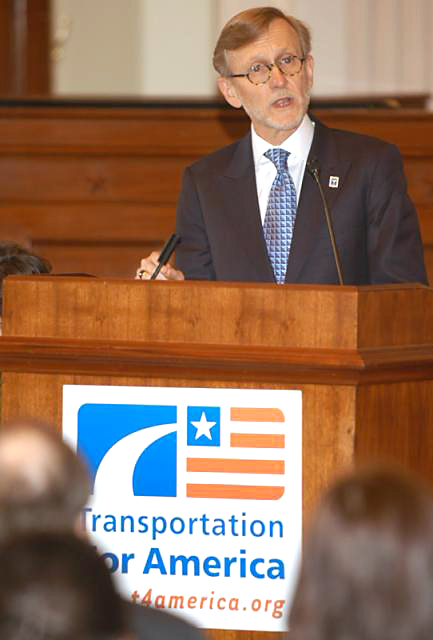
| John Robert Smith is co-chair of the Transportation for America campaign and former mayor of Meridian, Mississippi. |
Hearing President Obama call high-speed rail “the infrastructure of tomorrow” gave me great hope. Very rarely has transportation investment made the final cut in a presidential State of the Union address. The fact that it did make the cut this time really speaks to the president’s commitment to making high-speed rail a reality.
I’ve heard critics say over the years that the U.S. is too big for high-speed rail. China is the biggest country in the world and they built over the Himalayas and are now committing an additional $500 billion over the next 20 years. Saudi Arabia too is investing in high-speed rail in preparation for that certain day when oil reserves will no longer sustain the country. If they can do it, we can do it.
High-speed rail investment is about jobs, and not just temporary jobs, but long-term American jobs that cannot be outsourced. These jobs will employ Americans to build both rail networks and passenger rail equipment. This could be a real lifeline for unemployed automotive workers struggling to get and keep a new job. And these Americans will be going to work building a cleaner environment and more sustainable future for all of our children.
I have seen first-hand what investment in rail infrastructure and transit-oriented development can do to lift a mid-sized city like Meridian, Mississippi. Now there are people living in downtown, there’s entertainment downtown and a conference center has been built. It all started with a public sector investment done right. The vibrancy that returns to smaller communities as a result of rail service has improved the quality of life for millions of Americans. This is not about big city versus small, or urban versus rural. Chicago and Los Angeles will surely benefit from rail investment, but so too will places like Minot, North Dakota and Whitefish, Montana. This addresses the needs of our entire country and should be embraced by our representatives in Washington from all corners.
Of all the issues facing Congress, surely high-speed rail investment can transcend partisanship. As a Republican, I have worked with some the most liberal and conservative members of the United States Senate to protect Amtrak for people who depend on it. I see the potential for similar partnerships today and am heartened that we have a president who is leading the way.
Mayor John Robert Smith is co-chair of the T4 America Campaign, president of Reconnecting America, and former mayor of Meridian, Mississippi.
High speed rail grantees awarded, was your state included?
January 28, 2010By Stephen Lee Davis
As you may have heard by now, President Obama is following up his favorable mention of high speed rail in last night’s State of the Union address with a Tampa event to announce the winners of federal grants for high speed rail service. (In case you missed our official statement about the announcement, read that here.)
The President is due to make his announcement this afternoon, but the list of awardees has already been released. So who were the big winners? Certainly Florida and California, who got the biggest grants, netting $1.25 and $2.3 billion respectively. Although the lion’s share of funding is going toward a handful of corridors, 31 states will receive some portion of funding or benefit from new or improved rail service, according to reporting on the proposal. A few notable bloggers have already done superb analysis of the recipients of the $8 billion, starting with Yonah Freemark’s excellent corridor by corridor breakdown on the Transport Politic:
After months of speculation about which states will get funding from the Federal Railroad Administration to begin construction on new high-speed corridors, the news is in. As has been expected, California, Florida, and Illinois are the big winners, with more than one billion in spending proposed for each. But other states with less visible projects, including Wisconsin, North Carolina, and Washington will also get huge grants and begin offering relatively fast trains on their respective corridors within five years. The distribution of dollars is well thought-out and reasonable: it provides money to regions across the nation and prioritizes states that have made a commitment of their own to a fast train program.
Elana Schor at Streetsblog DC included a quote from Chairman Oberstar, who was certainly delighted at the first small step toward a true nationwide high speed rail network.
House infrastructure committee chairman Jim Oberstar (D-MN) hailed today’s first rail grants as “a transformational moment,” adding: “The development of high-speed rail in the United States is an historic opportunity to create jobs, develop a new domestic manufacturing base, and provide an environmentally-friendly and competitive transportation alternative to the traveling public.”
Information about all the corridors can be found in the White House briefing room online. We hope to post additional reaction and analysis later today or tomorrow.
T4 America: Prioritize Transportation Investments that Keep More People Working in Meeting President’s Call for New Jobs Measure
January 28, 2010By Transportation for America
Comments to Administration praise high-speed rail initiative, offer key principles for success in preserving, creating infrastructure jobs
Responding to his call for a jobs bill aimed at easing the unemployment crisis, the Transportation for America coalition today wrote to President Obama and cabinet members outlining the transportation investments can put the most Americans back to work, quickly.
The coalition, now with more than 400 members, also applauded the President for moving ahead on his vision for a world-class network of intercity rail. “Our coalition members have worked hard to make the case for just such an investment,” said John Robert Smith, co-chair of T4 America, “so the President’s announcement today of progress on 13 corridors is welcome news, indeed.”
The letter outlines key principles for targeting transportation funding to have the most impact in putting Americans back to work while also laying the groundwork for long-term economic prosperity.
First, Congress can save jobs right now and put laid-off public transit workers back on the job by offering emergency assistance to the hundreds of transit agencies across the country that are facing deep cuts in jobs and service in this economic crisis. This will not only keep bus and train operators working, it also will ensure that other Americans can make it to their jobs. Meanwhile, investments should be made in workforce development training opportunities targeted to workers in greatest need, as well as increases in funding for highway and road programs with the highest job growth potential.
Congress also must recognize that repair, maintenance and upgrades of existing roads and transit systems puts more people to work, faster than building new projects.
“It’s a no-brainer that funding needs to be dedicated to those transportation programs already in place – both to reinstate access to jobs, and provide transit workers with employment,” said James Corless, campaign director for T4 America. “It takes zero time and no red-tape for a transit system to rehire workers or find new employees if given the flexibility to spend funding to reopen cut service lines or repair already existing infrastructure.”
T4 America’s proposal also emphasizes the need to distribute investments towards forward-thinking programs that will begin to advance our nation’s transportation network, including high-speed rail and clean public transportation, both of which can also help to reduce dependence on oil. Crucial to truly revolutionizing the national system is to make sure that this jobs bill is short-term for 2010 only, with a commitment to creating a strong, long-term transportation authorization bill that meets our larger transportation needs.
“If President Obama is serious about another jobs bill that will truly impact job creation and spur economic growth, he and Congress need to allocate investments towards maintenance and operating costs for transit agencies across the country, giving them the ability to decide how best to put the money to use,” said Corless.
Transportation for America Praises Boost in High-Speed Rail Funding
December 9, 2009By Stephen Lee Davis
John Robert Smith, co-chair of the Transportation for America campaign and former Amtrak Board Chairman, released the following statement in response to Congress’ allocation of $2.5 billion for high-speed rail:
“We are pleased that the Consolidated Appropriations Committee bill for fiscal year 2010 includes $2.5 billion for high-speed rail. This is an important step forward and will build off the $8 billion previously allocated to high-speed rail in the American Recovery and Reinvestment Act. High-speed rail is a key priority of the Transportation for America campaign and our vision of expanded transit choices, intercity connectedness and less reliance on foreign oil.”
“This $2.5 billion would not be possible without the efforts of Congressman John Olver, a friend of public transportation throughout his 18 years in Congress. We applaud Congressman Olver’s efforts and look forward to our continued partnership.”
Washington lawmakers receive your message on high-speed rail
October 20, 2009By Stephen Lee Davis
Four billion or about one billion for high-speed rail.
That’s the question that a group of representatives in the House and Senate will soon have to answer as they try to reconcile differences in the two chambers’ versions of the yearly transportation appropriations bill. A few weeks ago, the House passed a transportation budget with $4 billion for high-speed rail. Shortly afterward, the Senate passed their version of the yearly spending bill with only $1.2 billion for high-speed rail.
So a group of organizations, including Transportation for America, started rallying support for more funding for high-speed rail. Did you or your organization sign the petition at FourBillion.com urging Congress to keep the $4 billion in the bill?
A few members of the FourBillion.com campaign took that petition with more than 100 organizations and thousands of names to a few Congressional offices last week and hand-delivered the message that now is the time to make a historic investment in rail and kickstart a national investment in fast, clean rail travel that can connect our metro areas.
John Krieger from US PIRG and Danny Plaugher, executive director of Virginians for High Speed Rail visited with Rep. Tom Perriello (VA), Rep. John Olver (MA), Rep. Eric Cantor (VA), and Rep. Debbie Halvorson (IL) to deliver the signatures. The full set of photos are here on our Flickr stream.
![]() |
| FourBillion.com 6 Originally uploaded by Transportation for America |
| House Minority Whip Rep. Eric Cantor (VA), right, meets with John Krieger, left, and Danny Plaugher of Virginians for High Speed Rail as they deliver petition signatures from FourBillion.com to Rep. Cantor supporting the $4 billion for high-speed rail in the House DOT appropriations bill. Photos courtesy of FourBillion.com and US PIRG. |
![]() |
| FourBillion.com 2 Originally uploaded by Transportation for America |
| Rep. John Olver (MA), right, with John Krieger of US PIRG, left, and Danny Plaugher of Virginians for High Speed Rail as they deliver petition signatures to Rep. Olver from FourBillion.com supporting the $4 billion for high-speed rail in the House DOT appropriations bill. Photos courtesy of FourBillion.com and US PIRG. |
You helped save funding for transit, safe walking and biking
September 29, 2009By Stephen Lee Davis
Two weeks ago, we were successful in beating back a handful of dangerous amendments to the yearly transportation budget in the Senate that would have broken federal promises to fund crucial, long-planned public transportation, passenger rail and bike/pedestrian projects.
In less than 48 hours, supporters like yourselves sent more than 10,000 messages to your Senators in opposition of these dangerous amendments. Your quick action was instrumental in letting the Senate know that it’s important we continue funding alternatives to driving that can help us use less oil, cut our emissions, bike and walk safely and reduce the amount of time we spend in congestion each day.
Sen. McCain had a slew of amendments that would have removed previously obligated funds for critical transit projects across the country. Sen. Bond reportedly had an amendment in hand to strip out high-speed rail funding. And Sen. Coburn proposed an amendment that would have removed the requirement that states spend a small fraction of their transportation funds on the kinds of investments that make biking and walking safer and more available.
We thank you all for your speedy action on these amendments. Your voices are regularly being heard on Capitol Hill! Keep it up.
Tell Congress to make a historic investment in high speed rail
September 22, 2009By Stephen Lee Davis
Congress is heading towards a decisive, historic moment on investing in high speed rail for America. But the outcome is far from certain.
In the next few weeks, Congress will decide whether or not to give the Department of Transportation $1.2 billion or $4 billion on high speed rail for the next year. $8 billion was allocated for planning and implementing clean, efficient, high speed train travel in the economic stimulus earlier this year, and with another $4 billion, we’d be making a historic $12 billion investment in high speed rail to help us move into the 21st century, unclog our congested airports and airspace, and provide a new clean, efficient alternative for speedy travel between major metro areas.
Sometime in the next week or two, Congress will decide whether or not to give DOT the amount in the House version of the bill ($4 billion), or the Senate version ($1.2 billion).
Tell Congress to keep $4 billion in the bill at www.fourbillion.com
Transportation for America is partnering with U.S. PIRG, Virginians for High Speed Rail, and the Midwest High Speed Rail Association to send a message to Congress that now is the time to make a historic investment in high speed rail.


Want the wonky details? As you may remember, the Senate passed the bill that funds the Department of Transportation and the Department of Housing and Urban Development last week. The bill that passed last week is what’s known as a (yearly) appropriations bill, where the budget for the department and the programs are finalized and officially given their money by Congress. The House passed their version of the DOT/HUD funding bill several weeks ago, so the differences between the two bills will be ironed out in a conference committee very soon. The House and the Senate will select conferees to reconcile the two versions of the bill, before sending a final bill back to the House and Senate for a last vote and then to President Obama’s desk.
Let’s tell them to send the president a bill with $4 billion for high speed rail.

Post this action on Twitter, or with other tools via the button below.
Help prevent cuts to high-speed rail funding
September 16, 2009By Stephen Lee Davis
UPDATE: Victory! For whatever reason, Sen. Bond decided not to offer his amendment and it will not come to the floor for a vote. Thanks to all of you who took action by writing or calling your Senators.
In the last 24 hours we beat back a dangerous anti-bike/ped amendment from Senator Coburn. Now we hear that Senator Kit Bond of Missouri will make a desperate attempt to cut high-speed rail funding with yet another amendment to the HUD/DOT budget. We need to act fast — the vote is expected today.
We’re watching C-SPAN closely in the T4 America office as the Senate continues deliberating the Transportation and Housing budgets, considering amendments one at a time. The Senate can be a pretty wild place, with amendments popping up unexpectedly and without little notice.
Senate leadership wants to have this budget bill done by the end of the day, so if this amendment reaches the floor, they’ll vote on it today. Take action and tell your Senators to ensure that this vital funding for high speed rail stays intact.
States clamor for high-speed rail stimulus funds as applications pour into DC
July 16, 2009By Stephen Lee Davis
![]() |
| Amtrak Acela 654 Northbound Originally uploaded by Jim Frazier |
When the stimulus passed in February, $8 billion for high-speed rail was added at the 25th hour, at the behest of the Obama administration. In the days since, states have scrambled to prepare their proposals to receive a share of the money, which will be distributed via a process of competitive grants.
When the administration’s blueprint was released in April, President Obama said “high-speed rail is long-overdue, and this plan lets American travelers know that they are not doomed to a future of long lines at the airports or jammed cars on the highways.”
With states competing for their share of the $8 billion to start developing and building high-speed corridors, competition was sure to be tough. As recently as yesterday, we had heard that $93 billion in grant applications were submitted to the Federal Railroad Administration (FRA). Just today, we saw this statement from DOT Secretary LaHood’s office detailing an even higher number: 278 pre-applications for grant funding totaling $102 billion. 40 states and the District of Columbia submitted proposals to get a share of the $8 billion available in the stimulus.
“The response has been tremendous and shows that the country is ready for high-speed rail,” Secretary LaHood said. “It’s time to look beyond our highways and invest in public transportation services like rail, which will enhance regional mobility and reduce our carbon footprint.”
Next up for the DOT and the Federal Railroad Administration is figuring out which of these 278 applications to move forward in the process. The first step will likely be figuring out which proposals best line up with the administration’s already-released blueprint for the 10 national high-speed rail corridors. The first grantees will be announced in the fall, according to the DOT release.