Bay Area bridge shutdown puts transportation network in the spotlight
October 30, 2009By Sean Barry
Even in the San Francisco Bay Area, a renowned transit hub with higher than average rates of walking, biking and transit ridership, more than 280,000 vehicles cross the San Francisco-Oakland Bay Bridge every day. It’s a critical artery connecting downtown San Francisco with the thousands of residents who live in Oakland and the surrounding suburbs.
It is thus understandable that panic ensued after a part snapped off in high winds and fell onto the roadway, resulting in a complete shutdown of the Bay Bridge early Tuesday. Thankfully, though at least two vehicles either ran into or hit the fallen part, no injuries resulted. As of this morning, the bridge remains closed without a date certain for re-opening.
The Bay Bridge was last closed down over Labor Day weekend, during which engineers discovered an unexpected crack. This structural flaw nearly delayed the bridge from reopening on-time, but crews received the needed materials in just enough time for the post-weekend morning commute.
It was one of those last minute repair pieces that broke off Tuesday, although engineers could not say whether the Labor Day rush had anything to do with it. Heavy winds are another potential culprit — hardly an uncommon occurrence in the Bay Area, however.
Once the bridge was closed, the immediate focus shifted to the Wednesday morning commute. Prognosticators were predicting mass chaos and never-ending gridlock as far as the eye could see on Wednesday morning.
Officials with the BART subway system arranged for extra train cars and personnel to accommodate the expected surge in passengers, leading to a record day of ridership that crushed the previous high water mark. Ferry agencies across the Bay ramped up service and Amtrak is providing a shuttle. MUNI, AC Transit, and other local agencies also stepped up rates of service and frequency to meet the demand.
| “When the Bay Bridge closed we saw a 49 percent spike in transit use. Thank goodness we had that transit option there.” |
| - Federal Transit Adminstration Administrator Peter Rogoff today at the Rail~Volution Conference |
Despite similar predictions of chaos and gridlock, commuters, transit agencies and officials effectively coped with the collapse of a major overpass near the Bay Bridge in April 2007. Many drivers quickly developed alternate routes or shifted their schedule, BART was effective at expanding capacity and major thoroughfares were crowded, but not gridlocked.
Media accounts accounts for this week indicate Bay Area officials have handled the shutdown relatively smoothly, especially considering how many vehicles use this bridge every day. BART trains were filled to capacity and the Richmond-San Rafael and San Mateo-Hayward bridges — both adjacent to the Bay Bridge — were jammed with cars but still moving, albeit at a sluggish pace.
As far as we can tell, California Department of Transportation officials have been responsive and responsible about safety and structural integrity. It is important they be given the time to get this right.
But even if the time crunch during Labor Day weekend did not contribute to the problem, it should be cause for concern. In too many transportation projects, safety is shelved in favor of speed and grandeur. Part of the Bay Area’s ability to cope is the investment they’ve made in a variety of transportation options and modes. Which begs the question, how would metropolitan areas that lack these alternatives fare if a similar incident occurred?
Diversity of options isn’t just about cutting emissions or reducing fuel consumption. A complete network is one that can continue functioning when a few parts go down. A city dependent completely on cars and interstates (or 1 or 2 transit lines) is a vulnerable city.
Across America, children, seniors, the disabled and people who do not or cannot drive are at risk due to unsafe streets and crumbling sidewalks. We cannot afford to spend untold billions on new projects if we cannot keep old ones from crumbling. Including strong “fix-it first” language in the transportation bill re-authorization would ensure that existing roads and bridges get the upgrades they need to keep commuters and all users safe.
In addition, the Critical Asset Investment Program proposed in Chairman Oberstar’s transportation bill would create a substantial, dedicated funding stream for maintaining roads and bridges, preventing states from diverting those funds to more political popular highway expansion projects. This program would also require transit agencies to show how they are maintaining their systems and keeping them in “a state of good repair.”
The Bay Area will get through this. But the incident is a reminder that transportation policy cannot be a piecemeal, crisis-to-crisis endeavor.
Bay Area business leaders push the Senate for clean transportation
October 22, 2009By Stephen Lee Davis
![]() |
| Carl Guardino 1 Originally uploaded by Transportation for America |
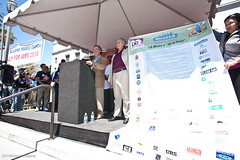
| Carl Guardino, president and CEO of the Silicon Valley Leadership Group, a T4 America partner, addresses a gathering at a recent reception hosted by T4 America that brought together administration officials and supporters. |
An organization representing more than 300 elite Silicon Valley businesses from Apple to Yahoo! sent a letter last week to Senate Environment and Public Works Chairman Barbara Boxer, a California Democrat, urging her to make sure the Senate climate bill adequately invests in clean transportation alternatives to reduce emissions in their region while keeping it mobile and competitive.
The Silicon Valley Leadership Group, made up of mostly tech-focused organizations in Silicon Valley, works to enhance economic competitiveness and maintain a high quality of life for the region. SVLG members employ more than 250,000 people in the Valley and generate more than $1 trillion worth of business each year. (SVLG is a partner of Transportation for America.)
Started in the 1970’s by the founder of Hewlett Packard, they recognize that investments in transit and safe, accessible, walkable neighborhoods are keys to their continued economic success and ability to lure smart and talented workers to the region.
In the letter, president Carl Guardino thanked Chairman Boxer for her leadership on the issue of climate change, and pointed out that California will need to make a large investment in cleaner transportation options if they are going to have any chance of meeting the ambitious reductions proposed in the climate bill:
Transportation represents the fastest growing source of national greenhouse gas emissions (GHG), and the largest single source in California, accounting for 40% of emissions. In Silicon Valley and the Bay Area, that number is higher still – 51% of GHG’s.
House bill, H.R. 2454 (Waxman/Markey), recognizes the importance of reducing transportation emissions by requiring states and metropolitan areas adopt new planning requirements and GHG reduction goals. However, the bill provides virtually no allowances for this purpose. Without adequate funding to address transportation’s increasing contribution to climate change, we will not be able to rise and meet this challenge.
The debate over the Senate’s climate bill is expected to heat up in the next few days as Chairman Boxer’s Senate committee releases the numbers showing where the allocations from the Clean Energy Jobs and American Power Act will be directed.
Transportation for America, our 28,000 supporters and 350+ partners like SVLG have been calling on the Senate to direct 10 percent of the funding to clean transportation alternatives.
The Senate bill will require states and cities to reduce emissions from transportation. Giving them 5-10% of the revenues will give them the tools they need to make investments in clean transportation alternatives, like public transportation and passenger rail, affordable neighborhoods around transit stops and neighborhood projects that increase safety for cyclists and pedestrians.
Click the jump to read through the entire letter from the SVLG.
(Continue Reading)
California Supreme Court hands victory to local transit riders and providers
October 5, 2009By Sean Barry
A recent California Supreme Court decision could restore billions in funding for public transportation in the nation’s most populous state.
The Court’s ruling late last week upheld a lower court decision declaring the state’s $3.6 billion raid of public transit funds illegal and ordered that the money be returned to local transit providers.
Two months ago, Transportation for America released “Stranded at the Station: The Impact of the Financial Crisis in Public Transportation,” illustrating the painful cuts transit systems have sustained at the state and local level. The cuts plateaued as unemployment reached 10 percent and Americans were demanding more transportation options, not less.
It is no secret that California has fallen hard as a result of the recession, but the severity of the cuts to public transportation in California was vastly disproportionate to the rest of the country. The reason for this was no mystery: the State was raiding dedicated transit funds every year in order to alleviate other budgetary shortfalls since 2007.
More than two dozen transit providers throughout the state enacted some combination of fee hikes and service reductions, according to our map of transit cutbacks. BART in the San Francisco Bay Area increased its base fare by 17 percent, and many transit systems in Southern California raised fares as much as 20 percent. The County Connection in suburban Contra Costa reduced its bus lines by 23 percent, and rural areas were hit hard as well. The California Transit Association, or CTA, an affiliation of local transit providers, logged 38 agencies facing cuts of some kind in their own version of our transit cuts map.
Last week’s state Supreme Court’s decision helps explain how things got this bad.
Since 2007, Gov. Arnold Schwarzenegger has successfully diverted $3.6 billion from the state’s transit fund to deficit reduction, prompting a lawsuit from the CTA to get the money back. The CTA argued that the raided funds came from gas tax revenues specifically designated for public transit. By refusing to review a lower-court decision in favor of the association, the high court effectively ruled Schwarzenegger’s raid illegal, ending the seizure of desperately-needed transit funds.
This is a huge victory and vindication for local transit providers. Randy Rentschler, director of the Bay Area Metropolitan Transportation Commission, told the San Francisco Chronicle, “everyone knows that the state’s in a budget crisis, but that crisis also exists in local governments in part because the state has taken transit money away from local entities.”
The case has broader implications for public transportation as well.
In tough budget years, Governor Schwarzenegger and the legislature are constantly looking for places to trim and local governments are an easy target. But money saved is not money earned, as local cuts tend to bite the state later through increased demand for social services and counties being unable to meet the basic needs of their citizens. The decision will hopefully lead to more caution.
Most importantly, California can no longer rob Peter to pay Paul.
But at this point, it remains unclear how much of the original $3.6 billion will be returned to the transit fund, and ultimately, to local providers to preserve vital service for riders. That money is desperately needed, not only because of the millions of Californians who rely on public transportation for their day-to-day mobility, but also because many communities are on the cusp of becoming success stories. Transportation for America’s “Stranded” report profiles how efforts in Sacramento, Orange and Contra Counties have already improved quality of life and relieved congestion, highlighting the need to keep up the support.
Does transportation have an impact on growing health care costs?
July 16, 2009By Stephen Lee Davis
![]() |
| Albuquerque8 Originally uploaded by Transportation for America |
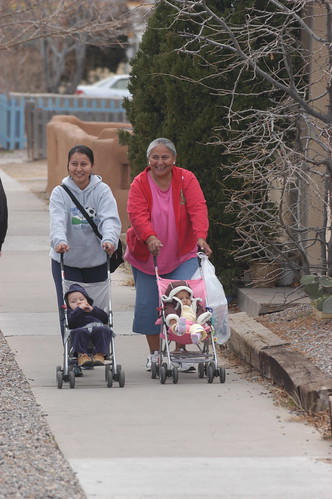
| Streets safe for walking and biking — especially streets that encourage incidental exercise by encouraging walking or biking — can help residents be more healthy, lowering the health care costs associated with obesity and inactivity. |
With Congress directing their attention to the contentious debate over health care reform and how to pay for it, it seems that transportation has been relegated to the back burner. In the meantime, evidence is continuing to mount that transportation investments — what we build and where — have an enormous impact on our health and the financial bottom line of providing health care.
Last week the California Center for Public Health Advocacy (CCPHA) released The Economic Costs of Overweight, Obesity and Physical Inactivity Among California Adults. In a state making national headlines for its current budget crisis, the study found that (in 2006) “overweight, obesity and physical inactivity cost the state $41.2 billion – $21.0 billion for overweight and obesity, and $20.2 billion for physical inactivity.”
An even more shocking recent study found that the already-dangerous effects of air pollution are magnified for pregnant women living near busy roads.
According to this study from a team of researchers from the University of California, Irvine, exposure to traffic-generated air pollution during pregnancy increases the risk of preeclampsia and premature birth. The study examined over 80,000 birth records and found that the risk of the life-threatening condition preeclampsia increased 33% and the risk of premature birth rose 128% in women living closest to congested corridors.
Many other negative health effects from vehicle emissions, congestion and air pollution have already been documented — with low-income and minority populations typically experiencing the most harmful side effects due to where interstates and highways get built.
The CCPHA report on obesity included some concrete policy recommendations for improving public health, a few of which are connected to our transportation spending decisions.
- Locate residential, commercial and office buildings close together so more residents can walk and bike to meet their daily needs
- Build neighborhoods with safe and attractive parks and other places for recreational exercise
- Create transportation corridors that support pedestrians and bicyclists
Including some realistic goals for improving public health in the transportation bill — one of T4 America’s six national transportation objectives for the bill — would be a great place to start. If we’re ever going to truly move away from a prescriptive health care model to a preventative model — saving us billions in health care costs — we’re going to have to address more than just the skyrocketing costs of treating illnesses and diseases — we’re going to have to look upstream and address some of the contributing factors.
Doing so could keep us healthier and save us billions.
With research from Becca Homa
Today’s Headlines — 06/15/09
June 15, 2009By Andrew Bielak
- New York Times takes an in-depth look at California’s complex plan for high-speed rail…
- …And talks to DOT Secretary Ray LaHood about helping Americans drive less and creating livable communities.
- Domestic and international flights dropped by 9.1 percent from March 2008 to March 2009. (Streetsblog SF)
- Officials in Los Angeles County consider implementing congestion pricing to manage traffic and pay for transportation projects. (Los Angeles Times)
Today’s Headlines — 06/11/09
June 11, 2009By Andrew Bielak
- The connections between the climate bill and federal transportation legislation are becoming clearer. (Greenwire via New York Times)
- Budget shortfalls force Michigan to cancel $740 million in roadwork. (Detroit News)
- San Francisco looks to increase parking fees, tolls, and tickets to better reflect the real cost of driving. (San Francisco Examiner)
- Senator Orrin Hatch has a close call with a pedestrian while driving around the Washington.
Daily Headlines — 05/22/09
May 22, 2009By Andrew Bielak
- Transportation secretary Ray LaHood responds to criticism from columnist George Will during his appearance at the National Press Club. (Streetsblog)
- Community opposition kills a planned highway expansion in Los Angeles. (Los Angeles Times)
- The American Lung Association looks at the country’s most polluted cities. (City Mayors)
The importance of a complete transportation system
May 6, 2009By Stephen Lee Davis
![]() |
| Glennis and the 20 Bus Originally uploaded by Transportation for America |
This story is told by Transportation for America organizer Will Handsfield, from a recent trip to California for a town hall meeting.
After leaving the 21st Century Transportation for Los Angeles conference, I headed over to the Normandie Metro Rapid stop to pick up the 720 bus.
This is where I met Glennis.
Glennis was expected at work at 7:00. It was 6:25, and she had been waiting at the stop for 30 minutes when I showed up. Glennis told me that once she got off at Santa Monica Blvd, she would still have about one mile to walk to get to her job. Her chances of getting there on time were looking pretty slim at that moment, and I could see the worry mounting on her face.
Not everyone has a car to drive, and plenty of people choose not to drive for many different reasons. Millions of Americans just like Glennis rely on public transportation every day to get to their jobs, and thus to support themselves. If the buses are late (in this case, the rapid is supposed to show up every 3-8 minutes during rush hour), it threatens the job security of hard working people like Glennis.
One of the people I spoke to at Google two weeks ago put it succinctly, “you should have to know the transit routes, but never their schedules” — essentially saying that infrequent transit represents a poor system. The Rapid bus is supposed to solve this by coming frequently, but for whatever reason, today it didn’t.
I waited for another 16 minutes with Glennis, and waffled with her on deciding whether or not to settle for the slower number 20 bus (pictured), despite the fact it makes many more stops. We stuck it out and a bus headed to Westwood finally arrived, and I said farewell.
When she left, she had another 19 minutes to get to work, with at least 10 minutes more of bus riding. I hope Glennis was able to walk that mile in the 9 minutes left.
For Glennis’ sake — and for everyone else waiting for the bus or stuck in endless traffic — we need to do better on providing a safe, efficient, complete transportation system with options for everyone.
Backers push bullet-train measure as a dramatic change in California transportation
October 16, 2008By Andrew Bielak
A measure set to appear on California’s November 4 ballot could pave the way for the construction of a high-speed rail line — and help to link the state’s big cities, foster job growth, and attack climate change and oil dependence. (Eric Bailey — Los Angeles Times)
Metro ridership remains strong as gas prices fall
October 16, 2008By Andrew Bielak
Despite a steep drop in gas prices over the past couple months, ridership on the Los Angeles Metro has remained at record levels. (Los Angeles Times — Steve Hymon)